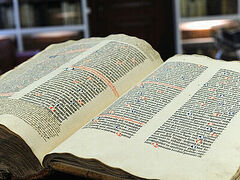
It is no secret that one of the duties of every Orthodox Christian is to periodically read the Gospel in particular and the Holy Scriptures in general. The Bible is called “the Holy Scriptures,” “the Word of God,” or “Divine Revelation” for a reason. It is the Book of Books because it surpasses all others in its importance. Historically, the Bible was the first real book to be translated into many languages, the first to be printed, and eventually the first to gain worldwide significance.
What makes it so different from all the other books?
First and foremost, the Holy Scriptures are the great source of Christianity. It is from them that over the centuries theologians have drawn inspiration to bring the basics of faith to us. They believed that all the necessary elements of truth could only be found in the Bible. However, the Orthodox Church sees the source of Christianity not only in the written Word of God, but also in oral Tradition. This idea is not new, since in ancient times these two concepts were always inseparable. Tradition and Scripture do not exist separately.
The Bible is a part of Tradition, its core. Without the living tradition of the Church, which preserves and transmits this experience, the Bible would be incomprehensible. All aspects of Church life—the sacraments, the services, moral principles, theology, views of the past and the future—are inextricably linked with the spirit of Tradition and the Holy Scriptures.
In the Orthodox understanding, the Bible and Tradition are not two separate elements that need to be united. The point is that the Bible must remain in its natural environment—the context that gave rise to it. This environment is Tradition.
The Bible is not only a text, but also a Spirit that always enlivens by its reading. That is why the Word that was once given to people living in the flesh remains living and active in the Church—the living Body of the Word of God. And the Word was made flesh, and dwelt among us, and we beheld His glory, the glory as of the only begotten of the Father, full of grace and truth… And of His fulness have all we received, and grace for grace (Jn. 1:14, 16).
The Holy Scriptures are more than just a book. They are not a text that God literally “dictated.” The Bible reflects the characters and talents of its authors, as well as the specifics of their age. However, they all had a profound experience of God’s presence and strove to convey this mystery in words available to them.
The earthly, human side of the Bible does not contradict its Divinely inspired nature. On the contrary, it makes it especially precious to us, because Scripture becomes a point of intersection between the Divine and the human. This also protects us against “the worship of the letter,” which is typical for some Protestant groups.
As St. John Chrysostom put it, the Divine and human nature of the Holy Scriptures clearly shows us the power of the Spirit, which convinces people to stick to the main thing and not be confused by insignificant disagreements. Therefore, the basis of Christianity is not abstract doctrine, but faith in the Living God incarnate in the Person of the God-Man. This is exactly what the Word of God testifies to. The Lord’s words: Search the Scriptures; for in them ye think ye have eternal life: and they are they which testify of Me (Jn. 5:39), are not only a call to people who lived 2,000 years ago, but also to all who read the Bible, and to Christians in particular.
St. Cyril of Alexandria taught that diligent study of the mystery of Christ grants us eternal life and leads us to virtue. When studying the Scriptures, we must keep in mind the main objective: not just to gain new knowledge, but to put it into practice. The meaning of Divine Revelation is in the words: But these are written, that ye might believe that Jesus is the Christ, the Son of God; and that believing ye might have life through His name (Jn. 20:31).
You can know life only through life itself. In other words, the practical application of the Scriptures builds up our relationship with God. We learn from the Bible about Christian life and find the basis for deep faith, because, So then faith cometh by hearing, and hearing by the Word of God (Rom. 10:17).
The following example from monastic life is an excellent illustration of this principle. A young monk came to an elder and asked him, “Give me a word so that I can live.” The elder answered very briefly, but thanks to his personal experience and grace, these few words were enough for the monk to live by them and overcome difficulties.
This is how the Bible should be understood and preached. As Christ said, If ye know these things, happy are ye if ye do them (Jn. 13:17). Therefore, speaking about the influence of the Holy Scriptures, we must remember that what matters is not abstract knowledge, but action.
What practical advice can be given to ordinary believers in the study of the Scriptures?
We will consider how the Holy Scriptures influence the spiritual life of Christians, based on the sermons of the ever-memorable Metropolitan Anthony (Bloom) of Sourozh. The whole life of this archpastor was devoted to the Word of God: not only did he read it and reflect on it, but he also helped the faithful comprehend it. Therefore, his thoughts are especially relevant in this matter.
Having become a mature theologian, Metropolitan Anthony shared advice on how to perceive the Holy Scriptures properly. Vladyka advised not to read the Gospel for the sake of abstract knowledge, but in order to find the places that touch your soul and give you strength.
Metropolitan Anthony believed that such lines help us see the beauty of Christ and understand what a true Christian should become. “My advice is as follows: as you read the Gospel, mark the places that make your heart warm and your mind clearer, where your will is suddenly enlivened, and a certain power flows into you; the places about which you could say, “How beautiful it is, how true it is!” And know that these passages tell you that by something, however small, you already resemble the person you should become, because you already see the beauty of the true man in Christ” (From: In the Name of the Father, and of the Son, and of the Holy Spirit: Sermons).
 Metropolitan Anthony advised us to choose the excepts that “move us,” that “strike us in the heart” and “set our hearts aflame,” like the heart of him on the road to Emmaus.
The most important thing in working with Scripture is to comprehend its true meaning. This is not easy, because along with the easy-to-understand texts, there are also those where the formulations refer to both simple human experience and deep religious experience. And some things cannot be understood properly at all without relying on Church teachings.
Metropolitan Anthony emphasized that, despite all the social and cultural changes, the Church has remained unchanged in its inner experience since the very beginning. That is why it can always give the right interpretation. “So, after a preliminary perception in our own modern language, we must turn to what the Church understands by this word; only then can we be sure of the meaning of this text and have the right to start thinking and drawing conclusions” (Prayer and Life).
In Orthodoxy, Scripture is not considered apart from Church Tradition. On the contrary, it grew out of Tradition and is an integral part of it. Tradition refers to the entire experience of the Church, from the Old Testament to the present day. Therefore, the main principle of interpretation is that Scripture should not be interpreted arbitrarily, but in the context of Tradition.
For the Fathers of the early Church, the Holy Scriptures were not a mere object of academic research, but a subject of prayerful meditation. Excerpts from Scripture were read at churches and explained right there by the pastors. This is how the famous homilies by Sts. Basil the Great, John Chrysostom, Cyril of Alexandria and others came into being.
The Meaning of the Holy Scriptures
The Holy Scriptures, or the Bible, are the Book of Books and the main source of Christianity. In Orthodoxy, they are inextricably linked with Church Tradition, which encompasses the entire spiritual experience of the Church. Scripture is not just a text, but the living Word of God, which remains active thanks to the Holy Spirit abiding in the Church. It has the Divine and human nature at once: it reflects both the human traits of the authors and Divine inspiration. The main purpose of studying the Scriptures is not just to gain knowledge, but to put it into practice in order to build up a personal relationship with God and acquire faith.
Practical Tips for Reading the Bible
To make reading the Holy Scriptures truly beneficial, you can follow simple tips:
Look for a response in your heart. Don’t read the Scriptures as an academic work, but as a personal message. Mark the places that set your heart on fire, make your mind clearer, and fill you with strength. Such passages show that you are moving in the right direction.
Study the Scriptures in the context of Church Tradition. The Bible is inseparable from Tradition. To understand it properly, resort to the commentaries of the Holy Fathers, their homilies, and teachings of the Church. This will help you avoid arbitrary conclusions and understand the true meaning of the sacred texts.
Put what you read into practice. The main purpose of reading the Holy Scriptures is not just to know, but to act. Try to implement what you read in your life. As Christ said, Happy are ye if ye do them [these things] (Jn. 13:17).
Read with prayer. For the Church Fathers, the Bible was the subject of prayerful meditation. Reading the Scriptures is a dialogue with God. Begin it with a prayer for the gift of understanding in order to hear the Word of God and accept it with your heart.
Choose what “moves you.” You can start with a Gospel that is central to the whole Bible (it is better to start with the Gospel of Mark, continuing with the Gospel of Luke; the Gospels of Matthew and John are read by people who are more prepared theologically). Do not try to read everything at once, but, rather, thoughtfully and slowly read the passages that are especially close to your heart.
May God help you in the God-pleasing task of studying the Holy Scriptures!