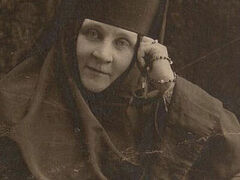
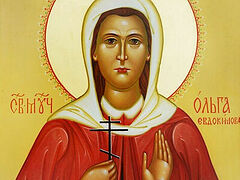
On September 27, the Orthodox Church celebrates the feast of the Exaltation of the Precious and Life-Giving Cross. In 1937, in the godless era, this day was marked by the shedding of the blood of many innocent victims: 272 people were shot at the Butovo firing range. Among them were Nuns Vera (Rozhkova), Matrona (Chusheva), and Valentina (Zasypkina). Information about their lives is very sparse, but it contains the main thing: the highest truth of life is faithfulness to God.
Secret Nuns. The Path of Christian Salvation
These women lived during the period of militant atheism—the persecution of the Church and the repression of the clergy and the faithful. After the adoption of the Decree on Freedom of Conscience, Church and Religious Organizations in 1918, monasteries were the first to suffer. In 1919, in accordance with the directions of the People’s Commissariat for Agriculture and the People’s Commissariat for Justice, all priests and monks were disenfranchised and could not be members of workmen’s cooperative associations. Subsequently, a number of other laws were passed, aimed at destroying the Church and perpetuating inequality between believers and other citizens of the country.
 The Decree on Freedom of Conscience. Photo: Runivers.ru
For this reason, in the 1920s and 1930s, many took monastic vows secretly, which allowed them to wear secular clothes and work in their fields, which was equivalent to obedience. Monasticism in the world has always been a very difficult path. Usually, even their closest family did not know about their tonsure. It was kept secret and was considered an intimate side of life. Such was the destiny of the three nuns—Vera, Valentina, and Matrona.
Nun Vera (Rozhkova)
Vera Rozhkova was born on September 17, 1899, into a peasant family in the small village of Pashkovo (the Uzlovaya district of the Tula province). The villagers were parishioners of the Church of the Protecting Veil of the Mother of God in the village of Kozlova Sloboda, built in 1769, where, apparently, the newborn was baptized. In 1904, a school was opened in Pashkovo, which Vera began to attend. She did well at school, and among her favorite subjects was the Law of God. In the future, the girl would obtain a higher education, but her path in life would be determined by her faith in God.
Her father, Emelyan Rozhkov, owned land on which rye, oats, and buckwheat were grown. Only their family members worked on this land—that is, the Rozhkovs were peasants of average means (“serednyaki”): neither poor nor rich. They raised their children in strictness, love of God, respect for elders, and awareness of the importance of study and work. The residents of Pashkovo perceived the October Revolution and collectivization without enthusiasm. Some suffered from dekulakization (the expropriation of farmland from wealthier peasants), while others were forced to give up their lands to the State and join the Krasnaya Zvezda (“Red Star”) collective farm established in the 1928–1930s.
 Nun Vera (Rozhkova)
By that time, Vera Rozhkova already lived in Moscow and worked as an assistant at one of the laboratories of the Bauman Institute. Of course, such a position meant that she had a higher education. Modest, conscientious, always even-tempered and benevolent with others, she would not have attracted much attention but for her hidden life, which became known later. She was a secret nun. Vera Emelyanovna was a member of the community at the ancient Church of St. Nicholas at Podkopayi. Valentina Zasypkina became her spiritual sister in the community.
Nun Valentina (Zasypkina)
Valentina Zasypkina was born in July 1897 in Tula into a middle-class family; her father obviously engaged in trade or mining. From an early age, she loved church services, and the gentle gaze of the Mother of God, looking down from Her icons, penetrated her very heart.
After successfully graduating from high school, she relocated to Moscow and between 1921 and 1924 studied at the Chemistry Department of the Second Moscow State University. For some reason, she did not complete the full course of study, but the education she had obtained allowed her to find a job. However, the young woman had her own hidden life as a secret nun. Despite the godless era, Valentina believed in God, was a parishioner of St. Nicholas Church at Podkopayi and a member of its community. These facts became the basis for her first arrest on April 14, 1931, under Article 58-10 of the Criminal Code. On May 26, the case was dismissed, and she was released from Butyrka Prison.
In 1932, the All-Russian Institute of Aviation Materials (VIAM) of the Research Center of the Kurchatov Institute was founded, in which Valentina Konstantinovna would work as a technical manager.
Women’s Monastic Community of St. Nicholas Church at Podkopayi
 Nun Valentina (Zasypkina) From 1928 to 1931, Hieromonk Andrei (Elbson; 1896–1937) was the rector of St. Nicholas Church, which still stands today at the corner of Podkopaevsky and Podkolokolny Lanes. Within its walls, in 1924, he took monastic vows and was ordained. Thanks to the efforts of Fr. Andrei, a monastic community appeared, whose members included Fr. Andrei’s parishioners and spiritual daughters —Nuns Vera (Rozhkova) and Valentina (Zasypkina). It is obvious that they took the veil with the blessing of the last Optina elder—St. Nikon, the successor of Elder Nektary, who was the spiritual father of Hieromonk Andrei.
On April 14, 1931, Fr. Andrei and many nuns were arrested as members of the “counterrevolutionary monarchist organization”—the True Orthodox (or Catacomb) Church—carrying on anti-Soviet propaganda and helping exiles. On September 17, he was released and deprived of the right to reside in twelve cities of the USSR for three years. At the same time, six nuns were sentenced to ten years in the Mariinsk labor camps in Siberia.
The Closure of the Church
 Hieromonk Andrei (Elbson) In 1931, St. Nicholas Church was closed. At first, apartments were set up in it. Then the church, the bell-tower, the chapel and the house of the clergy were given over to the workshops and the engineering department of the Polyethylene Plant. For some time, the community found shelter in a house at the Lianozovo train station near Moscow. Their service continued in secret in the town of Murom in the Vladimir region, where Fr. Andrei (Elbson) lived.
In 1936, he moved to the town of Kirzhach in the Vladimir region where he continued his secret ministry in Orthodox communities and in the Catacomb Church, which reappeared at that time. His contact with the Moscow community and his spiritual children—Nuns Vera and Valentina—was never interrupted: both meetings and joint prayers were arranged.
Nun Matrona (Vera Petrovna Chusheva)
Vera Chusheva was born in 1891 into a family of peasants who lived in a large village of the Bryansk district of the Oryol province (now the Kletnya district of the Bryansk region). It was the village of Akulichi on the small Oporot River.
The newborn daughter was baptized at the local Church of St. Nicholas the Wonderworker. It was a seventeenth-century wooden church, rebuilt after a fire in 1872. Its parishioners were residents of many surrounding villages. In 1900, in her native village, Vera went to school and received primary education. From an early age, she wanted to dedicate her life to God and good works.
At the age of nineteen, with the blessing of her parents and the priest of St. Nicholas Church, she went to Moscow and began to live at the diocesan community of nurses in honor of the Lord and the Protecting Veil of the Mother of God, which officially opened on July 7, 1872. There were hospitals, a pharmacy, an orphanage, general education and paramedical schools, workshops, a sericulture school, and an almshouse in this community. So all of its members always had a lot of responsibilities.
Five years later, Vera was transferred to the Skete in honor of St. Seraphim of Sarov and the Icon of the Mother of God of the “Sign”, set up for nurses who wished to become nuns. The skete, consecrated in 1912, was situated around seven miles away from Sarov. Here she became a novice, then a riassaphore nun with the name Matrona, and finally a nun.
After the October Revolution of 1917, the new Government deemed the activities (the main one was charity) of the community of nurses in honor of the Lord and the Protecting Veil of the Theotokos “unnecessary”. In 1923–1926, the community was gradually closed. In the 1930s, shared apartments appeared at the Pokrovsky Palace at the Church of the Protecting Veil of the Most Holy Theotokos, where the community used to live, and four nuns were living out their days in the half-basement. In 1924, the skete was closed altogether.
 Nun Matrona (Chusheva)
Nun Matrona went to the village of Novye Kuzmenki of the Serpukhov district. Here she lived in the house of Archpriest Mikhail Pyatikrestovsky, rector of the Church of the Dormition of the Most Holy Theotokos, which was never closed during the Soviet era. In 1931, Fr. Mikhail was arrested in a collective case involving the names of Bishop Arseny (Zhadanovsky) and Matrona Chusheva, but released a month and a half later. Nun Matrona spent nine years of her life in Novye Kuzmenki.
In the autumn of 1933, she took up her residence in the village of Kotelniki in the Ukhtomsky district of the Moscow region (now in the east of Moscow) in order to perform the duties of a cell-attendant and secretary to her spiritual father, Bishop Arseny (Zhadanovsky), together with another nun of the community of nurses in honor of the Lord and the Holy Protection—Alexandra (Murashova). Monastic life, secret prayers, and the reception of visitors to the bishop—such activities were considered criminal.
In 1937, Matrona managed to get a job as a laborer at a store in the town of Lyubertsy near Moscow.
The Case of Bishop Arseny (Zhadanovsky)
In February 1937, the NKVD (the People’s Commissariat of Internal Affairs) initiated a fabricated case on the “organization of illegal churchmen”, which involved sixteen people. The main person involved was Bishop Arseny of Serpukhov, the former Abbot of the Chudov Monastery in the Moscow Kremlin (destroyed in 1929–1932), and vicar of the Diocese of Moscow. He was in opposition to Metropolitan Sergei (Stragorodsky), who endorsed the Church policy of loyalty to the new regime and “peace with the Soviet authorities”. This policy led to a split within the Russian Church and the creation of the Catacomb Church. The investigative authorities attributed the foundation and the governing of the organization to Bishop Arseny, and the leadership to Hieromonk Andrei (Elbson), calling it “illegal, counterrevolutionary and monarchist”.
 Bishop Arseny (Zhadanovsky) Fr. Andrei and other non-commemorating priests opposed Metropolitan Sergei (which at that time meant imminent arrest) and considered Metropolitan Kirill (Smirnov; the future hieromartyr) to be the worthiest candidate as the Patriarchal Locum Tenens. A meeting between Fr. Andrei and Fr. Mikhail Shik was organized to discuss this issue. This fact, which officially sounded like the “participation in an illegal meeting” in February 1937, became the reason for arrests.
Bishop Arseny was arrested in 1931, 1932, and 1933 and served a three-year exile in Kazakhstan, after which he lived in the village of Kotelniki near Moscow (now within Moscow). There was a house church in his home and services were celebrated there secretly, attended by his spiritual children and locals. During interrogations, he admitted to this fact.
On February 23, 1937, Fr. Andrei was arrested. It happened in the apartment where Nuns Vera and Valentina lived.
On February 25, in the town of Maloyaroslavets (now in the Kaluga region) Fr. Mikhail Shik was arrested because he also celebrated services in a house church he had organized. Bishop Arseny was arrested on April 14. On the same day, the NKVD officers came for Nuns Vera and Valentina, and on July 26, for Nun Matrona.
And this is certainly not a complete list of those arrested in the case of Bishop Arseny.
Sentence
On September 26, 1937, under Article 58-10 of the Criminal Code of the RSFSR, Nuns Vera, Valentina and Matrona were sentenced to death for their “active participation in the counterrevolutionary organization of illegal churchmen”. The same fate awaited Bishop Arseny, Hieromonk Andrei, and Priest Mikhail Shik.
On September 27, 1937, the sentence was carried out in the village of Butovo (now in the south of Moscow) at the bloody Butovo firing range.