In the name of the Father, and of the Son, and of the Holy Spirit!
Dear brothers and sisters in the Lord, greetings to all of you on today’s great feast of the Exaltation of the Holy Cross, which is both joyful and sad at the same time.
Why is it joyful? Because we commemorate the events of the finding of the True Cross of the Lord, which the Jews hid after the Crucifixion of Christ. In the fourth century, under Emperor Constantine the Great, this Cross was found and solemnly elevated in the sight of the people, shown to all Christians, who, looking at it, exclaimed: “Lord, have mercy! Lord, have mercy!”
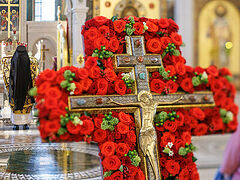
The image and symbol of it was yesterday’s rite, the so-called “Elevation of the Cross”. And this is a joyful event. Why is it also sad? Of course, because this is the Cross on which our Lord and Savior Jesus Christ was crucified. And this day is like another Holy Friday. It is special, because if it falls on a non-fasting day, then strict fasting is observed.
On this feast, it is difficult to speak about the Cross without making a short overview of human history in general... God created man, put him in the Garden of Eden, provided him with all the blessings of life, made him king over all Creation, and gave him just one commandment to grow through it to perfection, to the likeness of God. Man violated this commandment, and human nature became corrupted.
And as time passed, man moved further and further away from God—not God from man, but man from God. And later there happened what the Russian thinker Ivan Sergeyevich Aksakov (1823–1886) described as follows: “Having forgotten about the image of God, man is sure not only to forget the image of man, but also start aspiring for the image of the beast.”
We know this from the multitudes of ancient pagan cults and the images of the gods whom ancient mankind worshipped. Nevertheless, immediately after the fall, God made such a promise that the time would come when “the seed of the woman would bruise the head of the serpent” (cf. Gen. 3:15). There was already a prophecy, an allusion to the miraculous conception of Christ, that not the seed of the man, but the seed of the woman would “bruise the head of the serpent”.
Further in the history of mankind, the Lord guided the God-chosen people in a special way. We call this time the period of the Old Testament. God made a covenant with man, gave the Jewish people the Law and sent them the prophets through whom He revealed His will. This Law and this will were very clear.
It was very pleasant, very suitable for people of the Old Testament, because there was a lot about the building of an earthly kingdom and about the domination of the God-chosen people over the rest of mankind—and it was very understandable. And its commandments were very clear: Ye have heard that it hath been said, Thou shalt love thy neighbour, and hate thine enemy (Mt. 5:43); or An eye for an eye, and a tooth for a tooth (Mt. 5:38). Everything was very clear and very pleasant to accept, as it were.
And the time came when those promises and prophecies were fulfilled. The whole world was waiting for the Savior. We know that not only in the Old Testament, but also in various ancient pagan cults and myths, there was a general anticipation of a Savior.
And then, when that time came, something happened that absolutely no one had expected, something that the Lord had warned about through the Prophet Isaiah, saying: Hear ye indeed, but understand not; and see ye indeed, but perceive not (Is. 6:9); For as the heavens are higher than the earth, so are My ways higher than your ways, and My thoughts than your thoughts (Is. 55:9). Because God became man—without ceasing to be what He was, He became man. God became incarnate. This is the first thing that no one had expected.
And then what Christ said was not only a shock, but for some even the most unpleasant surprise. The Lord proclaimed, My Kingdom is not of this world (Jn. 18:36). It was a blow to the sore spot of the Jews. How could it be “not of this world” when they expected the domination of the Jewish people, of the Kingdom of Judah over the whole globe?
And the Lord proceeded to say: Learn of Me; for I am meek and lowly in heart (Mt. 11:29). Then everything fell apart at once. But what about “an eye for an eye, and a tooth for a tooth”?
Next the Lord did something that was shocking, and at which even the angelic realm was horrified: He was crucified on the Cross. Christ said: For I came down from Heaven, not to do Mine own will, but the will of Him that sent Me (Jn. 6:38). And in the Garden of Gethsemane, Christ prayed, as if foretasting and knowing about the Passion. He prayed: Father, if Thou be willing, remove this cup from Me: nevertheless not My will, but Thine, be done (Lk. 22:42).
What happened on the Cross? The deification of the human will, the will that Christ took upon Himself. How did it happen? Through obedience. The human will was corrupted through disobedience by not fulfilling the commandments, and the Lord, being obedient to the Father to death, healed the human will. He healed it. How? He united it with the Divine will.
And then the entrance and doors of this Kingdom, which is “not of this world”, began to open. The Lord showed us the way and gave us the strength to walk this path and enter this Kingdom here on earth. Brothers and sisters, this will be not after death and the Last Judgment, but already here on earth. And then it will just be passing out of our lives.
However, for many it is what we read today in the Epistle of the Apostle Paul: The Cross is unto the Jews a stumblingblock, and unto the Greeks foolishness (1 Cor. 1:23). And to this day, for many Orthodox Christians, the Cross is madness and a stumbling block. I even repeat: for Orthodox Christians.
Why? Because many people come to confession and start complaining about their lives: “Everything is wrong—I’m sick, I’m suffering, something’s not working out for me, all is falling apart...” In other words, people cry out to God: “Lord, help me settle well here on earth! Give me an earthly kingdom!”
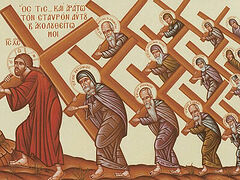
So, in our heart of hearts, these words of Christ that His Kingdom is not of this world are disappointing, because we can enter this Kingdom only through the cross, as stated in the Epistles, for example: We must through much tribulation enter into the Kingdom of God (Acts 14:22).
Why through much tribulation? Because through obedience to God, through bearing our cross, our will is healed. And this became possible after the coming of Christ, since from now on He gives us the strength to do so.
Before suffering on the Cross, Christ got His disciples together, took bread, and gave thanks, and brake it, and gave unto them, saying, This is My Body which is given for you: this do in remembrance of Me. Likewise also the cup after supper, saying, This cup is the New Testament in My blood, which is shed for you (Lk. 22:19, 20).
He that abideth in Me, and I in him, the same bringeth forth much fruit: for without Me ye can do nothing (Jn. 15:5). This is the strength that Christ has brought to us, but we will have to bear the cross anyway. God will give us the strength to bear this cross, but we still have to bear it.
There is the following serious instruction given by the famous elder—Archimandrite John (Krestiankin). He wrote in a letter to one of his spiritual children: “When you come to love suffering, then your real spiritual life, and not playing at spiritual life, will begin.” These are terrible words: “To come to love suffering.”
One of the books by Archbishop Luke (Voino-Yasenetsky), his auto-biography, is entitled, I Came to Love Suffering. Why did he come to love it? Because only suffering opens up to us the Kingdom of God that is within us (cf. Lk. 17:21). During suffering, there appears a certain Mount Tabor in every person’s life, a transformation. It can be seen in the experience of the last elders of the twentieth century, who went through prisons, labor camps and exile, and became holy, otherworldly men, and conquered this world.
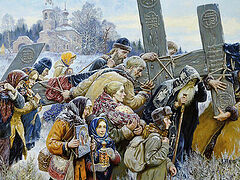
And these seemingly frail old men, emaciated, with poor health, became “mountains” and “walls” behind which thousands of people hid, and even the powers that be turned to them and asked, begged for their help. That’s the power these people had, and that’s the power of the new Kingdom that Christ gave us.
What should we do, brothers and sisters? We should think about it, reflect on it, and remember it when sorrows appear in our lives. And then? Next, don’t make this mistake. Which mistake? As the Apostle Paul said: Examine yourselves, whether ye be in the faith (2 Cor. 13:5).
Because when we have problems, we try to solve them, and it doesn’t work—as if we are banging our heads against a brick wall. Why? Because we try to do it on our own! That’s why it doesn’t work. And Christ warns us in advance: Without Me ye can do nothing.
Therefore, keeping this in mind in difficult moments of life, we must begin to pray to God with all our might, because Christ Himself said: Let not your heart be troubled: ye believe in God, believe also in Me (Jn. 14:1). Because, as Christ said elsewhere, What things soever ye desire, when ye pray, believe that ye receive them, and ye shall have them (Mk. 11:24). Whatever you ask for with faith!
And we must ask for exactly what Christ commanded: Lay not up for yourselves treasures upon earth… But lay up for yourselves treasures in Heaven (Mt. 6:19, 20). And once we begin to pray to God for Heavenly treasures, the Lord helps us instantly. Very often we do not receive what we ask for, because, as the Apostle James taught: Ye ask amiss, that ye may consume it upon your lusts (Jm. 4:3).
So, dear brothers and sisters, let us strengthen ourselves with the sign of the cross, which has power. Let’s attune ourselves and remember that it is not some mere waving of the hands—this is God’s power, which will help us enter the Heavenly Kingdom after passing this earthly journey. Amen.