Photo: wikipedia.org
Fear not; from henceforth thou shalt catch men (Luke 5:10)
The appearance of Jesus Christ in the world, dear listeners, immediately drew the hearts of the people to Him. The simple and guileless folk quickly recognized in Him a blessed, God-given higher Being, and exclaimed to His face:
Blessed is the womb that bare Thee, and the paps which Thou hast sucked! (Luke 11:27).
With the fire of the Holy Spirit dwelling in Christ, He acted upon human souls and hearts in a way that was indescribable and irresistible. People felt that it was not merely words (as with the scribes and Pharisees), but that the power of divine grace proceeded from His lips and, though invisible, had a tangible effect on them. And each person, involuntarily, pondered:
Who is He—this extraordinary Knower of hearts, this Lover of mankind and Worker of wonders? Who is He?
And then Christ—this was at the very beginning of His public ministry—once opened the book of the prophet Isaiah in the synagogue and read aloud:
The Spirit of the Lord is upon Me, because He hath anointed Me to preach the gospel to the poor; He hath sent Me to heal the brokenhearted, to preach deliverance to the captives, and recovering of sight to the blind... to preach the acceptable year of the Lord (Luke 4:18–19).
Having read and closed the book, Christ said:
“This day is this scripture fulfilled in your ears.” And all bore witness to Him and marveled at the gracious words that proceeded from His mouth (Luke 4:20–22).
From that moment, the influence of Jesus Christ on the people grew day by day. His divine mission in the world began to be openly acknowledged even by demons, whom He cast out of the possessed.
I know Thee who Thou art—the Holy One of God” (Luke 4:34), said one of them. Thou art Christ, the Son of God (Luke 4:41), said others.
The preaching of Christ, the Son of God, about the coming of the Kingdom of God found a universal response among the people. And thus arose the need for other preachers—evangelists—to further spread this good message. Jesus Christ then chose His heralds in the persons of the apostles.
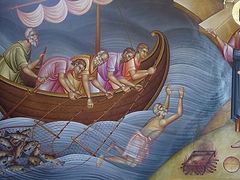
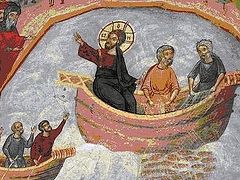
In today’s Gospel reading, as we heard, the initial calling of the apostles is described, along with the circumstances in which it took place. It occurred on the shore of the Lake of Gennesaret (the Sea of Galilee), where Christ was teaching the people from the boat of the fisherman Simon. Among the listeners were fishermen—Simon Peter and the sons of Zebedee, James and John. The night before, they had spent the entire night fishing from two boats, but had caught nothing. Now, weary and disheartened by their failure, they were attentively listening to Christ’s teaching about the coming of the Kingdom of God.
Then they heard their Teacher and Master address Simon with these words:
Launch out into the deep, and let down your nets for a draught. Simon answered, Master, we have toiled all the night, and have taken nothing: nevertheless at Thy word I will let down the net (Luke 5:4–5).
Their failure during the night might well have discouraged Peter. After all, if nighttime, the best time to fish, had brought no success, what hope was there during the day, when fish usually don’t bite at all? Had someone else made this suggestion, Peter likely wouldn’t have followed it. But this instruction came from the One who spoke with authority, with such inner power and confidence, that it was impossible not to obey Him.
And so, having done what He said—that is, having let down the nets—they caught so many fish that the nets began to break, and the boats began to sink (Luke 5:6–7). The sight of tearing nets, sinking boats, and the immense catch of fish was so overwhelming and awe-inspiring that the fishermen were struck with fear.
The participation of almighty divine power in this unheard-of catch was so evident that Peter fell at Jesus’ knees and said:
Depart from me, O Lord, for I am a sinful man (Luke 5:8).
This miraculous catch opened Peter’s eyes: the One whom he had previously called “Master” now appeared before him (in his inner perception) as Lord—as the supreme Divine Being, to whom the earth and sea, men and fish, and all of nature are subject. How could a sinful man have communion with the Lord? That is why Peter cried out:
Depart from me, Lord! I am a sinful man.
And what did Christ answer to this plea? He said:
Fear not; from henceforth thou shalt catch men (Luke 5:10).
These words of Christ were understood by the fishermen as a call to follow Him, to serve Him by proclaiming His teaching. They realized that they were being called to exchange their nets for new ones, and to trade in their fishing of fish for the fishing of human souls and hearts. And without hesitation, they brought their boats to land, forsook all, and followed Him (Luke 5:11). This is how the fishermen were called to apostolic service.
Brothers and sisters! Perhaps someone among you may ask: Why did the Lord see fit to grant the fishermen such an extraordinary, such an excessive catch? It was so that neither the fishermen nor anyone from the crowd could explain it as a coincidence—something they might have done if it had been a normal-sized catch. But the abundance of the catch made clear that it was the work of divine power.
Furthermore, the apostles were able to see in this exceedingly great catch a symbol, an image of the abundant catch of human souls to which Christ was calling them when He said:
Fear not; from henceforth thou shalt catch men.
Brothers and sisters! Through the miraculous catch of fish, Jesus Christ moved the hearts of the fishermen (Peter, James, and John) to follow Him and fulfill His will—to become fishers of men. And we know that these fishermen became His closest and most faithful apostles.
That miraculous catch penetrated their hearts and conquered them once and for all, drawing them into complete obedience to the Savior.
In the Gospel account of this miracle, there is also a particularly edifying moment for us. It is the moment when Peter falls at Jesus’ feet, begging Him to depart from him, as from a sinful man. In these words of the fisherman Peter, we see the fear of a sinful soul before the purity, holiness, and divine majesty of the Savior of the world.
The awareness of one’s sinfulness, one’s unworthiness before Him, and reverent fear before the Lord—this is, for us as well, the first condition of faith in God, the beginning of the path of salvation.
The fear of the Lord is the beginning of wisdom, says the Word of God.
From the lives of the saints, we know that the fear of God truly becomes the beginning of salvation. For example, St. Pelagia the Penitent, upon hearing a sermon in church about the Last Judgment, was filled with the fear of God. She gave away all that she had, entered a monastery, and attained a high degree of holiness.
The fear of God and fear of sin should be our constant companions, our inner motivators toward repentance, toward correction of life, and toward unbroken prayerful communion with God.
Let us also, like the Apostle Peter, more often fall spiritually and prayerfully at the feet of the Savior, at the foot of His Cross, and beg Him not to abandon us—sinful and unworthy as we are—as long as He continues to be patient with us, to love us, and to show us His mercy.
Amen.