Bucharest and Arad, Romania, October 6, 2025
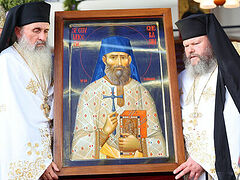
 The proclamation of the canonization of St. Dumitru Stăniloae. Photo: basilica.ro
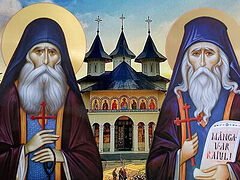
The Romanian Orthodox Church held local proclamations this weekend for the canonization of two 20th-century saints: St. Dumitru Stăniloae on Saturday and St. Ilarion Felea on Sunday.
The two saints were among 16 confessors, martyrs, and spiritual fathers canonized by the Holy Synod of the Romanian Orthodox Church in July 2024. Following the general proclamation of their canonization in Bucharest in February of this year, local proclamations have taken place throughout the year in the dioceses where these saints lived and ministered. The local proclamation of St. Gherasim of Tismana was celebrated late last month.
St. Dumitru Stăniloae at Cernica Monastery
 Photo: basilica.ro
The local proclamation for St. Dumitru Stăniloae took place on Saturday at Cernica Monastery, where his relics were uncovered in July 2024. The day began with the Akathist to St. Dumitru and the Third and Sixth Hours, followed by the Divine Liturgy at 9:00 AM in the Church of St. Nicholas on the monastery island, reports the Basilica News Agency.
The Liturgy was celebrated by a synaxis of hierarchs including His Beatitude Patriarch Daniel of Romania, along with Their Eminences Metropolitan Teofan of Moldova and Bukovina, Metropolitan Laurențiu of Ardeal, Archbishop Casian of the Lower Danube, and several vicar bishops from the Archdiocese of Bucharest and Ploiești.
 Photo: basilica.ro
Pat. Daniel delivered the homily, highlighting three principal characteristics of St. Dumitru’s spiritual personality. “In his holy life we can observe three principal traits that show his spiritual personality. He was an enlightened confessor of the Orthodox faith during the communist regime, a profound theologian of the love of the Holy Trinity, and a talented translator and interpreter of the Philokalia in the Romanian language, offering our Church a rich theological and spiritual work,” the Patriarch said.
His Beatitude emphasized St. Dumitru’s role as a teacher to those imprisoned under communism:
Between the terrifying walls of these camps of death, his voice, though weakened by hunger and torment, became a balm for souls thirsting for the word of God. His fellow detainees testified about the spiritual warmth of his words, which melted away hunger and cold, that they drove away despair and strengthened the faith of those who doubted. When he spoke about the Lord Jesus Christ and about the teachings of the Holy Fathers, silence fell around him, and the souls of those present were filled with joy and holy peace.
The Patriarch described St. Dumitru’s spiritual transformation in prison as one “born from suffering and sealed by the grace of the Holy Spirit,” which made him “shine like a lit candle in the darkness of communist atheism.”
Regarding St. Dumitru’s theological work, he noted that he “was a theologian enlightened by God who did not speak only from theoretical knowledge acquired through intellectual information over time, but often his words flowed from the living experience of his communion with God through prayer.”
On the translation of the Philokalia, the Patriarch explained that this was “not a simple linguistic transposition from Greek into Romanian, but a work of deepening and interpreting the writings of the great hesychast fathers who offered profound teachings about how spiritual life should be lived, having as foundation Holy Scripture, the Church Fathers, and their own hesychast experience.” He added that “his commentaries and rich underlining notes demonstrate his theologizing permeated by the philocalic spirit.”
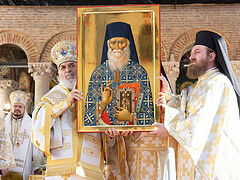
St. Ilarion Felea at Arad Cathedral
 basilica.ro
The local proclamation for St. Ilarion Felea took place on Sunday at the Archdiocesan Cathedral in Arad.
The liturgical program began with the Akathist to St. Ilarion Felea, followed by the Divine Liturgy celebrated by His Eminence Metropolitan Ioan of Banat together with His Eminence Metropolitan Timotei of Arad and Their Graces Bishop Lucian of Caransebeș, Bishop Sofronie of Oradea, Bishop Nestor of Deva and Hunedoara, Bishop Ieronim of Dacia Felix, Bishop Siluan of Hungary, and vicar bishops Paisie of Lugoj and Emilian of Crișana.
Following the Divine Liturgy, the synodal tomos of the canonization of St. Ilarion Felea was read.
***
St. Dumitru was born on November 16, 1903, in Vlădeni, Braşov County.
He studied theology at the University of Chernivtsi, then dogmatics and Church history in Athens. In the fall of 1928, he defended his doctoral thesis on Patriarch Dositheos of Jerusalem and his connections with the Romanian lands at the University of Chernivtsi. He subsequently studied in Berlin, Paris, and Belgrade, focusing on Byzantinology, dogmatics, and the original work of St. Gregory Palamas.
Upon his return to Romania, he was assigned as a substitute professor at the Andreiene Theological Academy, where he remained for 17 years.
On October 5, 1930, he married his wife Maria. Two years later, he was ordained to the priesthood, and another year later, on October 8, his daughter Lidia was born.
In June 1936, he was appointed rector of the Theological Academy of Sibiu. He remained in this position until 1946. It was during this time that he translated the first volume of the Romanian Philokalia. He was then transferred to the Faculty of Theology at the University of Bucharest, to the chair of ascetic and mystical theology.
He was arrested on September 4, 1958, and taken to Aiud Prison. He was released five years later and began working as a clerk at the library of the Holy Synod.
He became a corresponding member of the Romanian Academy in 1990, and a full member in 1991. He received honorary titles from several universities throughout the world.
Fr. Dumitru reposed in the Lord on October 5, 1993.
***
St. Ilarion Felea (1903-1961) was known as “the spiritual father of youth” in Arad.
In 1938, he was appointed professor at the dogmatics and apologetics department of the Arad theological academy, where he taught until it was shut down in 1948.
The communist regime sentenced him to 20 years in prison for “intense activity against the working class and the revolutionary movement”. The official reason was that he did not preach the so-called “fight for peace.” Initially held at Gherla prison, he was taken to Aiud, where he died in 1961.
The cause of death was a rapidly progressing colon cancer left untreated; he was buried in a common grave for prisoners.
Follow OrthoChristian on Facebook, Twitter, Vkontakte, Telegram, WhatsApp, and MeWe!