In the name of the Father, and of the Son, and of the Holy Spirit!
Dear brothers and sisters, we greet you on the feast—one of the most beloved feasts of the Russian people—which historically originated on the territory of our Holy Russia. It was in 1164 when through the efforts of the holy Prince Andrei Bogolyubsky the feast of the Most Holy Theotokos was established in the Russian Church, and a year later, in 1165, the famous Church of the Holy Protection on the Nerl was built in what is now the Vladimir region. And since that moment, we have celebrated this festival.
It was only in the twentieth century that this feast began to spread beyond the borders of the Russian Church. The Greeks, in whose country this event took place, do not pay so much attention to it. This festival is of great importance to us, because after this event—seventy-eight years later—the grandchildren of those over whom the Mother of God had spread Her holy veil at the Blachernae Church, undertook a great and dangerous labor—to baptize Russian pagans so that they would grow in the Church, and so our native land could prosper in Orthodoxy.
And, of course, it should be noted that new feasts are not created by brilliant preachers. We need some Church event, indicated from above by God Himself, which serve as an incentive to start a solemn festival in our Church calendar. And today we will speak about three points that are important for our understanding of this feast, to which we have probably not paid sufficient attention.
But first of all, let us turn to the event itself. It happened in the tenth century—to be more precise, in 910—when the Byzantine Empire was besieged from the east by the Arabs, and from the north, as some say, by the Saracens. However, other sources state that these were our ancestors, the Slavs, loyal subjects of Prince Oleg the Wise.
Reinforced by the Vikings, the Slavs successfully besieged Constantinople. And it seemed that the city was about to surrender under the onslaught of the “barbarians”, as they called our ancestors. But the people decided to get together at the church and pray, because there was no other way to resist, and they realized that without God’s help it was impossible to oppose those who had interfered in their life.
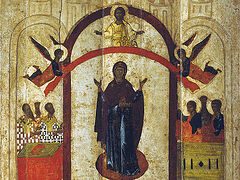
On this day, October 1/14, 910, the Vigil was being celebrated at four in the morning at the Blachernae Church, to which great relics had been brought from Palestine in the fifth century— namely the omophorion (the head covering) of the Mother of God and part of Her cincture (belt). So, at the church dedicated to the Most Holy Theotokos, people were praying fervently to the Queen of Heaven as their Intercessor that the Lord would have mercy on them.
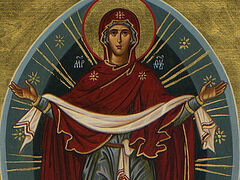
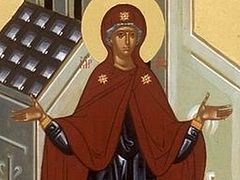
At four in the morning, Blessed Andrew, a “Fool-for-Christ”, and his disciple Epiphanius saw the Most Holy Theotokos walking in the air towards the altar. She knelt down and began to pray intensely on bended knee, after which She took off the omophorion and covered all the worshippers with it. Both St. Andrew, a “Fool-for-Christ”, and Epiphanius saw the grace that covered all those standing at the church.
The invasions stopped, the danger passed, and in the following year, 911, the Byzantine Empire concluded a peace agreement with the Russians. Grace triumphed, and repentance was accepted. But what did the Most Pure Mother of God pray for?
As an ancient chronicle says: “Along with the Angels with Her in the air, the Most Pure Queen prayed, ‘O Heavenly King, accept everyone praying to Thee and calling upon my name for help, that they not depart from my sight wasted and unheard.’” that’s what the Most Holy Theotokos prayed for. And this feast is also known to us because it is to the Icon of the Holy Protection of the Mother of God to which numerous victories of the Russian Army are attributed.
And what do we want to remind you about today? The first point of the three is that God has enabled us to address Him in a direct way. And it is indicated by the prayer “Our Father” when we turn directly to God. And in Orthodoxy there is no need for any intermediary to speak to God.
Then the question arises: Why do we seek the intercession of the saints? Why do we turn to the Most Holy Theotokos? First and foremost, we do not forget that “Wondrous is God in His saints.” And another well-known expression: The effectual fervent prayer of a righteous man availeth much (Jm. 5:16). And this is what the Bible tells us.
By Her human nature the Most Holy Theotokos is a human being just like us. She was born with the effect of the ancestral sin, like any human being living on earth. But one thing makes Her very different from all of us: She did not commit any personal sin in Her lifetime, and She did not even sin in thought. And She pleased God so much with Her life, becoming the Mother of God, that She acquired special grace and a special power to intercede for mankind. God does not reject the prayers of any person for the salvation of another.
And, among other things, having become the Most Pure Virgin Theotokos, as you and I know, She received twofold sanctification, as it were. The first was the moment of the Annunciation, when the miraculous conception of our Lord Jesus Christ took place. And the second was on Pentecost, when She received the grace of the Holy Spirit together with the Apostles.
Having become “more honorable than the Cherubim and more glorious beyond compare than the Seraphim”, She, as a Mother, was given the right to intercede for the human race, and we pray and turn to Her in the same way as to Christ. If we say to Sts. Sergius of Radonezh, Seraphim of Sarov, Ambrose of Optina and other saints, “Pray to God for us!”, then we say to Her, “Most Holy Mother of God, save us!” And here is one of the signs that God directly shows us that She has every right to do so and we should use it—and it is this very event that we are celebrating today.
The second point: The one who was vouchsafed to see The Protecting Veil of the Queen of Heaven in front of a multitude of worshippers in this Orthodox church was neither a bishop, nor a priest, nor a monk, nor a king, nor a warrior, but a Slav, a slave, and a “Fool-for-Christ”, which made him three times a stranger to the Church of Constantinople. Blessed Andrew was a Slav who at a young age was captured and sold into slavery in Constantinople to a wealthy man named Theognostus. So, who was the Blessed Andrew that he be vouchsafed such an honor?
St. Andrew would roam around in Constantinople, feigning foolishness and mocking the capital of the Christian empire. He walked on the streets half-naked, barely covered with rags, patiently enduring ridicule, voluntarily suffering beatings, sleeping in the sun or on dung heaps, hanging around with harlots and generally being a disgrace to this society. If we compare that with Russia, we could say that he was like Ivan the Ninny [a stock character in Russian folklore, usually a young simple-minded poor peasant, who challenges the conventional notions of success and intelligence in society.—Trans.] from Russian folk tales.
This example tells us that God is no respecter of persons; He looks neither at rank, nor at social status, nor at wealth, but at the state of the heart. There is a well-known beatitude: Blessed are the pure in heart: for they shall see God (Mt. 5:8). That’s what this feast draws our attention to—that we must keep our hearts pure. If your heart is pure, then you will contemplate God, the Heavenly Kingdom, and will attain salvation.
And the third point to which we would like to draw your attention. There is a famous expression that we all know: “We are Russians, and God is with us.” But, likewise, we can say: “We are Belarusians, and God is with us. We are Ukrainians, and God is with us. We are Georgians, and God is with us. We are Jews, and God is with us,” and so forth.
But God is no respecter of persons, and He loves everyone. And, as we know, God can only be with those who keep their faith pure and live in repentance and prayer, fulfilling God’s commandments. Those who do not do this become strangers to God. Not because God gives up on them. There is a well-known saying of the Holy Fathers: “Keep in mind that God will never give up on you—the main thing is that you should not give up on God.”
And the best illustration of this is the words of St. John the Baptist on the waters of Jordan, when he told the Jews: And think not to say within yourselves, We have Abraham to our father: for I say unto you, that God is able of these stones to raise up children unto Abraham (Mt. 3:9). And when the Nazi Wehrmacht invaded our motherland during the Great Patriotic War (1941–1945), the German belt buckles read: “God is with us.” But it is unlikely that God was with them.
And what about those who were destroying our churches and killing priests, monks, and laypeople in the early twentieth century? Was God with them too? After all, they were Russians. Therefore, belonging to God is not based on your nationality, but on the purity of your heart. That’s what we should remember on this day.
And the Protecting Veil is an image of maternal love. It should encourage us to turn to God with prayer. According to St. Ephraim the Syrian: “The Queen of Heaven is our first and supreme Advocate with Her Son and God, our vigilant and unashamed Intercession, the Protection of the whole world, the Giver of all good things, our Consolation, Refuge, and Salvation.”
So let us, the unworthy ones, offer up our prayer to the Most Pure Mother from the bottom of our hearts: “Remember us in thy prayers, O Sovereign Lady and Virgin Mother of God, that we may not perish from the multiplication of our sins. Guard from all evil and fierce adversities, as we trust in thee, honor the feast of thy Protection, and magnify thee.”
I also want to draw your attention to something that you probably haven’t thought about and haven’t seen in any sources: The events that are currently taking place on the southern frontiers of our country, where there is the war. What does it mean, and what is the Divine punishment that has befallen us and of which we must repent and implore God to heal?
Kiev is the third portion of the Mother of God in the universe, Diveyevo is the fourth portion of the Mother of God in the universe, and Russia is a home of the Most Holy Theotokos. And those states and peoples that are currently in this situation are mostly co-religionists, all belong to the same Church. That’s what you and I have been allowed to suffer for our sins.
And this should motivate us to turn wholeheartedly to the Most Holy Theotokos as our Intercessor, so that She, through Her intercession with God, may heal this wound, that we may achieve what we desire as soon as possible, and that peace in our hearts and in our countries may be restored. May the Lord and the Most Holy Mother of God help us in this. Amen.