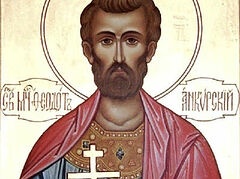
Great-Martyr Theodore Gavras
The Crimea is unique. It’s not just about the nature on this amazing peninsula. Its history itself is unique: Tauris, or Taurica, as the ancients called this land, has seen many peoples, wars, civilizations, and eras. But perhaps the most unique thing in Crimean history is that of the Orthodox Church. It began in the late first century A.D. with Hieromartyr Clement of Rome and now it continues in the modern life of the Church, for twenty centuries testifying to the Truth of Christ and the Church He founded, against which the gates of hell will never prevail. The Crimean land has known many empires and peoples, but it has always preserved Holy Orthodoxy. Isn’t it a miracle?...
 The Mangup Plateau
Theodoro
One of the most striking pages of the Crimea is the history of the Principality of Theodoro (also the Principality of Gothia, Mangup) with its capital on the Mangup-Kale Plateau, whose princes regarded themselves as the guardians of Orthodoxy in the ancient land of Tauris. The Principality of Mangup became the last stronghold of the Byzantine Empire and its last fragment. Constantinople fell to the Ottomans after a month and a half of siege, while the capital of the Principality of Theodoro—the eponymous city of Theodoro, or Mangup—lasted for six months. 7,000 janissaries, professional Turkish soldiers, died during the siege of the city. Even if this figure is exaggerated, it still gives us an idea of what losses the Ottomans suffered and how difficult this siege was for them. There were at most 2,000 soldiers in the ranks of the besieged.
Theodore Gavras
The Principality of Theodoro owes its name to the holy Great-Martyr Theodore Gavras. According to the Russian Byzantologist Alexander Vasiliev (1867–1953), from the time of the foundation of the principality, one of the ancient names of the Crimea—Doros—was reinterpreted with the addition of “Theo”. It became “Theodoro” and was understood as a “gift from God”, and at the same time reminded people of Great-Martyr Theodore Gavras—an ancestor of the founder of the principality Konstantinos Gavras. St. Theodore was a military commander and nicknamed “Stratelates”. That is why he is often confused with another St. Theodore Stratelates: a great-martyr from the city of Euchaita in Asia Minor, who was executed in 319.
 Great-Martyr Theodore Gavras Researchers identify at least twenty religious complexes dedicated to the memory of St. Theodore. It should be assumed that all or most of them were dedicated precisely to the founder of the Theodorite Dynasty—Great-Martyr Theodore Gavras. The most famous of them are Cape Ai-Todor (“Saint Theodore”), on one of the three rocky spurs of which the famous Swallow’s Nest Palace currently stands; and the rocky Cape Ai-Todor in the vicinity of Mangup, where, before the Ottomans captured the Crimea, there used to be an ancient monastery in honor of St. Theodore Gavras, which probably kept a significant portion of his relics. Today, at the foot of the cape, on the site of the ancient monastery, a monastery has been revived in honor of the fourth-century Great-Martyr Theodore Stratelates.
St. Theodore Gavras was born around 1050 in the Byzantine Empire’s theme (small military-civilian province) of Koloneia, in what is now Armenia, into an aristocratic family related to the Komnenos Dynasty that reigned in Byzantium at that time. As deeply religious Christians, St. Theodore’s parents raised him in piety and instilled the fear of God in him.
 Interior decoration of the cave Church of St. Theodore Gavras at Cape Ai-Todor
After the Byzantine Army had been crushed by the Seljuk Turks in the Battle of Manzikert in 1071, the Byzantine troops withdrew from the eastern regions, and the local feudal lords had to fight off the Turks on their own. The young commander Theodore Gavras assembled a detachment of soldiers in his hereditary possessions and, without the help of Constantinople, liberated the city of Trebizond, and subsequently completely liberated the themes of Chaldia and Koloneia from the Muslims. In numerous wars, St. Theodore proved himself to be a brave, pious and capable commander, defending the empire’s eastern frontiers from invasions of the Seljuk Turks. He enjoyed such great authority and support among the population of Chaldia that as an independent ruler he even began to mint coins with his own image.
 The walls of the Trebizond Fortress. 1916
The Byzantine princess and writer Anna Komnene (c. 1083–1153) mentioned St. Theodore Gavras in her Alexiad:1
“Theodore Gavras was in the royal city [Constantinople]. Knowing the audacity and energy of this man, [Emperor] Alexios decided to remove him from the capital and appointed him ruler of Trebizond, a city that he had previously taken from the Turks. Theodore came from the mountainous regions of Chaldia and gained fame as a valiant warrior, for he surpassed everybody else with his intelligence and courage. He did not fail in any, even the smallest, exploit, always prevailed over his opponents, and having taken control of Trebizond and using it as his possession, he became absolutely invincible.”
Emperor Alexios I Komnenos had no choice but to recognize him as the ruler of these regions, but in order to avert the danger of Trebizond’s full secession, the emperor, under a plausible pretext, kept his son Gregory in Constantinople, promising to marry him to his daughter Maria Komnene. Subsequently, the Emperor broke off their engagement.
As for St. Theodore, he was married twice. His first spouse was a certain Irene, probably from the Armenian Principality of Taron. After becoming a widower, he remarried, and his second wife was a niece of the wife of the Alanian King Durgulel. Thus, he entered into kinship alliances with two of the most influential ruling houses of Greater Armenia and the North Caucasus. It is noteworthy that Nikephoros of Alania, who was the Byzantine governor of Tauris around the same time, may have been a relative of St. Theodore Gavras’ second wife.
After a while, slandered by envious people, St. Theodore quit the service. He made generous donations to the famous Pontic monasteries of Panagia Sumela and Vazelon (of St. John the Baptist), and also contributed funds for the construction of the Convent of the Holy Trinity. Afterwards, it was renamed in honor of Great-Martyr Theodore Stratelates. The saint proceeded to withdraw to the mountains where he lived as a hermit.
 Panagia Sumela Monastery (a former Orthodox monastery in what is now Turkey)
Martyrdom and Canonization
In 1098, during yet another Seljuk Turk invasion, yielding to the entreaties of the populace, St. Theodore gave up his ascetic life and returned to the army, winning a number of victories over the invaders.
However, soon after, during a battle near the city of Bayburt (then in Armenia), St. Theodore was seized by Turks of Emir Ahmet-Melik Amyrali.
Emir Amyrali demanded that St. Theodore renounce Christ the Savior and convert to Islam. At first, the emir promised the saint riches and fame. In case of refusal, St. Theodore would be subjected to various tortures and be killed. St. Theodore did not lose his courage—as a true Christian, he was ready to suffer for Christ. His biography says that, inspired by Grace, St. Theodore replied to the emir:
“Your earthly wealth does not allure me. You can’t stop me from suffering for Christ. Why are you promising me glory that you can’t give? You’re trying to terrify me with death, which I don’t fear. It would be better for me to lay down my life for Christ than to separate myself from Him. If you had believed in the incarnation of Christ and His sacrifice, you would never have been at enmity with Christians. Instead, you would have acquired piety and not been thrown into hell. Believe in what I am telling you, believe in the Son of God Who shed His Blood on the Cross. Awaken from the darkness of ignorance so that you can be regenerated through the Baptism of the Holy Spirit, Who will forgive you your ignorance and past sins.”
 Great-Martyr Theodore Gavras The emir ordered St. Theodore to be subjected to the cruelest tortures. This is what the Life of St. Theodore tells us about it:
“First, they laid the saint face down on the snow and started whipping him, demanding that he renounce our holy and true faith. However, it was all in vain. St. Theodore remained as unwavering as Mount Zion (cf. Ps. 124:1). He continued to pray, turning to Heaven: ‘I thank Thee, O King of Kings and Son of God, thank Thee for taking note of me, an unworthy one. Give me the strength, O Lord, to become a worthy sacrifice before Thy Face, just as Thou wast crucified on the Cross to save people. Vouchsafe me to enter Thy Kingdom.’
“On hearing these words, the emir ordered his men to cut off the saint’s tongue, then cruelly gouge out his eyes, then peel off the skin from his arms, legs, head, and finally cut off all his limbs and throw him into the fire. Even after the executioners had torn out his tongue, the Holy and Blessed Theodore miraculously continued to pray.”
In the end, St. Theodore was thrown into the fire. Suddenly, all those present saw St. Theodore sitting in a chariot and calling on everybody to praise the Lord. Then he commended his soul into the hands of the Lord, completing his great battle. This took place on on October 2/15, 1098.
The emir turned the saint’s skull into a bowl, covering it with gold as a sign of his wonder at the martyr’s superhuman bravery and fortitude. Afterwards, this holy relic fell into the hands of Christians, and through it the Lord performed many miracles and healings in the city of Theodosiopolis, near which the holy Great-Martyr Theodore was executed.
 Miniature of a Sinai manuscript with an image of St. Theodore Gavras In the twelfth century, Great-Martyr Theodore was canonized. He was venerated as the holy Great-Martyr Theodore Gavras of Trebizond (or Stratelates). Later, his holy relics were translated to Trebizond and solemnly buried. A church and a monastery were set up over the saint’s grave. His memory is celebrated on October 2/15. In Russia, Great-Martyr Theodore was known as St. Theodore of Chaldia.
Great-Martyr Theodore Gavras became a hero not only of Greek but also of Turkish folklore, where he was referred to as a “noble and brave foe.”
On a miniature of a Sinai manuscript of the eleventh century there is an image of Jesus Christ laying His hand on the head of a warrior. The inscription reads: “Theodore Gavras, patrikios, a servant of Christ.” Symmetrically to this image, on the next page of the same manuscript, there is an image of the wife of St. Theodore Gavras, Irene Taronitissa, being blessed by the Mother of God.
The Legacy of Great-Martyr Theodore
 Funeral veil of Maria of Mangup, wife of Stephen the Great Great-Martyr Theodore’s nephew, Konstantinos Gavras, was the ruler of Chaldia from 1119 till 1140. But he fell into disgrace and was exiled by the emperor from Trebizond to Tauris. It was Konstantinos who founded the Principality of Theodoro. The principality amazed its contemporaries with its might and grandeur. Representatives of the Crimean branch of the Gavras family established family ties with the Byzantine imperial dynasties of Komnenos and Palaiologos, the aristocratic families of the Bulgarian kings, the voivodes of Moldavia, and the Circassian princely houses. Grand Prince Ivan III married off his eldest son Ivan to Helena, a daughter of Isaac, a prince of Theodoro. Maria, the sister of Alexander—the last ruler of Theodoro—was the wife of St. Stephen the Great, Voivode of Moldavia.
In 1426, Maria Gavras, a daughter of Prince Alexis of Theodoro, was married to the heir to the throne of the Trebizond Empire, who became its last emperor, David Komnenos (1458–1461).
 The map at the time of the events of 1450
The Principality of Theodoro was conquered by the Ottomans in 1475, outliving the Byzantine Empire by twenty-two years. It was the last surviving sovereign domain of one of the Byzantine families.
 Turkish siege artillery
And representatives of the Gavras family, who emigrated to Muscovy in the late fourteenth century, became the founders of the aristocratic Khovrin family and hereditary treasurers of the Principality of Moscow. From the sixteenth century, they have been called the Golovins. The Russian Genealogy Book, published by Prince Peter Dolgorukov, mentions Stephen Vasilievich Khovra, “Prince of Gothia”, who with his son Gregory moved from his domains to Moscow in the late fourteenth century. In Moscow, he was received with honor by Prince Dmitry Donskoy or his son Prince Vasily I, and was given a house at the Kremlin, which was marked in ancient maps of the city. Subsequently, Dmitry Khovrin’s granddaughter Darya Vladimirovna Golovina, the wife of the boyar Nikita Zakhariev (Romanov), became the grandmother of Michael Feodorovich, the first Tsar of the Romanov Dynasty.
But that’s another story.
 Mangup. The Citadel
Today, the ruins of former splendor and the Mangup Plateau survive from the Principality of Theodoro, which still captivates with its magnificence all who have ever visited it. And the Ai-Todor valley at the foot of Mangup invisibly but invariably preserves the memory of the holy Great-Martyr Theodore Gavras, who gave rise to a history that continues to this day.