Istanbul, October 20, 2025
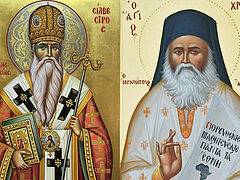
 Sts. Nifon (left) and Nektarie (right). Photo: basilica.ro
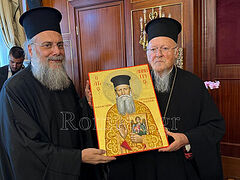
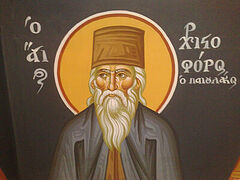
The Patriarchate of Constantinople has canonized two more Romanian monks from Mt. Athos: the founder of the Romanian Prodromou Skete, Hieroschemonk Nifon (Ionescu) and St. Nectarie (Crețu) the Protopsaltis.
The canonizations were approved at a meeting of the Holy Synod of Constantinople held on Saturday, October 18, reports the Basilica News Agency.
Prodromour (“Forerunner”) Skete is under the authority of the Great Lavra. Venerable Nifon and Nectarie, monks of Horaiţa Monastery in Moldvaia, purchased the Prodromou cell from Greek monks in 1851. In 1856, Patriarch Cyril VII of Constantinople approved the establishment of the Romanian skete. They were proposed for canonization by the Holy Synod of the Metropolis of Muntenia and Dobrudja at its session in May 2024.
“This Nectarie the Protopsaltis, or Nectarius the Vlach, was one of the greatest Romanian hesychasts who lived on Mt. Athos,” His Beatitude Patriarch Daniel of Romania explained at the time.
“He is widely known and appreciated not only by Romanians on Athos, but also by monastics of other ethnicities, and we have also seen receptivity from the Ecumenical Patriarchate, because they too said that he was a great chanter, also called the Nightingale of Mt. Athos,” His Beatitude noted.
In late August, the Ecumenical Patriarchate canonized two other Romanian Athonite monks: St. Dionisie (Ignat) of Kolitsou and St. Petroniu (Tănase) of Prodromu. Elder Dionisie lived at the Holy Cell of St. George at Kolitsou, under Vatopedi Monastery, while Hieromonk Petroniu lived at Prodromu Skete, which belongs to the Great Lavra Monastery.
***
St. Nifon
St. Nifon was born in Vaslui County to poor and very devout parents. Having heard of the renowned abbot of Horaiţa Monastery, Archimandrite Irinarh Roseti, he entered his community in 1826 and became a monk, taking the name Natanail.
In 1840 he departed for Mt. Athos together with Monk Nectarie from the same monastery. They first lived at Koutloumousiou Monastery. Then they purchased a cell at St. Anna Skete. There, Fr. Natanail became a schemamonk, taking the name Nifon.
Gathering many monks around him, some of whom were from Horaiţa Monastery, Schemamonk Nifon, assisted by his friend Nectarie, purchased a more spacious cell near the sea, at a place called Kerasa, on the property of the Great Lavra Monastery, where he moved with his disciples.
In 1852, Hieroschemamonks Nifon and Nectarie laid the foundation of the church at Prodromu Skete. Eight years later, in 1860, the church was already painted. In the same year, Bishop Isaia (Vicol), accompanied by several clergy and 200 pilgrims from Romania, consecrated the new church and appointed Hieroschemamonk Nifon as abbot.
In 1870, however, Fr. Nifon resigned from his position as abbot and returned to Romania. There he founded Bucium Skete in Iaşi, as a metochion of Prodromou. After several years he returned to the Holy Mountain and withdrew in silence with his disciple to a cave near the sea, 20 minutes away from the skete he had founded. Nearby he also had a small chapel dedicated to the Nativity of Christ, where he kept the daily rule and the Divine Liturgy on feast days.
***
St. Nectarie
St. Nectarie (Crețu) the Protopsaltis was one of the most spiritually advanced Romanian monks who labored on Athos, and in his time was considered first among the chanters of the Holy Mountain.
He was born in 1804 in the city of Huși. He attended classes at the school of Bishop Grigorie (†1846) at Golia, then went to Neamț Monastery, to be near his brother, Monk Atanasie. He was tonsured a monk, receiving the name Nectarie.
In 1842 the two brothers settled at one of the cells of St. Anna Skete on Athos.
In 1854, they left their cell and were received at Prodromou Skete, which was being built at that time. In old age, he withdrew to a cell in the Vigla wilderness.
Follow OrthoChristian on Facebook, Twitter, Vkontakte, Telegram, WhatsApp, and MeWe!