On October 17/30, the Orthodox Church commemorates the translation from Cyprus to Constantinople of a portion of the relics of St. Lazarus the Four Days Dead.
 St. Lazarus is one of the few who was destined to walk through the valley of the shadow of death (Ps. 22:4) twice. His name translates from Hebrew as “God helped” and accurately reflects the saint’s life experience. The Gospel of John calls him a “friend of Christ” and “the one whom the Lord loved” (cf. Jn. 11:5). Christ visited Lazarus’ house (in the village of Bethany just outside Jerusalem) regularly, where He spent time with him and his sisters Martha and Mary.
Before His Passion on the Cross, Christ would preach in Jerusalem during the day, and at night He would go to Bethany, where He probably stayed with St. Lazarus. So the closeness of this family to Christ is absolutely indisputable: St. Lazarus and Christ may have been friends since childhood. In any case, according to Church tradition, they were the same age.
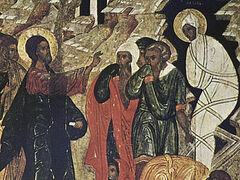
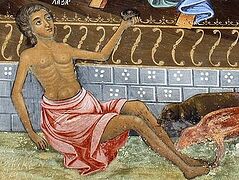
At the age of about thirty (shortly before the Resurrection of Christ), St. Lazarus fell seriously ill and died. Christ came to Bethany only on the fourth day after his death. And having planted a seed of hope in Martha’s heart with the words, I am the resurrection, and the life: he that believeth in Me, though he were dead, yet shall he live (Jn. 11:25), He ordered the tomb to be opened, after which He exclaimed: Lazarus, come forth (Jn. 11:43). And the man who had been dead for four days, whose body had already begun to decay, revived and came out into the light.
This event took place shortly before the Entry of the Lord into Jerusalem, which is why it is marked on the eve of this feast (on Lazarus Saturday). After the Resurrection of Christ, St. Lazarus became one of the members of the Christian community in Jerusalem and was persecuted together with it by the Jews.
According to a later tradition, the Jews placed him and other Christians in a boat without oars and cast them adrift at sea. However, they did not die, but eventually landed safely in Cyprus, where the Apostles Paul and Barnabas were preaching at that moment. Tradition has it that the Apostle Barnabas, a native of Cyprus, consecrated St. Lazarus bishop of the city of Kition (modern-day Larnaca) in the southeast of the island (opposite the Israeli coast).
St. Lazarus lived and served in this city for thirty years. According to Orthodox tradition, the Most Holy Theotokos and the Apostle John the Theologian visited him here during their trip to Ephesus. Around the year 63 A.D., St. Lazarus reposed in the Lord and was buried in the same city where he had served as a bishop. At that time, the city was called Kition, and now it is called Larnaca, because a huge number of tombs and sarcophagi (in Greek, λάρνακες) were discovered there.
 St. Lazarus Church in Larnaca. Agioslazaros.org
Interestingly, in the Church calendars, the saint is called “righteous,” and not a “holy hierarch.” Perhaps this is because he was not a monk. It is possible that St. Lazarus had a family, since in the early Church bishops could be married.
The saint’s grave was lost in the early Middle Ages as a result of the Arab conquest of Cyprus. The remains of Righteous Lazarus were found around 900 A.D. and a marble shrine inside a subterranean cave with the following inscription: “Lazarus the Four Days Dead, a friend of Christ.” This event became the reason for the October feast in honor of the saint.
The relics were divided—a portion of them was taken to Constantinople by the Byzantine Emperor Leo VI the Wise (ruled 886–912), and his skull and several bones remained in Kition. 300 years later, the Crusaders captured and plundered Constantinople, and so some of the relics of St. Lazarus ended up in Marseille, France. This fact later gave rise to the Catholic legend that Righteous Lazarus was allegedly the bishop of Marseilles. Now this portion of the relics is kept at St. Lazarus Cathedral in the Burgundian city of Autun.
 St. Lazarus’ relics in the church of Larnaca. Agioslazaros.org
In the tenth century in Kition/Larnaca a church was built over the saint’s grave, which is still a major religious and pilgrimage center. It remains one of the three surviving Byzantine churches in Cyprus to this day. During the reign of the French Crusader Dynasty of Lusignan (the twelfth—fifteenth centuries) and the Republic of Venice (the fifteenth—sixteenth centuries) in Cyprus, St. Lazarus Church was transferred to the Roman Catholic Church and acquired its modern appearance with characteristic Gothic arches and porticos.
Following the Ottoman conquest in 1571, the church was used as a mosque for several decades, and then the Orthodox were able to buy it back.
Nevertheless, up to the twentieth century, the saint’s relics in Larnaca (the skull and several bones) were hidden. They were uncovered and enshrined for veneration only after a fire in the 1970s.
 Two carved stone tombs under the altar of the church in Larnaca. Agioslazaros.org
The original crypt, where the holy relics were uncovered over 1,000 years ago, has survived at St. Lazarus Cathedral as well. This underground chamber is situated right beneath the altar of the church and is accessible to all visitors. Today, you can still see two carved stone coffins there, one of which is identified as the sarcophagus of St. Lazarus.
Of course, the main feast-day of Righteous Lazarus in Cyprus is Lazarus Saturday. In the evening of this day, the bishop of Larnaca with a vast concourse of believers and representatives of the secular authorities walk around the city center in a cross procession, carrying the shrine with the saint’s relics and his venerated icon. On this day, pilgrims from all over the world come to Larnaca to take part in these large-scale celebrations.
On the one hand, the veneration of St. Lazarus connects Palestine, Cyprus and France in an amazing way. On the other hand, such an unusual “friendship” did not appear by chance: Christ had many disciples, but not so many real “friends.” That is why St. Lazarus can justly be called the patron-saint of Christian friendship, in which God can become a Friend to a person, cry over him when he is ill, and even raise him from the dead.