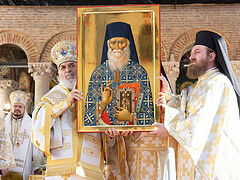
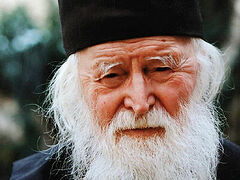
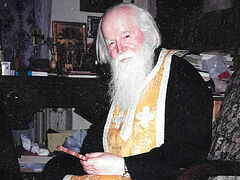
St. Sofian (Boghiu)
Archimandrite Sofian (Boghiu; 1912–2002) is one of those few people whose name is entirely appropriate, as “Sofian” means “wise” (from the Greek σοφός). This name reflects the labor of the entire life and ethos of this wise man enlightened by the grace and wisdom of God, who by virtue of this wisdom, multiplied over time through trials, became an apostle and spiritual father of Bucharest, a living member of the Church of Christ in the Romanian lands.
He began his ministry as a priest, as a spiritual pastor in Antim Monastery in Bucharest, where he was ordained and spiritually grew under the patronage of St. Antimos of Iberia, receiving three educations—first in the theological academy, then in the Academy of Fine Arts, and finally, in the strongest and most severe “special academy” of the communist prisons, as Fr. Sofian himself put it.
But it wasn’t in universities alone that Father acquired wisdom, the totality and richness of Divine gifts. Having received them from God, he nurtured them with great care, zeal, patience, and prayer all his life, especially in the monastic life, in obedience to God and his spiritual father. Fr. Sofian became a spiritual father and pastor, having first gone through the school of spiritual discipleship and the practice of humble obedience.
Fr. Sofian was and remains a model pastor. He possessed not only a wonderful education, but also a deep and impeccable theological, liturgical, and pastoral culture. Saying nothing from himself, he always referred with precision to the teachings of the Holy Fathers—enlightened teachers of the Church.
As a minister of the holy altar, Fr. Sofian was a true expert in the Church typikon, Church rites, modeled after the Heavenly order, such that all the clergy who visited the church of Antim Monastery received excellent training in the art of liturgical service. They learned from Fr. Sofian not only the typikon, how to cense, the sequence of liturgical actions and exclamations, but also Church singing and pastoral-missionary techniques, so necessary for a spiritual father. Fr. Sofian possessed the gift of heartfelt, melodious, and majestic singing of Church hymns, as well as the gift of wisdom and balance in his pastoral ministry.
“You can’t come to God, begging Him to forgive you as long as resentment against your brother lives in your heart. God accepts only what we offer him from a loving heart, not a heart that’s full of hatred, revenge, and false concepts of justice. Let us not forget that a sacrifice pleasing to God is a contrite spirit,” Fr. Sofian said.
He Softened and Warmed Human Hearts
 Fr. Sofian and cultural figures. Antim Monastery, 1980s
He was not only a priest, spiritual father, and Church painter, but also an intellectual artist, a monk adorned with virtues, endowed with many Divine gifts that he graciously, meekly, and joyfully poured out on those around him.
As a preacher, Fr. Sofian didn’t speak in a complex, academic language, although such language wasn’t foreign to him. With his sermons, counsels, and conversations, he softened and warmed the hearts of those who heard him. He spoke beautifully, not merely for the sake of aesthetics or human praise, but to inspire people to seek God and fulfill His commandments, to acquire God’s grace and eternal life. The main themes of his preaching were repentance, forgiveness, non-condemnation, prayer, alms, humility, and love.
“We can ask ourselves when God answers our petitions more quickly. This can be answered in a few ways. But the surest way is when our prayer is accompanied by fasting, alms, and a blameless life. Alms and fasting are the wings upon which prayer ascends. These three virtues—prayer, fasting, and alms—are closely intertwined and support each other for our benefit,” Fr. Sofian said.
Healer of Souls and Bodies
 St. Sofian Father’s counsels, penances, and means of correction weren’t uniform, they weren’t the same for everyone, but quite varied, corresponding to the internal age and measure of each, aimed at healing them from the passions. However, the admonition to nourish yourself with the Holy Scriptures and the teachings of the saints was universal, and St. Silouan of Athos was one of his favorite saints whose words Fr. Sofian advised to read and follow.
Father said:
St. Silouan wrote a book that is widely read in the Christian world. When I read it, I felt enlightened. This book contains the very purpose of life—to live in the Spirit of God. As he says, if we live by this humility, this love and kindness that the Savior calls us to, then we ourselves are content, full of life, full of good desires, laboring and maintaining proper relations with others—relations based on true love. When we have the Holy Spirit within us (this is what we were created for—to have Him in us), our life is full of light, humanity, love, and humility. The grace of God is very subtle. When we divert from the path of humility, obedience, and love in various incidents in our lives, then grace departs. And—God forbid—if we’re left without grace, we’re as good as dead.
In Communist Prisons
 St. Sofian, prison photo
Fr. Sofian didn’t shine alone, like a solitary star in an empty sky. Rather, he shone together with other fathers, other stars and lights of Romanian Orthodoxy known to us: Archpriest John Kuligin;1 Archimandrite Vasile (Vasilache), abbot of Antim Monastery during the time of the Burning Bush; Hieroschemamonk Daniil (Sandu Tudor), who was the initiator of the Burning Bush movement and the work of prayer that all these great confessors of Romanian Orthodox embraced and practiced; Archimandrites Felix (Dubneac) and Roman (Braga); Hieromonk Adrian (Făgeţeanu); Professor Fr. Dumitru Stăniloae; Archimandrite Arsenie (Papacioc); Protosinghel Petroniu (Tănase); Professor Fr. Nicolae Bordașiu, and others.
Fr. Sofian said:
Prison prayers are akin to the prayers of the holy hermit fathers and the hosts of martyrs burned at the stake, who, as the fire roared beneath them, were happy and thanked God for this sacrifice they were offering to His holiness. The prison prayers of many political prisoners were very similar to this. For us living today, their inspiration and their struggle suggest the thought that it’s good to humble yourself, to struggle, to live an ascetic life as much as possible, with fasting, prayer, prostrations, forgiveness of the insults we’ve received in life, and patience without complaint. And then our prayers will be accepted by God, just as the prayers in the communist prisons were accepted.
Fount of Wisdom and Love
 St. Sofian
Prudence or balance in our life means walking the Divine path, the middle path. We should always keep this balance of life before us. Because it sometimes happens that we deviate to the left or to the right. Whoever is pious and wants to do God’s will and fulfill the commandments takes up fasting, prayer, almsgiving, and a strict way of life, and this is very good. Only, let him walk the balanced path.
Be truly humble and you’ll find love; have humble love, and I assure you, you’ll be saved. Anyone who doesn’t fulfill this commandment to love others can’t be considered a Christian.
There’s no condition more pitiful than being unable to forgive your brother even in the most difficult moments in life. Those who can’t forgive can’t love. Those who can’t love people can’t love God either. And in order for us to be able to love God, we have to be at peace with others.
“Humility, love, and sincerity are of great benefit to us, so our lives and the life of Romanian society as a whole can improve,” St. Sofian taught us.
A Meek and Humble Teacher
As a confessor, Fr. Sofian used consolation more often than chastisement, so that people began to feel ashamed when they heard his fatherly advice and brotherly exhortation. Father’s meek but firm, humble and loving word pierced hearts and prompted men to acquire life and the priceless treasure of the Holy Spirit, ever looking to Christ, placing all hope in Him. With his counsel, he exhorted us to change our lives, first of all forgiving those who have sinned against us, not condemning them or saying anything bad about them, and then offering pure sacrifices of praise and thanksgiving to God.
St. Sofian said:
Humility, with the help of the Good God, destroys all of satan’s snares. Humility coupled with love is strong, inasmuch as it flows from the very Person of Christ the Savior, Who calls us: Learn of Me; for I am meek and lowly in heart: and ye shall find rest unto your souls (Mt. 11:29).
God, our rest, is Love itself, full of humility, protecting His creation from the enemy, the devil, the mortal enemy of mankind, so named by the Savior Himself, for the devil was a murderer from the beginning (Jn. 8:44).
Brethren, blessed is he who has humility: Humility doesn’t get angry and doesn’t anger another. Humility doesn’t slander, condemn, or disparage anyone. A humble man doesn’t despise another even in his thoughts. And if he sees him sinning or having one or even several faults, then he draws attention to it respectfully, face to face, so as not to offend or dishonor him. Thus he tries to correct him and truly help him. This is humility.
The Living Conscience of the Church
 St. Sofian
Father was and remains an exemplary spiritual father, a spiritual pastor, both by his impeccable life as a responsible and loving father and by his constant exhortation to prayer and Communion. In Confession, he always asked and instructed us:
“What consequences will your mistake have in terms of unity between yourselves and with the entire Church? Therefore, above all, hold on to mutual understanding and love and unity among yourselves!”
Throughout his priestly ministry, Fr. Sofian always embodied a sober ecclesiastical conscience. He felt one with the universal Church of Christ, connected with the saints and angels in Heaven and Orthodox Christians on earth, and bore his mission as a priest and minister to God and men with full responsibility.
Therefore, he commemorated every name before God with great attention, saying: “Every name is a soul, and the soul is the eternal image of God.” Fr. Sofian commemorated as many people as possible and didn’t get upset at all when someone organized a panikhida for one person. He would use this opportunity to commemorate as many names as possible. He would spend hours on end every day with Fr. Adrian and the other parish clergy reading hundreds of memorial lists at the holy altar. He never let a day pass without commemorations, and when he couldn’t go to church, he took the memorial lists and prayed over them in his cell.
St. Sofian—a Prophet of the Signs of the Times
 St. Sofian St. Sofian said:
We live in a very dangerous era and therefore, especially now, we have to be very strong; we especially have to be humble. The devil is proud while God is humble. And because of pride, the devil gets the upper hand, because man likes to be proud, not humble. Then many people—whole crowds—go over to the devil’s side and his kingdom grows stronger. Therefore, we have to watch over ourselves, but also over those with us. Help them walk God’s path, which is the path of life. The other path is the path of death, darkness, and nothingness.
The end could still be delayed if great repentance and correction were to begin, but that seems harder to me somehow. I don’t know the whole political background very well, but undoubtedly, in today’s world—which walks the broad path of pleasures and passions—surely there is some kind of leader drawing people into this race toward self-destruction.
There are institutions that don’t openly say that their policies are the destruction of mankind, because no one would listen to them then. These institutions lead nations to catastrophe, but they say they’re leading to freedom (as some understand it, not as it really is).
I say again: The world could be renewed if we made some effort and truly regretted our sins; if we all repented, from the king down to the lowest servant, as occurred in the Old Testament with the city of Ninevah.
Brief Biography
St. Sofian was born October 7, 1912, in Bessarabia, in the village of Cuconeștii-Vechi, Bălți County.2
At fourteen years of age, in the autumn of 1926, he joined Rughi Skete in Soroca County.
From 1928 to 1932, he went to a Church singing school at Dobrușa Monastery in Soroca County.
From 1932 to 1940, he studied at the seminary at Cernica Monastery in Bucharest.
On December 25, 1937, while studying in seminary, he received monastic tonsure, with his name changed from Serghie to Sofian.
On August 6, 1939, he was ordained a hierodeacon at the cathedral in Bălți by Metropolitan Titus (Simedrea), then the Bishop of Bălți.
From 1940 to 1945, he studied at the Bucharest Academy of Fine Arts.
From 1942 to 1946, he studied at the Bucharest Theological Faculty and received his degree in theology in October 1946, with the thesis, “The Image of the Savior in Iconography.”
In 1945, he was ordained a hieromonk at Antim Monastery in Bucharest.
From 1945 to 1948, he took part in meetings of the Burning Bush movement that were held at Antim Monastery.
On June 15, 1950, he was named abbot of Antim Monastery.
From 1954 to 1958, he served as abbot of Plumbuita Monastery in Bucharest.
In 1958, he was arrested and imprisoned on charges of “conspiracy against the social order through hostile mystical activity within the Burning Bush organization.” He was sentenced to sixteen years of forced labor. In 1964, he was released under a general amnesty for political prisoners.
In 1967, he returned to Antim Monastery and served as abbot until 1998, until serious health problems forced him to step down. Fr. Sofian patiently cultivated hundreds of disciples in Confession, for which he’s rightfully called the Apostle of Bucharest.
On September 14, 2002, he reposed in the Lord and was buried in the Căldărușani Monastery cemetery near Bucharest.
On July 11–12, 2024, he was canonized by the Holy Synod of the Romanian Orthodox Church together with other martyrs and confessors of the twentieth century with the title Venerable Confessor Sofian of St. Antim Monastery. His feast is celebrated on September 16 (new style).