Every person’s life consists of constant discoveries—amazing and inspiring ones. Sometimes they happen when you look forward to them, sometimes they enter your life gradually and courteously, and sometimes, when you persistently ignore them, they burst into your life, filling it up.

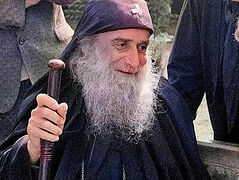
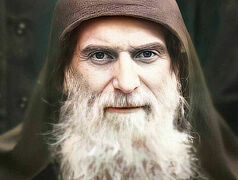
One day, when I opened an article on the website of the Moscow Sretensky Monastery, I clearly felt somebody looking at me from the monitor. An elderly man with a gray beard and merry eyes was looking at me attentively from a photo next to the text. And it was so unusual that I immediately remembered the famous fantasy novel by J. K. Rowling and “live” photos in newspapers and books. Meanwhile, the elder in the photo was clearly smiling more and more cheerfully: his eyes were sparkling and shining with some unearthly joy, a smile was slowly lighting up on his lips, and there was some movement and life in the whole image—the man in the photo breathed and exuded happiness. For several minutes I couldn’t move or take my eyes off this wonderful portrait, from which emanated such a stream of ardent love that somewhere inside, under my ribs, I could clearly feel its warming and gently burning knot. At that moment I probably looked like a teapot into which boiling water is poured. When the amazing flow of warmth overwhelmed everything, tears welled up from my eyes, and at the same time I felt indescribable happiness. It’s as if someone very close and dear were hugging you—like a small and defenseless child—after a long separation, and you know that from now on he will always be with you.
Seeing my tears, my daughter wondered if everything was okay with me. I showed her the photo and explained what had happened as best I could. She examined the image carefully and said, “Mom, this is someone very nice and kind. Awesome!”
The elder in the photo was St. Gabriel (Urgebadze). To my great shame, by that time I had known little about this saint, his life and ministry. My unusual acquaintance with him came like a statement of the fact: God is Love—full stop!
A week later, a particle of St. Gabriel (Urgebadze)’s relics was brought to the Holy Trinity Convent of my native city. And a day later, on the very birthday of the beloved father, the relics began to stream myrrh.
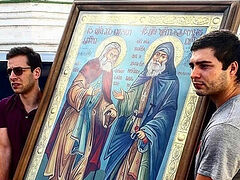
 Our second meeting with Fr. Gabriel (Urgebadze) was less emotional. The elder’s image smiled reservedly at the parishioners. I introduced my children to him. The younger one (my son) in a businesslike manner asked the elder to increase his intelligence, and the daughter bought a small icon of St. Gabriel in the church shop. We went back to Moscow, and the icon of the elder—the “great love of the twentieth century”—went with us.
With surprise I was learning more and more about the renowned saint, who loved fasting and prayer in solitude from childhood, built a multi-domed church in the courtyard of his house and collected icons from the city trash dumps. He was persecuted and once even sent to a mental hospital. This true ascetic had an ardent faith, possessed the gift of spiritual discernment, saw the innermost secrets of human hearts, and was clairvoyant. Numerous healings occur at the tomb of the elder, who is not only venerated by the Georgian people, but also by the whole of Orthodox world.
His contemporaries remember Elder Gabriel as a simple, humble and loving man, whose words possessed Divine authority and power. He could be strict, but he always took pity on repentant sinners, hugging them wholeheartedly, giving them hope and love. Even today, the holy “fool-for-Christ” inspires love in people’s hearts, strengthens their faith, and—both invisibly and visibly—accompanies believers who embark on the path to salvation.
Elder Gabriel would always repeat that “faith is a God-given talent”, “humility is an inextinguishable candle pleasing to God”, “every trial will pass by the humble without touching them”, “mercy is gold, and humility is a diamond”, and that “only with a heart full of love can you denounce someone else’s sins”.
“Mama Gabriele”, as they called him in Georgia, always humbled himself: “Whenever I start to consider myself better than others, I put my copper diadem on my head and go out barefoot. As people look at me they laugh, and I see what a nonentity I am.”
The elder taught us not to judge and reminded us that our lives are incomplete without God’s help: “Even if you see a murderer, a harlot or a drunkard lying on the ground, do not judge anyone. God has given them the reins, but He is still holding yours. If he gives you the reins too, you may find yourself in a worse situation by committing the sins you are judging them for, and perish”; “Don’t judge, God Himself is the Judge. He who condemns others is like an empty wheat ear, with his head lifted high he looks down on others.”
 St. Gabriel would also say that the Lord’s mercy is boundless: “The Lord had mercy on the harlot and saved the thief. St. Mary of Egypt used to be a harlot, but with God’s help she began to struggle in the desert, fasted, prayed, and overcame her passions, was cleansed of all the sins, and became worthy of the Heavenly Kingdom. The Lord will both humble you and exalt you.”
He taught us to love everybody, and if we can’t, then at least we must wish everybody well: “Live in a way so that not only God but people too can love you—there is nothing greater than that.”
“There is no one on earth who can fully explain what love is. You won’t understand it on earth.”
“If you hate even one person, you hate Christ Himself in his image and are far from the Heavenly Kingdom.”
Elder Gabriel considered good deeds to be the equivalent of love: “God does not accept empty words. God loves good deeds. Good works—this is precisely what love is.” The saint preached caring for our neighbor as a path to salvation: “If somebody is sick and needs medicine, and you have to bring it from afar—maybe at night, and walk through a forest where wolves roam—and you don’t hesitate to embark on such a journey to save your neighbor, that’s love.”
“Mama Gabriele” warned that if you don’t fulfill God’s commandments, then it is no use bothering God with prayers—such a prayer would be a sin. He taught us to pray for our enemies: “First, start praying for those you love most—for example, for your children. Then pray for the rest of your family. Next for all your neighbors and relatives so that you don’t have any enemies. Bless the city you live in, but Tbilisi is not alone—bless all the inhabitants of Georgia. And Georgia is not alone: it is surrounded by other countries, so ask God for people not to feud with each other. Now that you have prayed for everyone and there is only your enemy left, don’t forget him either. Ask God to fill his heart with kindness and his mind with wisdom. That’s how you can pray for your enemy.”
The elder insisted that a person’s spiritual state is seen by his clothes, that it is no good giving advice without knowing a person’s spiritual state, and also that we create our own “fate” ourselves: “If somebody recklessly endangers his life and dies, he commits a sin, and fate has nothing to do with it.”
Once, answering a monk’s question about what fasting is, Elder Gabriel enumerated all his (the monk’s) sins. Ashamed, the monk fell to his knees and burst out sobbing. Then the elder smiled: “Now go and have your lunch.” However, the monk replied that he did not want to. “This is what is called fasting: when you remember your sins, repent and no longer think about food.”
St. Gabriel (Urgebadze) warned us: “The Lord does not forsake man, but man forsakes God. Hell is separation from the Lord”; and “If you could see what grace descends during the Liturgy in church, you would readily gather the dust from the floor and wash your face with it!”
He especially reminded us that monks are “soldiers” who cannot be carefree, and argued that “any monk must do physical work, otherwise he will be despondent and will not be saved”; “a good monk should have a sensitive heart, like a woman’s”; and “for a good monk one prosphora a day should be enough.” He argued that praise is pernicious to monks, and “he who praises monks is an enemy of monasticism” and that “monastics should live in simplicity. Simplicity is the grace of God.”
Elder Gabriel advised his numerous spiritual children to strive for God tirelessly: “Seeing your aspiration, God will provide you with everything you need.” And: “For God it does not matter whether you are a monastic or a layperson. The main thing is to strive for God. It is through striving that a person is saved. Monastic things will be required of monastics and lay things of laypeople.”
This is how the wondrous St. Gabriel (Urgebadze) reminds us of the source of unquenchable Divine love, of the unchanging path of salvation. And he continuously makes new discoveries in people’s lives, warming up souls that have gone astray with his warm heart and lively smile.