Minsk, November 6, 2025
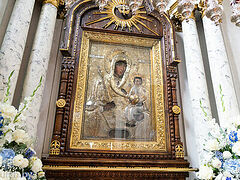
 Zhirovichi Monasery. Photo: monasterium.ru
Two ancient monasteries have been declared spiritual centers of the Belarusian Orthodox Church.
The Belarusian Synod met on October 17, to consider the issue. After hearing a report from His Eminence Metropolitan Veniamin of Minsk and Zaslavl, the Synod agreed that creating such spiritual centers would benefit the Church’s spiritual life.
Given their historical importance to Orthodoxy in Belarus and their role in shaping the nation’s spiritual, cultural, and governmental traditions, the Synod decided to designate two monasteries as Church-wide spiritual centers: the Spaso-Euphrosyne Convent in Polotsk and the Holy Dormition Monastery in Zhirovichi, reports the Moscow Patriarchate’s Synodal Department for Monasteries and Monasticism.
The Synod will consider granting similar status to additional churches and monasteries at a future meeting.
Throughout history, churches and monasteries have served as places where people experience God's presence, receive intercession from the Theotokos and saints, and find spiritual comfort. Certain sites hold special importance—those linked to Belarusian saints and housing major Orthodox relics that form part of the nation's spiritual and cultural inheritance.
The Polotsk and Zhirovichi monasteries rank among the most important such sites. These monasteries hold deep meaning for Belarusian believers and enjoy recognition internationally. The government supported major restoration projects at both locations, completed in 2025. These improvements will allow monks, nuns and pilgrims to worship for many years in historic monastery churches and enjoy well-maintained grounds and architecture.
The Synod’s resolution emphasizes that institutions receiving spiritual center status should expand their religious education efforts, focus on ministry to young people, engage in social outreach, and provide catechetical instruction.
***
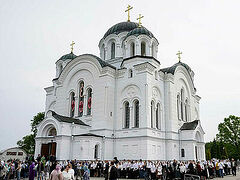
 Polotsk Monastery. Photo: monasterium.ru
The Spaso-Euphrosyne Monastery was founded around 1125 when St. Euphrosyne established a monastic community at a location called Seltso. A stone Church of the Savior was constructed in just 30 weeks.
In 1582, Polish King Stephen Bathory transferred the monastery to the Jesuits. It briefly returned to Orthodox control when Russian forces took Polotsk in 1654, but was given back to the Jesuits in 1667 under the Treaty of Andrusovo. The Jesuits were expelled in 1820, and the monastery passed to the Catholic Piarist order. The Savior Church was returned to Orthodox control in 1832, and the monastery itself was revived in 1841.
In 1910, St. Euphrosyne’s relics were solemnly transferred from Kiev to the monastery. Soviet authorities closed the monastery in 1925, confiscating valuables including the cross-reliquary and silver reliquary containing the saint's relics. The monastery reopened during German occupation in 1943. It was closed again in 1960, with the sisters transferred to Zhirovichi Monastery. The monastery was finally revived in 1989, and restoration work transformed it over the following years.
***
Zhirovichi monastery was established in 1520, and construction of the Holy Dormition Cathedral began in 1629. It was subsequently rebuilt and reconstructed several times. It acquired its modern appearance in the second half of the 1800s.
It was at the Zhirovichi Monastery in 1839 that the Lithuanian Uniates signed the act of reunification with holy Orthodoxy, under the much-venerated Metropolitan Joseph (Semashko) of Vilnius and Lithuania. The monastery thus became the first spiritual center in Belarus for the restoration of Orthodox worship.
Follow OrthoChristian on Facebook, Twitter, Vkontakte, Telegram, WhatsApp, and MeWe!