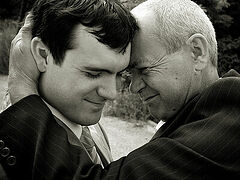
At the very heart of the Law of God, on the Tablets given to Moses, there is a commandment with a promise: Honor thy father and thy mother: that thy days may be long upon the land which the Lord thy God giveth thee (Exod. 20:12). For many, these words are a source of blessing and the foundation of strong and healthy families. But what should someone do if the words “father” and “mother” do not evoke warm feelings or gratitude, but chilling horror, shame and mental anguish? A childhood was stolen by a alcoholic parents, poisoned by emotional abuse, and lost through indifference and rejection. For such a soul, this commandment will be a heavy weight on the heart rather than consolation. Such people have a feeling of guilt, bitter and unfair: “I can’t honor them, so I’m a bad Christian.” Their hearts are torn between their duty and an instinctive desire to escape suffering. Let’s consider what the Bible tells us about such a situation and how to live with it, combining spiritual truth and psychological well-being. What does “to honor” mean? It does not mean “to tolerate violence”.
First of all, let’s highlight a very important point. To honor does not mean to allow yourself to be destroyed. In the original Hebrew text, the word “honor” (כָּבֵד) means “to be heavy”—that is, to have importance and meaning. Honoring parents means recognizing their importance in your life, given by God, and recognizing their authority to in its healthy manifestations. But nowhere in the Scriptures do we find a call for slavish submission and patient acceptance of evil, especially when your life, soul, and faith are in danger.
The Lord Himself sets the boundaries. The Book of Genesis says: Therefore shall a man leave his father and his mother, and shall cleave unto his wife: and they shall be one flesh (Gen. 2:24). It’s not just about marriage. This means that in order to build a new and healthy life it is sometimes necessary to abandon the old toxic system. This is God’s plan for a growing personality. Even Christ mentions family, speaking of abandoning everything for His sake: He that loveth father or mother more than Me is not worthy of Me (Mt. 10:37). God must always be put first. If the parents’ demands go against the will of God (and God’s will is our wholeness, freedom from sin, and life), then it is our duty to choose God. Ye have heard that it hath been said, Thou shalt love thy neighbor, and hate thine enemy. But I say unto you, Love your enemies, bless them that curse you, do good to them that hate you, and pray for them which despitefully use you, and persecute you (Mt. 5:43–44). Abusive parents in fact become their children’s enemies. And here Christ gives a paradoxical commandment: to love. But let’s be frank: How can you love someone who constantly torments your body and soul?
Biblical love (ἀγάπη; Greek: “agape”) is not a feeling or an emotional attachment. It is a decision of the will, an act. To love such parents in a Christian way means, first of all, to pray for them. Ask God for their healing, salvation, and enlightenment. It’s hard, it requires a spiritual feat, but it breaks the vicious circle of hatred and revenge in your heart. We must wish them well. Not to the detriment of ourselves, but in the perspective of eternity—to wish them to meet with God and change. And we must forgive them. Forgiveness is not an excuse for evil. It doesn’t imply that “everything you’ve done is fine.” Rather, it means: “I commit your case to God’s judgment and refuse to bear the poison of hatred towards you in my heart any longer.” Forgiveness is an act of self–liberation in the first place. As the psychologist Casey Combden said, “Resentment is a poison that we drink in the hope that it will poison someone else.”
But immediately after the commandment to love your enemies, Christ instructs: Be ye therefore wise as serpents, and harmless as doves (Mt. 10:16). The wisdom of the serpent is caution, the ability to avoid danger. From a psychological point of view, this means setting healthy boundaries. It is wiser to rescue a drowning person than drown together with him. In essence, psychology echoes the Biblical wisdom: you cannot be responsible for someone else’s sin and illness.
It is important to recognize the problem. The first step is to allow yourself to call a spade a spade. Yes, my parent is an alcoholic/tyrant. Yes, he is prone to violence and insults. Yes, he hurt me. We must stop pretending that “everything is fine” or “they didn’t know what they were doing”. They knew. Sin is always a conscious choice.
You will have to distance yourself. It can be physical distancing—moving, limiting contacts, and sometimes completely stopping communication for a while or forever. It can also be emotional distancing—to stop expecting love, acceptance, and apologies from them. Stop investing in a relationship that is a bottomless pit. It’s not a sin—it’s an act of self-preservation.
Sometimes it’s worth asking for help. God works through people. Bearing the burden of your childhood trauma alone is unbearable and unnecessary. Find a Christian psychologist, a religious counselor, a psychological support group, or even just people with similar traumas. And, of course, don’t forget about God. The Church should become your new spiritual family where you will find support and healthy treatment of each other. Learn to take care of yourself. Your body is the temple of the Holy Ghost (1 Cor. 6:19). Your task is to protect this temple from destruction. Taking care of your mental and physical health and allowing yourself to be happy is your duty to God.
But how can we honor such parents now? What remains of the commandment? You can honor them from a distance: pray for them, not take revenge, and not wish them ill—all this is honoring your parents too. In a critical situation, if they are in danger, calling an ambulance is a sign of honoring (because you recognize the value of their God–given lives). Being a good person, living with dignity despite their evil influence is the highest form of honoring. You show that their sin has not broken the image of God in you.
God is not an indifferent tyrant who demands the impossible from us. He is the Father, The Lord God, merciful and gracious, longsuffering, and abundant in goodness and truth (Exod. 34:6). He sees your mental anguish and collects each of your tears in a vessel. He doesn’t want you to die in a toxic swamp, hiding behind the word “reverence”.
Your soul and your life are precious in the eyes of God. To save it, to get out of the hell of family dysfunction, is fulfilling God’s will for you. And you can honor such parents from afar, with love and sadness in your heart, praying for them and entrusting them and your healed life into the hands of the One Who is the only perfect Father for all of us.
When we meet a person who grew up in a family where mental anguish, alcohol, or icy indifference reigned, we see only the tip of the iceberg. Under the water are scars invisible to the world: wariness, inability to trust, the habit of always waiting for a dirty trick... The soul of such a person is a house built on quicksand, where there is anxiety instead of a foundation, and the walls are built out of resentment. Such people may seem prickly, overly independent, or, conversely, in acute need of approval. But there is always an unhealed childhood trauma behind it—a cry for love that was never given by the closest people.
How should we treat such people? The only answer is with patient and gentle love. God, Who is a father of the fatherless, and a judge of the widows (Ps. 67:6), sees every such story. He does not condemn anguish, but heals it. And He calls on us to be His hands and instruments on earth. This means discarding all such banal scholastic advice as “just forgive” our “you must respect your parents”, and instead realizing that prickliness and distrust are the armor that has been saving these people from their traumas for years. This is not their essence, but a shield that they are afraid to lower.
Our task is not to “fix” their past, but to create a safe present for them. Charity suffereth long, and is kind; charity envieth not; charity vaunteth not itself, is not puffed up, doth not behave itself unseemly, seeketh not her own, is not easily provoked, thinketh no evil (1 Cor. 13:4–5). Your patience when they test the boundaries, your reliability when they wait for a dirty trick, and your unfailing kindness will become for them living and tangible evidence that there is another Love. That you need not scream to be heard, need not crawl to be pitied, but you just can be what you are—and be accepted.
Become for such people a quiet haven where you can be silent, cry together, talk about trifles and bit by bit piece together their broken selves. Don’t give unasked-for advice, but be prepared to listen. Don’t demand momentary trust, but be worthy of it with your faithfulness. Your presence will become the solid foundation on which, perhaps for the first time, these people will begin to build a new, real house—that of their healed souls, where the windows will be open to the sun and the doors to true, unconditional love. And this is our common labor of love: to help them see in our eyes a glimmer of the gaze of the Heavenly Father, Who will never forsake or betray.