We have talked with the Abbot of the Holy Trinity Monastery (ROCOR) in Mexico City (Mexico), Schema-Archimandrite Nektary (Haji-Petropoulos). He has told us how to combine medical practice with monastic service, and how a political assassination impacts on the firmness of faith.
 Schema-Archimandrite Nektary (Haji-Petropoulos)
In the giant megalopolis of Mexico City, where ancient Aztec temples stand adjacent to Spanish Catholic cathedrals, and streets are filled with hustle and bustle, there is a place where time flows differently. Behind the inconspicuous door of a colonial-style building, a world opens up full of prayerful stillness, Russian liturgical singing and that special way of life that has been preserved in Orthodox monasteries for centuries.
Here, in the heart of Catholic Latin America, a Russian Orthodox monastery has existed for almost twenty years now, whose history is a chronicle of miracles, obtained through much suffering and obedience and confirmed by faith. Its abbot, Schema-Archimandrite Nektary—a monk, a doctor and a missionary—has kindly agreed to tell us not only about their problems and trials, but also about the grace-filled power that helps them not only survive, but also bring the Gospel light to a difficult and sometimes hostile environment.
Fr. Nektary has an amazing life. He was born in 1965 in Istanbul into an Orthodox family. His paternal grandparents were Greek, originally from Sukhumi, and his mother’s family was from Iran. The future schema-archimandrite spent his childhood in Istanbul and Tehran. When the boy was twelve, his family moved to New York. His mother died of leukemia when he was fourteen. Before her death, she entrusted her son to the care of their family’s father-confessor—a bishop of the Patriarchate of Constantinople in Mexico City. Here, at the age of eighteen, the young man took monastic vows with the name Nektary in honor of St. Nektarios of Aegina. While still a simple monk, he and several other monks visited dozens of monasteries in the Holy Land, Greece, and the Balkans in the hope of understanding God’s will for themselves.
Finally, he made his choice and in 2005 entered the Holy Trinity Monastery (ROCOR) in Jordanville, where after some time he was ordained by the ever-memorable Metropolitan Laurus (Skurla; †2008): first as a hierodeacon, and later as a hieromonk. After that, Fr. Nektary, with the blessing of Metropolitan Laurus, returned to Mexico to open the doors of the Holy Trinity Skete (now a monastery) for Russian-speaking Orthodox believers living in that country.
Schema-Archimandrite Nektary is a highly educated man. He holds several academic degrees in theology, medicine, and history. He speaks six languages. The monastery brethren are well matched for him: all of them have a higher education and speak several languages.
The Monastery of Obedience: How to Survive through Prayers and Blessing Alone
 Metropolitan Laurus (Skurla) The story of the monastery’s foundation is a contemporary parable about faith moving mountains. This idea belonged to the First Hierarch of the Russian Orthodox Church Outside of Russia, His Eminence Metropolitan Laurus—a man whom Fr. Nektary remembers with special fondness as a holy elder. Realizing that it was almost impossible to provide for a married priest and his family in one of the most expensive cities in the world, Vladyka Laurus gave his blessing for the establishment of a monastery there.
“Our metropolitan believed that there was no way to pay a married priest to come to Mexico—there were no resources for that. So Vladyka said, ‘If we send monks, they will find a way to survive and serve the sacramental needs of the community.’”
Thus, Fr. Nektary received a new and crucial obedience. When he asked in perplexity what funds would be allocated for such a complicated mission, Vladyka’s answer was like a Gospel promise:
“I said to Vladyka, ‘Oh, we have nothing. We don’t have any money, we don’t have a job.’ And he replied, ‘You have our prayers and our blessing.’ Metropolitan Laurus was indeed a holy man. And, of course, through his prayers we have survived,” recalls Schema-Archimandrite Nektary with deep emotion.
The beginning was more than modest, almost desperate.
“Initially, we had no one, no flock. There was nothing. We had to start from scratch.”
The monastery was built in a derelict private house that had stood empty for many years. Fr. Nektary received a State license to restore this historic building and, together with the brethren, put it in order on his own.
“We restored this house on the condition that we would use it ourselves.”
Thus, through the prayers of Metropolitan Laurus and the Herculean efforts of the monks, a Russian Orthodox monastery was born in the heart of this Catholic country.
“The Monastery Supports Programs”: Labors for Salvation
The Mexican monastery is unique because it is absolutely self-sufficient. Contrary to the traditional model, it does not exist on donations from benefactors, but on the earnings of the brotherhood itself. All the monks, including the abbot, work in the world full-time.
“All of our fathers work full-time. Our entire salaries go just to pay the rent. Because renting this place is very, very, very expensive,” explains Fr. Nektary.
He is a practicing psychiatrist, a professor who works in a private hospital and conducts online classes for students from Spain, which gets him up at three in the morning. Among the brethren is Fr. Arseny—the only Orthodox icon painter in Latin America, as well as a journalist. Fr. Christopher is a teacher of languages, a philosopher with an academic degree. All of them are highly educated people who speak several languages fluently and have devoted their professional talents and knowledge entirely to the service of the Church and the flock.
This principle has become the cornerstone of their existence. All income from secular work goes on rent, church maintenance and extensive social activities, which are not supplementary, but the essence of their mission in this city.
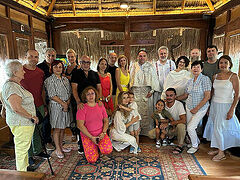
 Members of a group studying history and art at the Holy Trinity Monastery
Ministry of Mercy
The social ministry of this monastery impresses with its scope, dedication and willingness to challenge the darkest sides of human nature. The monastery provides medical and psychological assistance in Russian to alcohol and drug addicts, victims of domestic violence, and helps the needy and unemployed. Over the past three years, the monastery has provided aid to around 2,000 refugees from different countries who found themselves in Mexico without funds, shelter and hope.
But the toughest, most painful, and, alas, regular part of their work is helping Slavic women who married Mexicans after meeting them online. “In ninety-nine percent of cases, these marriages end in disaster,” the brethren state with pain.
After six months or a year of living together, when children are already born, the initial idyll turns into a nightmare. Women become victims of severe domestic violence, which became particularly acute during the Covid-19 pandemic.
Husbands often take away passports from their Slavic wives, deliberately do not legalize their relations, leaving them in a legal vacuum, total dependence and despair. “So they have nothing except the Church.” The monastery has lawyers who handle the cases of these women for free.
“And we usually win. So we are really respected and loved in the community, because we help many women.”
In order to protect the monastery itself from litigation and possible scandals, Fr. Nicetas founded an officially registered civil association, through which all legal and human rights work is conducted. This, however, does not protect him from lawsuits from embittered husbands, but he takes it as an inevitable part of his cross.
An even more frightening and dangerous aspect of the monastery’s ministry is helping victims of human trafficking. Young women from Eastern Europe are tricked into coming to Mexico allegedly to work as dancers, and then forced into prostitution, while their passports and even children are taken away.
“If they refuse to do what they’re told, they won’t be able to see their children, let alone get their documents back.”
Notoriously, the pimps, cynically using the last shreds of faith in their victims, sometimes bring them to church.
“Oh, because they’re very cunning. They know that these women need some relief. And these poor women pray, begging all the time to let them see their children. So these scoundrels bring the poor women to church so that they can cry their hearts out, light candles, pray—and then they take them away again.”
It is in these brief moments that the clergy have time to speak to unfortunate women, assess their situations and offer them real help.
“This is a very tough question. And we’ve faced this many, many times... I try not to talk too much about this issue because it’s dangerous. But despite the hazard, we continue to help.”
This service entails risks, but to quit it is to betray those who have no one else.
Between the Cell and the Church: a Symbiosis of Monastic and Parish Life
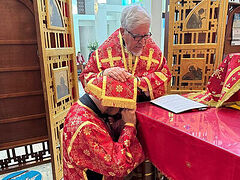
 During the sacrament of wedding
Originally, the monastery was conceived as purely monastic, without parishioners, but Divine Providence ordained otherwise. Over time, the monastery got its own flock, mostly Russian–speaking families who had ended up in Mexico. Fr. Nektary faced a hard dilemma—how to combine the strict monastic rule with the needs of laypeople? He turned to his ruling hierarch for a blessing.
“I asked him: ‘Vladyka, what should I do? I mean, it’s a monastery, but have a lot of parishioners.’ And he replied: ‘I will give my blessing for the monastery to serve as a parish on weekends and on the great feasts.’”
This formed a unique hybrid of a monastery and a parish, born out of necessity and sanctified by blessing. On weekdays, it is a closed monastery with a monastic rule, silence and solitude. But with the coming of the weekend, its small space is transformed.
“Yesterday the birthdays of some parishioners were celebrated here—about seven birthdays. So there were plenty of people... Children were running around and shouting. We accept this because it’s a parish on weekends.”
So that the brethren would not be deprived of the opportunity for solitary prayer and strict observance of the rules, sketes were founded outside the city, in rural areas. But the main life, service and labor are concentrated here—in the heart of a city of many millions, where the monastery has become for many not just a church, but a house of prayer, a family and the last refuge.
A Doctor and a Pastor: at the Intersection of Faith and Science
Fr. Nektary’s education and professional path are unique and multifaceted: he is a theologian, a general practitioner, and, lastly, a forensic psychiatrist. This amazing versatility allows him to carry out his ministry at the very intersection of faith and science, finding common ground between medical knowledge and spiritual experience.
As a practicing psychiatrist, he constantly encounters cases where people suffering from serious mental disorders such as schizophrenia are considered possessed. Catholic priests who have unsuccessfully tried to perform the rite of exorcism over them sometimes invite him for professional counsel.
He describes one such case involving a teenage girl whom everyone, including her family, believed to be possessed. Numerous doctors and psychiatric clinics were powerless to help her.
“She knew that a priest would come who would exorcise the demon. Once she saw me, she ran to hide. I followed her with holy water and began to read prayers from the service of Baptism over her. The girl started screaming, but she was healed.”
Why did his intervention help?
“Because it was schizophrenia, but she really believed that she was possessed. So the girl believed that only a priest specializing in exorcism would able one to help her.
“It was a healing act of faith that changed her consciousness—a kind of ‘placebo effect’, but on a spiritual level.”
Fr. Nektary is firmly convinced that miracles of healing still occur today, but since the apostolic times the main thing has changed—the measure of people’s faith. He emphasizes the importance of a proper humble attitude towards illness and health.
“I don’t think we should pray for healing. First of all, we must ask God for acceptance. We must ask for patience and acceptance of His will... If He deems it necessary to heal us physically, we will be healed. But we will be healed spiritually anyway.”
 The holy New Martyr Ephraim the Wonderworker He has also shared his personal, very intimate experience of miraculous intervention. Finding himself in a very difficult physical and spiritual condition, having exhausted all earthly strength, he went to Greece, “hoping at least to die in a country where there are Athonite monks.” There, through the prayers of the New Martyr Ephraim of Nea Makri,1 whom he had not previously known, a miracle occurred. After this saint’s appearance in a dream, the painful tumor, diagnosed by doctors as cancer, vanished without a trace. The doctors just shrugged their shoulders, explaining it as “spontaneous remission”.
“I can’t speak about it because it’s too great and sacred just to feel the presence of the Lord. Just to know that He looked at me for one second—the Lord looked at me and had mercy on me. So it’s very great and very, very sacred.”
These words are not a rhetorical figure of speech, but evidence of a genuine, almost unbearable awe for a touch of grace.
The Godfather’s Testament: Lessons in Humility from Bishop Pablo
Fr. Nektary’s spiritual father and godfather—Bishop Pablo/Paul (secular name: Francisco de Ballester-Convalier; 1927–1984)—played a very important role in his life. He was an outstanding personality: a former Franciscan monk who converted from Catholicism to Orthodoxy and became the first bishop of the Patriarchate of Constantinople in the Western Hemisphere who had converted to Orthodoxy. He built a magnificent Orthodox cathedral in Mexico City, and was a brilliant lecturer widely known even far beyond Mexico.
It was Bishop Pablo who brought young Nektary to Mexico, becoming not only his spiritual mentor, but also his family. His martyrdom (he was shot dead while leaving the church after the Sunday Liturgy, and Fr. Nektary was with him at that moment) became the hardest ordeal and turning point in the young monk’s life. But the memory of Vladyka, his faith and perseverance strengthened Fr. Nektary and determined his future path.
 “Not so much what he told me, but how he behaved in relation to faith, because he was a true monk.”
Bishop Pablo, who moved in the highest circles of society, had fame, power and the support of the President’s wife, led an extremely simple and ascetic life.
“His way of life was very simple. Very, very ascetic. And that was the example I got from him—how to be a humble person, especially before the Lord. That’s what he always taught me. You must be humble before the Lord—always, at any moment.”
Fr. Nektary has borne this testament of humility, reinforced by a personal example, throughout his life, full of incredible labors, sorrows, dangers and at the same time miraculous grace. This testament of his spiritual father became the foundation on which all Fr. Nektary’s pastoral and missionary activities were built.
“Russia Is a Real Treasure That keeps Our Faith Alive”
Concluding our conversation, Schema-Archimandrite Nektary asked me to convey a simple but meaningful message to readers in Russia. He, having observed Orthodoxy from the outside, from a considerable distance, has noted a curious phenomenon: In Latin America, interest is growing not just in Orthodoxy, but specifically in its Russian tradition.
“People are more attracted to Russian Orthodoxy, perhaps because it is very strict and very monastic... To be Russian Orthodox is a greater responsibility than any other Orthodox.”
He sees this in the Confessions of his parishioners, who, with childlike simplicity and seriousness, repent of the pettiest (from the point of view of an external observer) violations of the Typicon: “Father, father, I’m sorry—I had some cheese on Friday.” Or people will say: “I couldn’t finish my evening prayers... I’m sorry, Father.”
It is precisely in this faithfulness to the “small” rules, in this reverent striving for the strict observance of tradition, in the strictness of the Typicon, that Schema-Archimandrite Nektary sees the earnest of preserving a living faith rather than formalism.
“Please, dear Russian brothers, keep doing this. Yes. Because this faithfulness is the treasure that keeps our faith alive... If you give up these things, then you will abandon your faith. Because all this brings you closer to God.”
Fr. Nektary’s monastery in the heart of Mexico City is a living, breathing and joyful testimony to how faith, strengthened by much suffering, obedience and humility, and embodied in boundless, sacrificial mercy, is able not only to survive under the harshest conditions, but also to become light, warmth and indestructible hope for the entire world around you, which is sometimes very dark.