Not long ago, in my new series of articles, I began writing about the Church of the Resurrection of Christ near the Warsaw Railway Station and about people who overcame alcohol and drug addiction. In this piece, I want to share two stories of how, with God’s help, addicts found healing and true freedom. These are stories of hope—living testimonies to the power of Christ.
He Was Taken Home Drunk—Still in His School Uniform, with a Young Pioneer Tie Around His Neck
Vitaly’s Story
Vitaly started drinking when he was fifteen or sixteen. He was a sad, withdrawn boy, constantly haunted by fear. Alcohol became his “cure.” When he drank, he became talkative; the fear seemed to disappear. The very first time he tried it, he drank himself senseless. He collapsed, and his friends carried him home—still wearing his school uniform and the red Young Pioneer tie around his neck—completely drunk. His parents hushed up the incident, but Vitaly’s dependence only deepened. Drugs soon followed.
Looking back, Vitaly believes the root of his addiction was his lack of faith in God.
One day he learned that some addicts had managed to stay sober for as long as seven months. To him, it seemed beyond comprehension—he couldn’t last even a day without drinking. But he wanted to be like those people.
For eight long years, however, his life fell into a relentless cycle; he’d stay sober for three months, relapse, and start again. Then came another short period of abstinence, followed by another fall. Once he even managed a full year of sobriety. For some reason, he began to count and “accumulate” his sober days—as if keeping score would somehow bring him closer to freedom.
Vitaly knew that healing was in God’s hands. But he also felt that God was far away—as if the Lord could hear everyone except him.
Then, one day, something miraculous happened. During yet another six-month period of sobriety, Vitaly and his friend Nikita traveled to Pushkin Hills. Deep in the forest, a priest lived in a small wooden hut. Near it stood a massive tree with two huge trunks.
Nikita asked whether they could help with anything. “Cut down that tree,” the priest said—and handed them a small, worn saw.
Vitaly began to saw. The work was exhausting; sweat poured down his face. After half an hour, the priest told him to stop and rest, but Vitaly insisted on finishing. Finally, he sawed through one of the trunks—and from that day on, he never drank again.
Later, reflecting on what had happened, Vitaly said it was as though he had sawn off a part of himself—the part enslaved by addiction. Perhaps that very trunk symbolized his craving for alcohol and drugs—the gnawing compulsion that drives a person to use against all reason. Whatever it was, that day became a turning point in his life. The forest where it happened remains a sacred place for him to this day.
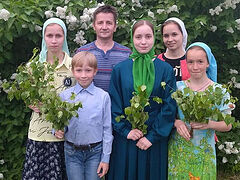
Back then, Vitaly had no family, no children, and lived in deep loneliness. Now, he has a wife and five children—from a toddler of one and a half to an eighteen-year-old son.
He sees his new life as a blessing—as is his decision to entrust it entirely to God. His family, his home, his work—all of it came through patience, labor, and prayer.
“What’s gained through honest work and given by God will stay with you,” Vitaly says. “It becomes a blessing. But what comes from darkness—the high, the thrill, the easy money—comes fast… and makes you pay for it later. And often, the price is high.”
With His Life, God Made the Impossible Possible
Alexander’s Story
This story is yet another testimony that with God, a person can overcome anything—even rise again from the ashes. But this, of course, requires the person’s own will and effort.
Alexander agreed to share his story openly—under his real name and with his photographs.
“My First Drink Was in Kindergarten”
 Alexander at a volunteer clean-up Alexander grew up in Kazakhstan in a large family of five children—four brothers and one sister. He was one of the middle sons.
He first became acquainted with alcohol at an age when most children are still learning to write.
“The first time I consciously drank was when I was seven,” he recalls. “But I tried it even earlier—after the steam bath, our grandmother would give some to the oldest of us. I remember the moonshine tasted sweet, but I didn’t understand what it was. And in first grade, at the New Year’s party, I already drank for fun.”
His childhood was harsh—shaped by the streets. He was “taught” through beatings, not words. They’d show him something one day and whip it out of him the next. It made no sense to him. Searching for comfort, he turned to alcohol and later to drugs. By the age of ten, Sasha was already drinking vodka.
“With God, one can overcome any obstacle and rise from the ashes,” he says now. “But that’s possible only when a person truly desires it and is willing to fight for it.”
When his older brother left for Russia to study, Alexander felt suddenly free. By thirteen, he had tried drugs. From fifteen onward, he used cannabis constantly. He learned to hide the truth—he knew that honesty only brought him punishment. That was how life on the streets taught him to survive.
Falling Deeper
Alexander thought he would stop someday—that he could quit when he wanted. But the habit took complete control. Each time he used drugs, it felt, for a moment, like everything was fine. But it was an illusion.
At seventeen and a half, he was arrested for drug possession for the first time and sentenced to a year and a half in prison. Upon release, he promised himself to change. Yet, within the same year, he was caught again—this time with thirteen kilograms of wild-harvested cannabis.
He was sentenced to eight years, served five, and was released early. Again he vowed to start fresh. He met a young woman, and soon they had a daughter. But addiction proved stronger than love or reason. He abandoned his family and returned to his old ways. It was 1993.
“We lived in Moscow. I had a job, even some prospects for promotion, but all I cared about were alcohol, drugs, and women. Family—that was just my cover, a way to stay out of prison,” he admits.
In 1997, he was imprisoned again.
By then, Sasha (Alexander) trusted no one. He believed he was allowed to fail, while everyone else had to live by the rules. His thinking was completely warped, but he didn’t care. The madness only grew.
He was released from his third sentence in 2001. Once again, he hoped things would change. But they didn’t. The drugs remained—only now he turned to newer, stronger ones.
He met another woman, and she bore him a son. Alexander thought that fatherhood would finally steady him—that it would give him purpose.
“I thought my son would change me,” he says. “That my life would finally settle down.”
But it didn’t.
In 2007, Alexander left home for work one morning—and never came back. Alcohol had taken hold again. His second family fell apart, just as the first had.
“With His Life, God Made the Impossible Possible”
Alexander’s Turning Point
At that stage, Alexander had completely lost control of his life. He lived in abandoned buildings, reeked of alcohol, and yet—paradoxically—thought of himself as a “ladies’ man.” Once he even stole a phone from his son’s teacher and went into hiding. Under the influence, he deliberately put himself in danger, taking actions that could have easily ended his life. He had hit bottom, though he still didn’t understand it.
In 2014, after yet another binge, Alexander went to see his sister. By then, she had had enough. After his third drunken outburst, she put him on a train to St. Petersburg, to their eldest brother. That was where Alexander’s recovery began.
A House of Hope
Alexander’s brother worked as a counselor at a rehabilitation center called “House of Hope on the Hill.” He sent Sasha there. It was 2011.
Something in Alexander’s consciousness began to shift. He realized he needed to put his life in order—that with every glass and every dose, he was gambling with his own existence. Only a month into the rehabilitation program, he already felt like a different person.
When he left the center, he was astonished to find he had no desire to drink. But there was a new problem: he had no idea how to live. For someone who had spent decades dependent on alcohol and drugs, sobriety felt like landing on a strange planet.
“It was like I’d spent my whole life in space,” he says, “and suddenly I stepped back onto Earth.”

One of the parishioners from the Church of the Resurrection of Christ told Alexander about a small church that had recently opened at the city’s addiction treatment hospital. Its rector, Father Alexander Gavrilov, was known for his kindness and wisdom. With nowhere else to turn, Sasha decided to go.
He met Fr. Alexander—and that meeting changed his life. “Do you believe in anything?” the priest asked him. “Did you believe in Grandfather Frost as a child? Then believe in God!” Sasha agreed—he should believe. But he didn’t know how. Still, he took it as a chance—and, as it turned out, that chance became the way out.
“When I came to that church, I was stunned,” Alexander recalls. “You could just talk. Not curse, not put on a show—just talk. About what hurt, what weighed you down, what made you sick inside. And Father Alexander—I mostly just listened to him. Maybe I asked a few things, but mostly I just listened.”
For four years, Sasha attended group meetings and services at the church—a place he grew deeply attached to. He completed a twelve-step recovery program, during which he finally saw himself as others saw him—and recognized who he truly was. He realized that when he drank, he always imagined things would somehow turn out well—but every time it ended the same way: fights, prison, or homelessness.
After completing his rehabilitation, Alexander became a night-shift counselor, and later a group leader himself. One day, during a service at the Church of the Mother of God of the Inexhaustible Chalice, a woman whose son struggled with addiction came in and fainted.
“What are you all standing there for? Take her outside for some air!” someone shouted. Alexander rushed to help. That woman later became his wife. In 2019, they had a daughter. It was a miracle for him—one he never expected.
“The ninth step of the program says that a new, happy life will begin,” Alexander says. “I never thought it would really happen to me. But it did. The Lord gave me what I could never even dream of—a wife, a daughter, work, and health.”
Now he works in construction—physically demanding work—and mentors others on their path to recovery. His “wards,” as they are called, often recover remarkably fast. But not all do. His first three died: two from overdoses, one was killed. “It’s heartbreaking,” he says. “But recovery is a two-way effort. God stretches out His hand to everyone—but if a person doesn’t respond, even the Lord can’t help. There’s simply no one to take His hand.”
“I’m Sixty—and Sometimes Act Twelve”
Alexander admits that for years, he was stuck at the emotional age of when he first tried alcohol. “I’m sixty,” he laughs, “but sometimes I still act like a twelve-year-old.”
Psychologists confirm this; with alcohol or drug abuse, the psyche stops developing. A person may hold a senior position, run a business, have a family—but emotionally, he remains an adolescent. It becomes especially visible in moments of drunkenness or withdrawal. And, as odd as it sounds, most addicts don’t look like what we expect. They aren’t the disheveled figures sleeping on benches or lying drunk in the streets.
They are respectable people—with families, cars, jobs, and titles. People you’d pass by without ever guessing the truth. Yet beneath it all lies the same heavy dependence—and the same desperate need for God’s mercy.
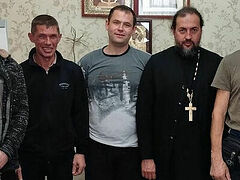
 Alexander in the Refectory Alexander believes that God worked a true miracle in his life. After sixteen years behind bars and all the trials he endured, he is alive, he looks well, and now he stands before the altar—speaking to others about his journey.
“There’s no need to look back at what happened yesterday; it’s already gone. Tomorrow hasn’t come yet. We must live today, here and now, in this very moment,” Alexander says, concluding his story. “To catch this moment and live in it—because God is always here, near us. You don’t need to look for Him in yesterday or tomorrow. And I am truly grateful to all of you—that I am alive and doing well.”
Today, Alexander comes to church with his wife and daughter. He takes active part in parish life—working, helping others, joining every volunteer clean-up, assisting in construction, and, as his friends like to add, cooking excellent meals.
The Lord accomplished what once seemed impossible through Alexander’s life. And as Scripture tells us: The things which are impossible with men are possible with God. (Luke 18:27)