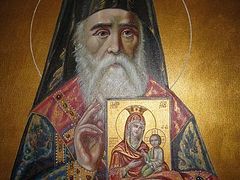
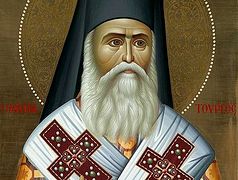
On November 22 the Holy Church honors the memory of St. Nektarios of Aegina (secular name: Anastasios Kephalas). The kontakion to this wonderful saint reads as follows: “Divine thunder, spiritual trumpet, planter of faith and pruner of heresies, pleasing to the Trinity, O great holy hierarch Nektarios, thou who ever standest with the angels, pray unceasingly for us all.” Let’s take a closer look at why the Church gave him such expressive names.
The future saint was born on October 1, 1846 in the village of Selymbria in Thrace. His parents, Dimos and Maria Kephalas, were poor and pious Christians. They baptized their son with the name Anastasios. From a young age, he showed special piety and love for learning. After graduating from elementary school, he went to Constantinople, where he had to live in poverty and work hard. Living in the world, the young man was building his inner man by reading the Gospel and the Church Fathers daily. When he turned twenty, he went to the island of Chios, where he began working as a teacher, while setting an example to others with his ascetic life and prayer. Desiring an angelic life from his adolescence, in 1876 he became a monk at the Nea Moni Monastery, where the brethren came to love him for his virtues.
The monastery elder and a local wealthy benefactor convinced the young monk to finish high school in Athens. From there, Hierodeacon Nektarios traveled to Alexandria, where he was cared for by Patriarch Sophronius IV of Alexandria (ruled 1870–1899), who insisted that Fr. Nektarios complete his theological education. In 1885, he graduated from the Theological School in Athens. The Patriarch ordained Fr. Nektarios hieromonk, and then consecrated him Metropolitan of Pentapolis. Later, he was appointed preacher, representative and secretary of the Patriarch. People loved him for his virtues and purity of life. But there were those who envied him and obstructed his ministry, and the Patriarch eventually dismissed him from his posts. Met. Nektarios took his situation with humility, according to the words of Christ: Blessed are ye, when men shall revile you, and persecute you, and shall say all manner of evil against you falsely, for My sake (Mt. 5:11). He returned to Greece, where he continued to preach the Word of God and write books.
In Athens, he found himself alone, ignored, despised, and almost without means of subsistence. But he kept nothing for himself, giving the little he had to the poor.
Initially, St. Nektarios planned to retire to Mt. Athos, but gave up this idea. He spent several years as a preacher, and then was appointed dean of the Theological School in Athens. Under his leadership the school rapidly developed both spiritually and intellectually. The students found in him a teacher with profound knowledge of the Holy Scriptures and the Church Fathers, and at the same time a dean who performed his duties with great kindness and attention to everyone. He taught pastoral theology at that school. Meanwhile, administrative and teaching duties did not prevent him from leading an ascetic and prayerful life.
 In 1904, St. Nektarios founded a convent in honor of the Holy Trinity on the island of Aegina, where he moved in 1908. The saint devoted all his physical and spiritual energies to the building of the convent and to spiritual guidance. He often worked in the garden himself, was engaged in construction work, while trying to live in the spirit of the early monks. The fame of his virtues and God-given talents spread throughout the area, and many believers flocked to him. The saint possessed the gift of healing. Through his prayers, both laypeople and monastics were healed from diseases, and much-needed rain began during periods of drought. He comforted, encouraged, confessed, and prayed. He was everything to everyone, thanks to the grace of the Holy Spirit that dwelt in him. Following the Apostle Paul, he lived in accordance with the words: Yet not I, but Christ liveth in me (Gal. 2:20). During church services and private prayers alike, saints and the Mother of God often appeared to him. In the difficult years following the First World War, he taught his nuns to trust in God’s mercy day after day, obeying the Savior’s command: Take therefore no thought for the morrow: for the morrow shall take thought for the things of itself. Sufficient unto the day is the evil thereof (Mt. 6:34). He forbade them to keep any food in reserve, urging them to give whatever was left to the poor.
Throughout his life, St. Nektarios wrote a large number of works on theology, ethics, and Church history. In particular, he wrote about patience in sorrows: “We must bear them with patience, because, firstly, if we are impatient, we do not hear anything, and even worse—we increase our sufferings; and, secondly, he who patiently endures sorrows here on earth will receive a reward in the life to come, by his patience showing in practice his faith in the life to come, which is faith in the One Who promised it.” He fulfilled in practice what he taught, being slandered by his opponents towards the end of his life. But here, too, he endured the trials with patience, instructing his flock to do the same: “Let us take heart and endure a little, so that we may be found worthy of Heavenly joy and Divine glory. Let us be philosophical about the things of the world, so that we can live our lives more positively. Let us trust in God, and He, Who healed the paralytic, will help us in our sufferings. Wait a little, and the grace of God will come. Let us endure a little longer for the sake of the Heavenly Kingdom.”1
He taught the nuns who struggled under his omophorion an important component of cenobitic monastic life as follows: “Ask God for love every day; and it is followed by a host of various good virtues. Love and be loved. Give love in order to receive love back. Give your whole hearts to God so that you may stay in love, and he that dwelleth in love dwelleth in God, and God in him (1 Jn. 4:16). Cherish the feeling of love. Love each other as holy sisters, and may one common love for the Lord unite you.”

He also left these important instructions in his letters to the nuns: “I believe, wish, and insist: follow a wise path in everything, living according to the needs of your lives and the need to sustain your bodies and health, and seek moral perfection. I fervently wish you to grow strong in this virtue, so that you can say and feel: Yet not I, but Christ liveth in me (Gal. 2:20). When you attain one virtue, seek to acquire other virtues also, but above all that one, because without it you will not do anything. And let none of you deceive herself into believing that prayers and supplications will bring you to perfection: you will be mistaken; for the Lord Who dwells in us, Whose will we do, and Who says that He will dwell and walk in us when we fulfil His commandments, brings us to perfection. The only and first commandment is as follows: May the will of God—not ours—be done in us, with such perfection as it is in Heaven with the holy angels, that we can say: ‘O Lord, may it be Not as I will, but as Thou willest: Thy will be done, on earth as in Heaven.’ Without Christ in us, prayers and supplications lead us into delusion.”2
These letters contain important instructions about prayer: “As for thoughts during prayer, I tell you: When they come, read aloud and do not pay any attention to them, because as much as someone listens to them, so much do they penetrate. Change your thoughts by reading aloud.”3
Being an angel in the flesh, he lived with his soul wholly longing for God, putting love for the Creator at the forefront of his earthly life. In his book, The Song of Divine Love, the holy ascetic expressed his prayers and sighs to God in the following verses:
O, love, the fullness of my heart!
O, love, the sweetest image of the sweetest Jesus.
O, love, the sacred seal of the disciples of the Lord.
O, love, the symbol of the sweetest Jesus,
Strike my heart with your desire.
Fill it with goodness, kindness, and joy.
Make it the dwelling-place of the Most Holy Spirit.
Kindle it with a Divine flame, that its miserable passions may be consumed and it may be enlightened, singing unceasing praise to you.4
 Until the end of his life, the saint was a true monk, ascetic, and spiritual father of his nuns, while serving in remote places in Greece. His holy and pious life shone like a guiding light for all his neighbors, according to the words of the Lord: Ye are the light of the world (Mt. 5:14). Before his blessed repose, he suffered a protracted and painful illness, which he endured with genuine Christian patience and hope. He had foreseen his repose in advance. St. Nektarios spent the final weeks of his life at a hospital in Athens, where he departed to the Lord on November 8, 1920. Miracles began to occur immediately after his death. Thus, even in the hospital, a paralyzed patient was cured by the saint’s clothes. And there are innumerable miracles and healings taking place through the prayerful intercessions of St. Nektarios in our days. Pray to God for us, O holy father Nektarios, that we may be vouchsafed healing and salvation!