Bishop Dionysius (Lukin) of Rotterdam The Orthodox parish in Rotterdam was organized by Archimandrite (from 1966, bishop) Dionysius,1 the son of a royal naval officer. Fr. Dionysius walked the long path of pastoral ministry, which he had consciously aspired to since his youth, as he himself noted in his speech as when he was consecrated Bishop of Rotterdam in March 1966.
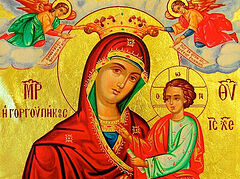
“I received a superficial religious upbringing. My joining the Church was the result of my inner transformation and very sincere conversion to God that took place in the days of my youth. And then I decided to devote my life to the service of God, while striving for monastic life. During this period of my life, I corresponded often with monks from Mt. Athos and received as a blessing from Archimandrite Misail, Abbot of the Russian St. Panteleimon’s Monastery—a small icon of the Mother of God, ‘Quick to Hear’, which is commemorated the day after my name day that I had before my tonsure. Even then, I saw in it a special sign from above of my monastic calling, and since then I have had a special reverence for this icon, repeatedly receiving help through it in crucial moments of my life.
“Since it was almost impossible for me to fulfill my desire to enter a monastery as I lived abroad at that time, after graduating from the Theological Institute in Paris and becoming a hieromonk. I served in various parishes in France and Italy, until, by the will of God, I ended up in the Netherlands in 1936. There, I immediately had to start building the Church of St. Mary Magdalene in The Hague, which was solemnly consecrated in 1937. The news of this event spread throughout the Russian press abroad. By Divine Providence, it even reached the virgin forests of Southern India where a Russian hermit struggled in his cell at that time. A Dutch scientist was staying in India in those days. On hearing from locals about the Russian hermit, he wanted to visit him.
“So, having learned about the consecration of a new Orthodox church in the Netherlands, Hieroschemamonk Constantine—that was the hermit’s name—donated to the new church the icon of the Mother of God, ‘Quick to Hear’, that he had just painted. He sent us the icon through his unexpected Dutch guest, having previously made an inscription on it: ‘As a blessing to the Orthodox Netherlands.’ Indeed, soon after we had been given this icon, the first Dutch conversions to Orthodoxy began. Subsequently, especially during the difficult years of the Second World War, we received help many times through the icon of the Mother of God, ‘Quick to Hear’. So, as a token of our gratitude and as a testimony to Her intercessions, we decided to dedicate the first church founded after the war to this wonderworking icon of the Most Holy Theotokos...”
One miraculous manifestation of help and intercession by the Most Holy Theotokos, which Fr. Dionysius mentioned, occurred to him. During the Second World War, when the Netherlands was occupied by Nazi Germany, Fr. Dionysius would hide people in his church from raids. Following a denunciation, he was arrested by the Gestapo and, being in one of the chambers of this sinister organization, he was preparing for the worst. Praying in front of the icon of the Mother of God, “Quick to Hear”—the one that the Russian hermit had donated to the Netherlands—he made a vow: if the Lord would rescue him and give him the opportunity to organize a parish or build a church someday, he would have it dedicated to the Icon of the Mother of God, “Quick to Hear”. And soon Fr. Dionysius was released.
After the war, there were quite a few Soviet girls and young women in the Netherlands who had been abducted by the Nazis from the Soviet Union to work in Germany. They were labelled as “Stalin’s daughters” or “Red girls”. These girls and women began going to church in The Hague, because that church turned out to be the only place that reminded them of their lost Motherland. But there was still a considerable number of first wave emigrants in The Hague. And they did not accept their new parishioners! After all, they had been brought up during the “godless five-year plan” periods and knew little, if anything, about church and liturgical life. Then Fr. Dionysius organized a parish in Rotterdam for those rejected by The Hague, where a ballet school building was initially rented for worship. Every Sunday, they had to prepare the hall for the celebration of the Liturgy: to set up analogions, hang icons etc.; and after the service and a parish tea party they had to clean everything up until the next time.
 The “Northern Lights” houseboat. Ruskerk.nl
In 1957, the parish in Rotterdam was given the opportunity to worship on a houseboat called “The Northern Lights”. A temporary church was arranged there in honor of St. Nicholas. In 1958, a theological conference was held in Utrecht, which was attended by Metropolitan Nikolai of Krutitsa and Kolomna, who at that time was chairman of the Moscow Patriarchate’s Department for External Church Relations.2 Fr. Dionysius met with Vladyka Nikolai and asked him for financial help to purchase a building in Rotterdam in order to build a house church and living space for a clergyman there. Financial help was provided, and in 1958 the community bought a building on Persijnstraat under the ownership of the Moscow Patriarchate. It took a lot of effort for the members of the parish to clean out the old neglected house and decorate it, preparing it for consecration.
And already on January 26, 1959, the house church in Rotterdam was consecrated in honor of the Icon of the Mother of God, “Quick to Hear”. The ceremony was performed by Metropolitan Nicholas (Yeremin) of Korsun and Bishop Anthony of London,3 a well–known preacher, with a host of clergy concelebrating and numerous believers and guests attending the service. The parish in Rotterdam was very active and very large. The women who had found themselves far away from their homeland came to the church themselves and brought their children and husbands with them. It wasn’t so easy at that time—the Cold War broke out and everything “Russian” was associated with the Soviet Union and the “Reds”.
Their children would help during church services and learn the Russian language. Orthodox summer camps for children were organized, where children rested, worked and prayed. Fr. Dionysius was greatly assisted by active parishioners, among whom Valentina Petrovna Timofeyeva, one of the founders of the parish and the long-term choir director of the church, was especially famous. She passed away on September 28, 2004.
In 1966, following a decision of the Holy Synod of the Russian Orthodox Church, Archimandrite Dionysius was consecrated in Moscow as Bishop of Rotterdam. The consecration at the Holy Trinity-St. Sergius Lavra was performed by the ever-memorable Patriarch Alexei I with a large concourse of hierarchs.4 After his episcopal consecration, Bishop Dionysius served in the parish of Rotterdam for ten years until his repose on March 8, 1976. He is buried in the old cemetery in The Hague next to his father.5
After Bishop Dionysius’ death, the life of the parish was led by the following priests: Fr. Eustratius Bergman, Hieromonk Ignatius (Lockhorst), Priest Anthony Du Pau, Priest Gregory Krasnotsvetov,6 and Priest Anatoly Babyuk.
 The Icon of the Mother of God, “Quick to Hear”, at St. Alexander Nevsky Church Under Archpriest Gregory Krasnotsvetov, who reposed not so long ago, the first stone Russian Orthodox church was built in Rotterdam in honor of the Right-Believing Prince Alexander Nevsky, consecrated on June 20, 2004. The dome for this church (having first been divided into four parts) was brought from Russia. The icons for the iconostasis were painted in the Holy Trinity-St. Sergius Lavra. St. Alexander Nevsky Lavra presented the church with an icon of St. Alexander Nevsky with a particle of his relics, and the Solovetsky Monastery—with an icon of Sts. Herman, Zosimas, and Sabbatius of Solovki with particles of their relics. The church also has an icon of St. Luke (Voino-Yasenetsky) with a particle of his coffin and an icon of Blessed Xenia of St. Petersburg with a particle of her tombstone.
The venerated icon of the Mother of God, “Quick to Hear” in the Church of St. Alexander Nevsky is situated to the left of the high golden iconostasis. It is small and already darkened by time. And to the right of the altar is another icon of the Mother of God, “Quick to Hear”. Its case contains awards received from the Russian Orthodox Church by Bishop Dionysius and the church director Valentina Petrovna Timofeyeva, who both worked hard in the field of service of God and people.
The parishioners of the church in Rotterdam love and honor their shrine.