When I moved to the United States fifteen years ago, for a long time I was absolutely indifferent to local holidays, including one of the main ones—Thanksgiving Day. Well, Americans get together with their families on the fourth Thursday of November and eat turkey—what do I have to do with it? Of course, a day off, discounts in stores—thank you, but what next?
And then the most important thing happened, and, as it turned out, I had a lot to do with it! And not because of discounts at all.
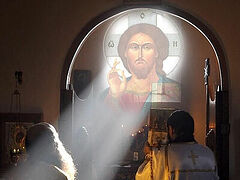
About ten years ago, the Lord brought me to the Russian Orthodox church in Washington, D.C. in a completely mysterious way. When I started attending services, I simultaneously immersed myself in reading our parish newsletter, where in the calendar the fourth Thursday of November was always indicated as, “Thanksgiving Day, a public holiday”. Every year on this day, a prayer service and the Liturgy were celebrated at the church, an akathist was sung, and after the service, a common meal was held.
Gradually, I began to wonder: Why should Russian Orthodox people, even if they live in America, celebrate—and so reverently—a holiday that has nothing to do with Russia or Orthodoxy?
My journalistic curiosity made me recall a decision of the Synod of Bishops of the Russian Orthodox Church Outside of Russia (ROCOR) of many years ago, which I had heard about many times with half an ear, but had somehow ignored.
After rummaging the internet, I dug up the original source, dated March 5, 1985:
WHEREAS: Archbishop Anthony’s oral report that in the United States of America it is a pious custom to celebrate a public holiday called Thanksgiving Day with a prayer of thanksgiving. In some of our parishes, a thanksgiving prayer service is celebrated on this day. This custom should be made a law.
“RESOLVED: In the Russian Orthodox churches in the United States of America to establish Thanksgiving prayer services on Thanksgiving Day, which can be replaced by thanksgiving petitions at the Litany of Supplication if the Liturgy is celebrated on that day."
From that time onward, the holiday that had been alien to me before began to become closer and dearer to me. I started tracking its history down and began to realize that it wasn't about turkey alone, though this bird played its role too.
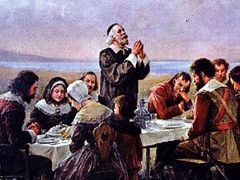
As I found out, it goes back to the first settlers from England, who landed on the shores of North America in 1620. More than half of the approximately 100 arrivals died in the first severe winter from hunger, cold and disease, while the survivors founded a colony and taught the local natives which crops it would be best to cultivate in that area.
Metropolitan Jonah (Paffhausen) delivers a Thanksgiving sermon at St. John the Baptist Cathedral (Washington, DC)
The reward for their efforts was an unexpectedly rich harvest. In the fall of 1621 the colonists decided to arrange a feast of thanksgiving to God, inviting native Americans to it.
My “harvest” turned out to be different, for which I am very grateful. After learning about the history, I thought more seriously about it and realized how important it is to say “thank you” to your family, friends, those around you, and through them to God. I came to love going to services on this holiday, and then going to visit my closest friends—this tradition appeared by itself. And, by the way, now turkey tastes better to me, perhaps because I’ve become a little more aware of the meaning of Thanksgiving.
And I would like Russia to have its own Thanksgiving Day too.