In the name of the Father, and of the Son, and of the Holy Spirit!
Dear in Christ brothers and sisters! On this holy day, the Church marks the great feast of the Entry of the Most Holy Mother of God into the Temple! If you prayed attentively during the Vigil, you heard with what solemn praises and hymns this festival is celebrated. What are the greatness and triumph of the event celebrated today about? Let us first consider the external and then the internal aspects of the feast, based on the Holy Tradition of the Church.
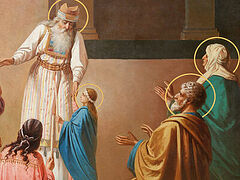
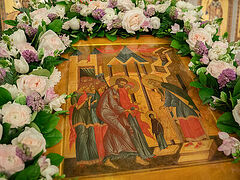
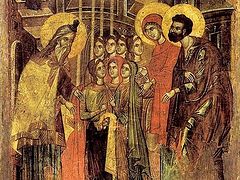
The Most Holy Theotokos was born to the aged pious spouses Sts. Joachim and Anna, who had vowed to dedicate the child to God. Until the age of three, the baby was in her parental home, and as soon as the girl was weaned, the parents hurried to fulfill their vow and dedicate their daughter to God. At the Old Testament Temple some young virgins dedicated to God used to live and perform a special service. When the three-year-old girl was brought to the steps of the Temple, She was met by the then high priest and the virgins serving at the Temple. Miraculously, without the help of others, but strengthened by Divine power, the Girl Herself went up the steps, followed by the young virgins with candles. The high priest led the Girl into the Temple of God, and, by a special inspiration from God, realized that it was not an ordinary child, but a Holy Vessel of the grace of God.
According to tradition, the high priest took the Mother of God to the Holy of Holies of the Temple, which, according to the Old Testament rules, only the high priest could enter once a year. The life of the Mother of God in the Holy of Holies was completely hidden from human eyes. St. Gregory Palamas wrote that at the Temple the Mother of God abode in sacred stillness and contemplation, listening to the reading of the Holy Scriptures (the books of the Old Testament) when services were celebrated at the Temple. Over that period angels would give Her food and serve Her. “Rejoice, Thou Who revealest to us the life of the angels,” we sing in praise of the Mother of God in the Akathist to her.
But the inquisitive human mind doubts many matters of faith and demands proofs. Similarly, among believers there are those who do not believe that the Mother of God was brought into the Holy of Holies of the Temple in Jerusalem. However, a believing heart knows that it was the case, and this is what the choir sings about and the liturgical hymns are read about; and St. Gregory Palamas, a great defender of the Orthodox faith, devoted a lengthy homily to the life of the Mother of God in the Holy of Holies.

For the Mother of God, entering the Holy of Holies and living there was Her path and ascent from strength to strength towards God, to an even greater purity of heart and an immaculate state. With the help of the grace of God, strengthened by the Holy Spirit, Mary attained such a height of holiness and perfection that She became able to contain the Uncontainable—to give birth to God. To become a Living Temple of God—greater than the earthly Temple of Jerusalem where God dwelt. By nature the Mother of God was a human being like us, but by the purity of Her life and immaculate state She surpassed all saints and even the bodiless angels themselves. As St. Silouan the Athonite put it, the Mother of God had such a pure life that She did not even sin with a single thought.
Brothers and sisters, you and I, like all people, were created and called to be temples and dwelling-places for God Who wants to rest and abide in our souls and hearts. But what should we sinners do, since we are so far from such purity and perfection? It doesn’t become us to lose heart. The Mother of God has shown us the path by which we can purify our hearts and draw closer to God. This is the path of obeying the will of God, giving yourself wholeheartedly and dedicating yourself to God, aspiring with your soul and your whole being for the love of God. This is the path of stillness of the mind (hesychia) and the prayer of the heart.
According to St. Gregory Palamas, the Mother of God gave us an ideal example of the monastic way of life: “She remained silent, providing significant protection to contemplatives, because she rightly chose a silent and detached way of life.”1 The life of the Ever-Virgin Theotokos teaches us all, and especially monastics, to avoid vanity and worldly chores, excessive care for our bodies and not to cling with our hearts to sensual pleasures and earthly blessings. The question arises: How can we attain stillness of the mind and purity of heart, when we are at times surrounded by bustle and care?
It is not with our bodies that we should withdraw into the desert, but with the help of the grace of God let us try and bring our minds and feelings into a state of silence and stillness. And as the Holy Fathers tell us: “To be a monastic is not to separate yourself from people and the world, but to deny yourself, to stay outside the desires of the flesh and go into the desert of passions (that is, into passionlessness).”2
The Jesus Prayer and unceasing remembrance of God, or, in other words, walking before God, will help us in this. Through vigilance and prayer, with God’s help, we can enter the “Holy of Holies”—into our “inner cell”, into our heart, inside which is the door to the Kingdom of God. Let us be attentive to our hearts and not unite with sinful thoughts, but drive them away in the name of Christ. Let us keep our hearts in humility and poverty of spirit, especially being wary of thoughts of condemnation and exaltation over our neighbors, since the Lord will never enter an arrogant heart.
It is also a great help for us that each of us (at Valaam Monastery), or almost all of us, has his own cell, his own corner, or just a secluded place in nature, where he can turn off his mobile phone in his free time from work and obediences, forgetting all his worries and thoughts, and devoting this time to God alone. At first, of course, it will be very difficult, and there will be thousands of reasons obstructing this. And the first is the wandering of our mind and various vain thoughts. But if we strive to devote our free time to such focused solitary prayer, if we move towards God with our minds, then we will develop good habits and craving for prayer and communion with God. Then, without forcing ourselves, we will desire and seek the real prayer of the heart.
Therefore, dear brothers and sisters, as long as we have such an opportunity to spend time alone with God, to seclude ourselves, let us not neglect our free time, wasting it, but let us try to detach ourselves from ourselves, from fuss and excessive care about our bodies, and let us devote ourselves to God in prayer. And the reward that the Lord promised us if we purify our hearts from passions is Himself, Who will come to the temples of our souls with the Father and the Holy Spirit.
On this feast and every day of our lives let us unceasingly call on our Heavenly Intercessor, the Most Holy Theotokos, for help. Through Her holy prayers, O Lord, help us acquire purity of heart and enter the Kingdom of God. Amen.