Photo: orthodoxnews.de
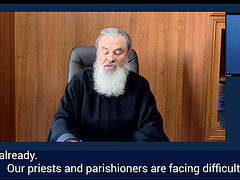
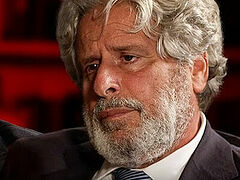
Schema-Archimandrite Gabriel (Bunge), a renowned Orthodox elder living in the Swiss Alps near Lugano, has deep admiration for Ukrainian Orthodox faithful who remain loyal to the canonical Ukrainian Orthodox Church despite ongoing persecutions.
“What honestly concerns me much more is the people who come to us here. Russians, Ukrainians, Moldovans, Serbs, Macedonians... and so on. What concerns and grieves me much more is the conflict in Ukraine,” Fr. Gabriel said in a recent interview with the German edition of the Union of Orthodox Journalists.
The 84-year-old elder, who holds a doctorate in history, receives regular information about the situation in Ukraine through the Union of Orthodox Journalists. He celebrated Pascha this year with His Grace Bishop Panteleimon of Baturyn, a longtime friend and professor at the Kiev Theological Academy, who brought him a cross as a gift from His Beatitude Metropolitan Onuphry of Kiev and All Ukraine.
“I personally pray every day. I deeply admire the faithful and the Church, the clergy and the hierarchy for their faithfulness to the canonical Church. Despite all the persecutions and all the material benefits they could possibly receive if they betrayed the canonical Church, they remain faithful to it,” Fr. Gabriel said.
He continued: “They endure persecutions, including our friend Panteleimon—they expelled him from the monastery and so on. And despite all this, they do not protest, they bear it silently, remaining faithful to the Church of Christ. I deeply admire this, I must say!”
The elder emphasized his daily prayers “that they endure to the end, and I pray to God that this end comes soon. And then everything will return, more or less, to normalcy.”
However, he acknowledged the lasting impact of war: “But for our guys who are on the battlefield, there will be no such normalcy. Understand? Soldiers returning from war all suffer from post-traumatic syndromes. No matter what war, no matter what nation—this has been observed.”
Speaking from historical perspective
As a historian, Fr. Gabriel drew connections between current events and historical judgment. Referencing Patriarch Bartholomew of Constantinople, he stated: “Whether people believe in God or not—for example, Bartholomew in Constantinople—I don’t know, that’s also not my concern. But it seems they don’t believe in the judgment of history. After all, everything we do or don’t do will enter history. And the next generation will definitely record: this one apostatized, this one sold out, that one, that one, and so on.”
“History forgets nothing!” he emphasized. “You can destroy as many documents as you want—there will always be enough left to restore them. And before God’s judgment: God is merciful, but history is not. History cruelly judges all our sins and transgressions.”
He referenced the Old Testament pattern: “Every time the people of Israel turned away from God, they were defeated by their enemies, enslaved, finally—say, for 70 years—taken away to Babylon.”
Counsel for soldiers dealing with trauma
Drawing from personal experience—his own father was deeply traumatized by internment in American camps after World War II—Fr. Gabriel offered specific spiritual counsel for soldiers suffering from post-traumatic stress.
He recounted the story of a Soviet Afghan war veteran named Lyonya who came to confession decades after the war, still completely traumatized: “He was like a living corpse. This originally pleasant young man (I assume) had a completely distorted face. And at Confession he said just one phrase: ‘I was in Afghanistan.’“
Fr. Gabriel told him: “Listen, Lyonya, you saw terrible things and learned to commit terrible acts that in normal life you would never have done. But the people you had to kill—war is war—they also had a father and mother, possibly a wife and children. Look, every day, kneeling, ask forgiveness from those you had to kill: ‘Forgive me, brothers.’ Every day! And then you’ll find peace.”
“And he did it. And it was like a resurrection. Over time he was resurrected. And again we saw that pleasant guy he was in his youth when they sent him to Afghanistan,” the elder recalled.
“We must, of course, ask God for forgiveness for all our sins. But we must also ask forgiveness from those to whom we have caused harm,” Fr. Gabriel explained. “As Christians, we of course confess this to God, but we must also be reconciled with those we had to tear from life.”
He expressed doubt about conventional therapeutic approaches: “Of course, with post-traumatic syndromes there are psychologists, psychotherapists, medications, and God knows what else. But I doubt that this can truly heal anyone. It’s like a bandage on a wound.”
Fr. Gabriel also shared that he must pray for soldiers on both sides: “I must pray for both sides. ‘Father, pray for my brother, pray for my brother, pray for my cousin’—some of them are Ukrainians, others are Russians.”
War and sin
When asked whether war and sins such as abortion are closely connected, Fr. Gabriel agreed emphatically: “Yes, absolutely!” He recounted a conversation with Bishop Panteleimon: “I said to him: ‘Listen, why must we endure all this? After all, we all suffer because of it, even if we don’t like it.’ Because of our sins? Because of our sins.”
He noted that Russia and Ukraine were European leaders in abortion rates even before the war, and expressed concern about Switzerland’s demographic collapse: “In Switzerland, almost no children are being born anymore! There is an extremely sharp decline in demography. But these two things (war and abortions) are very close to my heart.”
In conclusion, Fr. Gabriel said: “I deeply admire you and pray that you remain faithful to the end. We pray for this, I pray daily. So once again: my sincere admiration and respect. I have traveled much in Ukraine, but it is a large country. I only know half. I know Pochaev, but not Svyatogorsk Lavra. Unfortunately. And the respected Metropolitan Arseny. You saw for whom we all pray. During the Great Entrance. Because we feel the closest connection with them.”
He concluded with a request: “Pray also for us, that we not only speak beautiful words but follow them with corresponding good deeds.”
Follow OrthoChristian on Facebook, Twitter, Vkontakte, Telegram, WhatsApp, and MeWe!