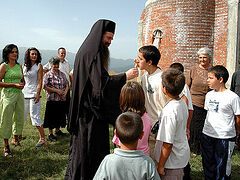
On November 14, 2025, Schema-Archimandrite Mikhail (Krechetov) reposed in the Lord at the age of eighty-eight. He was known to most believers as Archpriest Valerian. Two years ago, he was tonsured as a monastic, and just before his repose—into the great schema. For more than fifty years, he served as priest and spiritual father in the Church of the Protection of the Most Holy Theotokos in the village of Akulovo near Moscow. In his condolences, His Holiness Patriarch Kirill wrote of him: “The newly reposed pastor possessed genuine meekness, and his work was imbued with sincere love and active care for others.”
Let us partake of the spiritual wisdom of Schema-Archimandrite Mikhail, gathered from his homilies over the years. May the Lord grant rest to his soul in mansions of the righteous!

***
If the thought of condemning another arises within you, immediately think: “Why should I look at someone else when I myself am a sinner? And how can I judge another when I myself will be judged? He sins one way and I another—also bad, or even worse. Perhaps he sins out of ignorance, but my sins aren’t out of ignorance. Perhaps he has such a personality, upbringing, nature, but I have a different nature, yet I do such things…” This is how we have to constantly humble ourselves.
***
The Lord will forgive you, of course, if you forgive, and won’t judge you if you don’t judge. But how difficult it is not to condemn, not to harbor ill will towards anyone if you have no humility. Humility lies in the awareness of our sinfulness—that’s the only thing that makes it possible to become humble.
***
Every sin you see around you should remind you of your own sinfulness. By the grace of God, this will lead to humility; that is, a real awareness of your own infirmity. This feeling was inherent in all the saints.
***
We have no consistency. Just impulses, impulses—more or less often. But the most important thing is that we have to try to remind ourselves of our own sinfulness. That’s the main point of the Jesus Prayer: “Lord Jesus Christ, Son of God, have mercy on me, a sinner.” We should repeat this constantly so as not to forget who we are.
***
Sometimes people say: “I received Communion, and somehow it feels almost wrong.” But incidentally, that doesn’t necessarily mean it’s bad. It could be the special mercy of God, so that you feel that even though you received Communion, you’re still far from being a saint—if we can even speak of any sainthood at all when it comes to us... If you feel a state of joy and stillness, of peace after Communion, that’s good, but don’t forget that you’re still a weak, sinful person. That’s the most important thing.
***
When we see the sins of others (which is the majority of what we see), we have to immediately remind ourselves of our own sins. That’s what the saints always did. When they saw the transgressions of another, they tried to avoid condemnation and to remember their own sins.
***
If we felt like sinners, we wouldn’t envy, because we’d recognize: “If this is what the Lord is sending me, then it’s what I need.” Glory to God for all things! The Lord sends you something—give Him thanks.
***
If you yourself don’t judge, people will try to push you into it. Let’s say they’re talking about someone, condemning him, and you feel like you have to nod along out of politeness: “Yes, yes, yes…” But once you’ve nodded along, you’ve already condemned. We have to especially try to avoid sins like these.
***
It’s said: If ye from your hearts forgive… (Mt. 18:35). This is a very great struggle of course, because in order to forgive from the heart, you have to humble yourself. And once you try to humble yourself, you’ll start to understand how difficult it is.
***
Sometimes someone won’t let up: “But why is it this way, and why that way?” Well, because that’s how it is. Just accept it humbly, receive it with simplicity of heart, and that’s it; you’ll find peace. We know that when the Lord preached here on earth, He said: “Not a hair falls from your head without God’s will.” And if not a hair falls from your head without God’s will, then everything is governed by Divine providence, which means there’s a reason it’s the way it is.
***
The things we do must be first of all in harmony with God’s will. The first question is how is this consistent with God’s will? But the result is from God either way. Because, for example, you may want something good but the time hasn’t come for it yet.
***
A simple perception of life, a simple perception of the Gospel word, of Gospel examples—that’s really all there is. “Oh, what’s going to happen?” What’s meant to happen will happen. “Oh, that man’s going to do something!” No, he won’t do anything, and neither will the other man—but he’ll do what he’s been given to do. No one does anything any other way. “Well,” they say, “such and such will happen.” Yes, but who knows what will happen? What the Holy Fathers said will happen is what will happen. “How will it happen?” I don’t know how, but it will.
***
We often speak without thinking, throwing words around left and right. Referring to some good work, we say: “I did it all for nothing.” Sometimes we say out of resentment: “I did so much for this man, and all in vain.” Everything—even years of labor—all for nothing, all crossed out. That’s how scary these thoughtless words are. That’s why they say: “By your words you’ll be justified, and by your words you’ll be condemned.”
***
Sometimes the feeling of our own nigh-onto righteousness gets to the point where we start teaching others or taking offense at someone. If we had a constant feeling of our own sinfulness, a feeling of repentance, then we’d always feel unworthy of either God’s mercy, God’s grace, or joy. And we should receive every consolation that the Lord sends us in life with immeasurable gratitude, as unworthy recipients. And every sorrow should be received by saying: “Yes, this is exactly what I deserve.” And we should even rejoice that the Lord is giving us the chance here to suffer something for our sins.
***
We’re burdened with many sins yet have neither repentance nor humility. We only boast to one another. We’re all wallowing in the mire, each one deeper than the next, just thinking: “I’m not in as deep as him…” If only we could find something to exalt ourselves with! And it’s even unclear whether we’re not just as deep: As soon as we look at others and condemn them, we’ve already sunk even deeper. Even if we haven’t committed the same obvious sins that others can see, even internal ones—pride and vainglory—are sufficient to plunge a man into the abyss.
***
How we boast to each other! It’s incomprehensible; it’s a disease, in adults just as in children: “But I have this, and I have that…” Chatter, lies—we exaggerate everything… If God has given us a talent, we use it to exalt ourselves while reproaching and offending others. Everywhere pride, pride…
***
We have to strengthen our faith, genuine faith. And we have to do it with every breath. As the Lord says: “Not a hair will fall from your head outside the will of God.” So that’s it. Everything should be handled exactly as the simple folk say: “Whatever God does, it’s all for the best.”
***
Evil won’t come out of us only when it no longer exists within us. And it won’t exist within us only when we strive with all our might to preserve spiritual peace. If you preserve this spiritual peace, you won’t become embittered, and if you don’t become embittered, then evil won’t proceed from you.
***
All the truths that are given to us in the Gospel, that the Church presents to us in the Apostolic Epistles, in the Church’s typikon, speak of one and the same thing: that saving your soul, and even more so the souls of others, takes time and struggle. There’s a time of preparation, a time of growth, and then a time of testing, when something gets sent your way now and then to see what you’ve actually achieved. As we grow spiritually, we’re visited by temptations and trials and constantly checked about how much we fulfill the law. Whether it’s about prayer, going to church, fasting, or other Church rules, our growth is constantly being checked.
***
Whenever something happens, if we have the habit, we’ll immediately pray: “Lord Jesus Christ, Son of God, have mercy on me, a sinner.” But whoever isn’t in the habit will start cursing. Pray instead of cursing!
***
The spiritual disease of the last times is the weakening of our will and determination. It takes effort to fulfill God’s commandments: You just have to do it! No matter whether you want to, whether you like it (few people like it), you still have to do it. That other thing? You can’t do it. Period. Tell yourself no, and that’s final. But here’s the thing: Most people today suffer from a lack of willpower. And if there’s any determination at all, it’s only where we’re driven by our passions and can’t refuse what we really want. So again, either way, it’s still a lack of will.
***
The firm pillars—truly the “salt of the earth,” of whom the Lord speaks of when He says, Ye are the light of the world (Mt. 5:14)—are the Holy Fathers. They stand firm and show us what needs to be done.
***
We all know perfectly well that we’re going to die. No one can escape it. Everyone knows that the consequences of many sins are quite grave. However, we still sin, not thinking about how we’re going to depart this world one day and have to answer for everything we’ve done. We don’t want to live as the true faith commands.
***
To the pure all things are pure. As the Most Pure, the Lord sees the slightest manifestation of purity, the slightest spark in every man. But we can’t perceive the good, let alone some subtle movement of the soul, and all because of our impurity. We can’t stand others, but the Lord puts up with us! How many times have we promised to do something and then not done it? The Lord is longsuffering with us, so you should be longsuffering with your neighbor.
***
Our task is to try to preserve love in the environment God has placed us in, because that’s the foundation that helps us withstand more difficult trials and sufferings, especially for the sake of the faith. Don’t kid yourself—someone who gets irritated with his neighbor and can’t put up with his faults isn’t going to tell his killer: “May the Lord forgive you!” If you can’t tolerate your neighbor, you won’t be able to handle real suffering. Sure, pride might keep you going for a bit, but not long. It’s a house built on sand.
***
We have to try to go to church more often… Pray more often and pray more, at least with short prayers: “Lord Jesus Christ, Son of God, have mercy on me, a sinner,” “God, be merciful to me, a sinner,” or “Most Holy Theotokos, save us.” Or who can’t at least say: “Lord, have mercy?” Even that’s enough.
***
Just as salt preserves any food, so no virtue can truly exist or have integrity or strength without humility. Without humility, any virtue or labor is rotten—with vainglory, stubbornness, self-will, arrogance, and so on.
***
Learn of Me; for I am meek and lowly in heart (Mt. 11:29). Of His many Divine virtues, the Lord noted only meekness and humility. They are the door the Lord spoke of, saying: I am the door (Jn. 10:9). That is, whoever follows this path, the path of Christ, will save himself and others. There’s no other way to be saved. And absolutely everyone needs this salt—humility.
***
Every work that man does here on earth, if it’s done with humility—that is, if it has salt in it—yields spiritual fruit. That’s why if a man walks his path in life with faith that the Lord is able to save everyone, wherever he may be, and with humility, then he achieves salvation.