Let's Celebrate Christmas with Light Hearts
 Winter is already very near, and with it comes one of the most long–awaited and radiant feasts: the Nativity of our Lord Jesus Christ. The road to it lies through the Nativity Fast, which, like any other fast, for some reason is associated with gloomy faces, an empty fridge and a feeling of guilt for accidentally eating a chocolate bar. But what if we look at this season from a different perspective? Not as a heavy commitment, but as an amazing journey that prepares us for a real occasion for joy? Let's try to dispel the myths together and find simple recipes for how to spend these forty days easily, meaningfully and with sincere joy in our hearts.
The first and most important step is to stop thinking of fasting as of an obligation imposed by the Church. Imagine that you are preparing an incredible birthday present for your friend. You don't spend weeks frowning and thinking, “Oh, again I have to think up a gift, wasting time and effort!” No! You are happy, full of ideas and anticipation of his joy. So is it here. Fasting is our personal, voluntary labor of joy. It is a time when we can consciously clear space in our lives—both on our plates and in our souls—for something more significant. It is not the Church that punishes us by depriving us of meat and dairy products, but rather we ourselves, out of our love for Christ, say to Him: “I want to prepare a place in my heart for You.” Fasting is not a duty—it is our offering to God.
St. John Climacus defined it very precisely: “To fast is to do violence to nature.” “Violence” is not in the sense of “torment”, but in the sense of effort and training. Just as athletes voluntarily limit sweets for the sake of good results, so we voluntarily take on this labor for the sake of meeting God.
To understand the meaning of the Nativity Fast, it is useful to know its history. The Nativity Fast (Advent), or “Philippovki’ (St. Philip’s Fast), as it used to be called in Russia (since it begins after the feast-day of the Apostle Philip on November 14/27), is one of the oldest fasts. It was first mentioned in the fourth century A.D. Initially, its duration and severity varied. Somewhere it lasted a week, and somewhere else—a little more. The fixed forty-day period for the entire Church was established in 1166 at the Council of Constantinople. Forty is a sacred number. It symbolically represents the forty years of the Israelites’ wandering in the wilderness and the forty days of fasting of Christ Himself before His public ministry. It is a period of purification, testing, and preparation.
But we should keep in mind that this testing is not the same for everyone: Fasting for laypeople is different from that for monastics. One of the biggest fears of Christian converts is the strict monastic rules prescribing xerophagy and abstaining even from vegetable oil. Here it is important to remember the golden rule: Do not take on a feat you are not ready for. Church canons (for example, the Rules of St. Timothy of Alexandria) explicitly speak about the differences in fasting for monastics and laypeople. A monk is a “professional man of prayer,” and his life is wholly subordinated to spiritual goals. But our life in the world is about work, family, and chores that require physical strength.
What does this mean in practice? The degree of strictness is determined by several components. First of all, your personal desire. Those who want to fast more strictly will do so. And it is also clear that those who do not want to fast at all—for instance, non-believers—will not fast. The priest to whom you go to confession (your father-confessor, as many like to say in the monastic manner) will help you determine the strictness of your fasting based on your health, way of life, and spiritual experience. Inexperienced fasters are usually allowed relaxations at the beginning of this path so that fasting would not become a shock to their body and mind. Even if a Christian is filled with enthusiasm and wants to fast like schemamonks during Holy Week, any experienced priest knows that such an “ardent heart” will burn out quickly.
It is the same with prayer: Some neophytes have approached me and asked me to give them the blessing for the daily reading of several canons, psalms, and so on in addition to the usual morning and evening prayers. They felt the grace of God and, like the apostles at the moment of the Transfiguration of the Lord, forgot about everything else. Recall this moment: Lord, it is good for us to be here: if Thou wilt, let us make here three tabernacles; one for Thee, and one for Moses, and one for Elias (Mt. 17:4). Here the priest’s task is to cool down such fervor a little, because no one has canceled everyday life with its problems and difficulties. I normally answer that this is not an obligation, but permission on my part; read as much as you can and want, as much as you deem necessary. And then, over time, the Christian will adjust the rule for himself.
The general rule of the Nativity Fast for laypeople is abstinence from meat, dairy products and eggs. Fish is allowed on certain days (mostly on Saturdays and Sundays, except for the last week), and vegetable oil is optional. Now many people will object, because the well–known fasting calendars forbid the use of vegetable oil on many fasting days. My friends, these calendars were compiled from the Typicon and reflect the monastic rule, not secular life. This rule was written for the cooks of monastery refectories, so that they could know what to cook for their monks tired from their labors on different days. For instance, monks and nuns are often allowed oil and even wine on the feasts of specially venerated saints. I would like to note that for some reason the calendars for laypeople are silent about wine.
 Moreover, these rules may vary in different calendars, since there are several Typicons: the Greek, the Jerusalem, the Egyptian, etc. The general principles are similar, but there are also many differences. For example, attitudes towards seafood, such as squid, mussels and the like, vary. The Greek Typicon allows seafood even on the days of strict fasting, since ordinary fishermen and peasants had almost no other sources of protein on fasting days; and the Jerusalem and Egyptian Typicons do not mention seafood at all, since it was not included in the diets of these peoples. But locusts are mentioned as a kind of fasting food in the Jerusalem Typicon, and even the Gospel says that the strictest faster—St. John the Baptist—ate them in the desert (Mk. 1:6). The most important thing is not to go into extremes. St. Seraphim of Sarov taught: “Fasting consists not only of eating rarely, but also in eating little; and not in eating once a day, but also in not eating very much.” And the Holy Church says about this that it is better to eat meat than to “eat” your neighbor with resentment and irritation because of hunger. Alas, many people, sometimes even experienced Orthodox Christians, perceive fasting as an obligation imposed “from above”, rather than as a personal labor performed out of love of the Creator. Thus, what psychologists call “withdrawal syndrome” appears here. Similarly, if an alcoholic is forbidden to drink alcohol, he will become very aggressive and irritated towards anyone who drinks it in his presence. There will be a feeling of injustice: “If I'm not allowed, then let everyone else not drink it either.”
And, of course, we should mention relaxations. The Church is not a strict military barracks, but a loving Mother. It understands perfectly well, in all traditions and rules, that circumstances can vary and often people need fasting relaxations. And the Church canons allow fish, dairy products, or even all non-fasting food to sick people. Health is a gift from God, and it's unwise to risk it. The principle of not harming yourself is at work here. For instance, it applies to diabetes or severe colds. Pregnant and breastfeeding women are forbidden to fast. Above all take care of your baby's health, and then follow your religious principles.
Travelers are also given fasting relaxations. It is hard to control your diet during a journey: you have to eat what God has sent you. But if you have a choice, it would be good to observe the fast on your journey. People who do hard physical labor need more protein, and you can resort to relaxations for the sake of your health. It’s the same for children. For them, fasting is usually milder, and the main point is not so much avoiding non-fasting food or sweets, but rather the education of the spirit, for example, through avoiding excessive entertainment or extra time on the computer or on the cellphone. But what matters here is that the child himself should want to fast. If his parents make him keep the fast, it’s coercion, not fasting.
An important point: If you decide to use relaxations, don’t do it secretly, with a sense of guilt, but consciously, after discussing it with the priest. Perhaps you will compensate for it by stricter abstinence from something else—maybe from social media, empty talk, unnecessary entertainment and amusement.
Fasting is not a diet; it is a period when we redistribute resources. The time and effort that used to be spent on cooking complex dishes and entertainment can be directed to something useful for the soul: praying harder and doing more good works, reading spiritual literature, and live communication with your loved ones, which nowadays is increasingly turning into correspondence. If possible, you should arrange an “information detox” for yourself—instead of flipping through the newsfeed you can busy yourself with something salvific.
Modern psychology confirms the wisdom of Patristic experience. The restrictions that we voluntarily take on ourselves train our willpower. And conscious abstinence from the instant satisfaction of our desires (“I would eat a rissole now, but no, I'll wait”) is the cornerstone of emotional intelligence and self–control.
Fasting is not for despondency, but for a joyful victory over yourself, over your passions. The Lord says bluntly: Moreover when ye fast, be not, as the hypocrites, of a sad countenance: for they disfigure their faces, that they may appear unto men to fast… But thou, when thou fastest, anoint thine head, and wash thy face; That thou appear not unto men to fast, but unto thy Father which is in secret (Mt. 6:16-18). Christ explicitly commands us to be joyful.

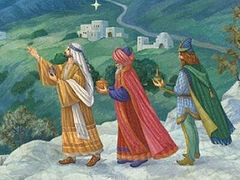
The Nativity Fast is not forty days of self–torment, but forty steps leading us to the manger of the Infant Christ. Each of these steps is a small victory over yourself, a kind word, a prayer read, and patience shown. Approach the Nativity Fast creatively, with love and without fanaticism. Make good fasting dishes, spend time with your close ones, enjoy the silence of the evening without TV, and learn to hear yourself and God.
And when “Christ is Born, glorify Him!” is sung on Holy Night, you will realize that you are not just standing at the service, but have come to meet a Friend Whom you have been to Whom you have been walking for forty long days. And this meeting will be truly joyful and long-awaited. Have an easy and fruitful fast!