Who, then, is the patroness of this fearsome weapon, the “god of war”? It turns out to be St. Barbara (from the Greek Barbara, meaning “foreign woman”)—a heroine of Christian hagiography, a virgin and holy great martyr, venerated both in the Orthodox East (especially in Russia) and the Catholic West. Her feast day is observed on December 17 (December 4 according to the Old Style calendar); in the West, on December 4.
The hagiographic account of St. Barbara’s life and martyrdom is based on an ancient tale that took shape in the seventh century, probably of Egyptian origin. It is characterized by symbolic generalization and narrative parallelism (similar motifs recur in the stories of St. Irene and St. Christina), along with variation in the details.
According to hagiographic sources, Barbara was born in the Egyptian city of Heliopolis and was the only daughter of a wealthy pagan named Dioscorus. To protect his beautiful and intelligent daughter from the advances of suitors from all over Egypt, her father built a tall tower for her—unaware that this coincided providentially with her own chaste resolve to preserve her virginity. When the masons were finishing the tower in her father’s absence, they pierced two windows in the wall, and Barbara—who had secretly embraced Christianity—ordered them to make three, as a visible confession of faith in the Holy Trinity. She also cast down the idols of the pagan gods that had been set up in the tower.
Upon returning home and discovering this, Dioscorus handed his daughter over to the prefect Martian, who subjected Barbara to cruel tortures. In prison, she received consolation and healing from Jesus Christ, who appeared to her and miraculously gave her Holy Communion. (Hence Saint Barbara’s role as an intercessor who, in difficult circumstances, delivers Christians from the danger of dying without the Eucharist.) During her continued tortures, Barbara sang psalms as if she felt no pain. Finally, in fury, Dioscorus himself beheaded his daughter—and was instantly struck down by a bolt of lightning.
Tradition dates Barbara’s martyrdom either to the beginning of the fourth century (the period of the last great persecutions of Christians) or to the reign of Emperor Maximinus (235–238). In the latter case, it is emphasized that Barbara’s instructor in theology was the famous Christian scholar Origen of Alexandria (†253/4).
Later, the relics (or part of the relics) of St. Barbara were transferred to Constantinople. According to the testimony of the Byzantine writer Anna Komnene (1083–1153/4), those accused of crimes and fugitives found refuge in the Church of St. Barbara. It is probably on this basis that the belief arose that Barbara was granted by God the grace to deliver people from sudden and violent death.
In 1108, a part of her relics was brought to Kiev by the Byzantine princess Barbara (of the Komnenos dynasty), who had married the Grand Prince Sviatopolk Iziaslavich (baptized Michael). The Life of St. Barbara, a beloved reading in Rus’, was reproduced in the Akathist Hymn composed by Metropolitan Joasaph Krokovsky (1708–1718) of Kiev, as well as in folk spiritual verses and psalms.
An early depiction of St. Barbara survives in a Roman fresco dating to the eighth century. In the following century, the West borrowed her vita from the Menologion (or Menaion) of the Byzantine hagiographer Symeon Metaphrastes. There she appears as one of the Fourteen Holy Helpers—“patronesses”—who deliver from sudden death. Barbara is invoked in prayers as a protectress against storms at sea and fire (or lightning) on land, which apparently became the basis for her veneration as the patron saint of armorers and firearms (artillery).
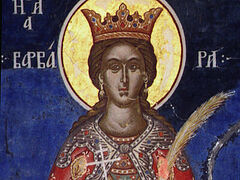
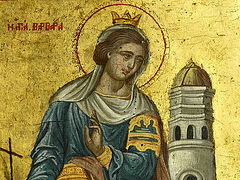
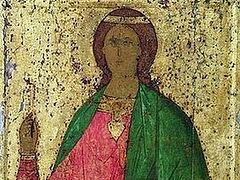
St. Barbara is depicted wearing a crown, with a sword (the instrument of her execution), a tower with three windows (a model of which she may hold in her hand), and a peacock (symbolizing immortality and the Resurrection of Jesus Christ). She is also portrayed with a chalice (the Eucharistic cup), symbolizing a blessed Christian death. At her feet, there may be a cannon.
The image of St. Barbara was especially popular among Flemish and Italian painters of the fifteen–sixteenth centuries. The motifs of her vita were used by G. K. Chesterton in his poem “Saint Barbara.”