In the name of the Father, and of the Son, and of the Holy Spirit!
Rejoice, speedy hearing of the poor; rejoice, agreeable care of the sorrowful. Rejoice, pure provider for the three maidens; rejoice, zealous guardian of purity. Rejoice, hope of the hopeless; rejoice, delight of the whole world. Rejoice, O Great Wonderworker Nicholas! (ikos 5 of the akathist To St. Nicholas the Wonderworker, Archbishop of Myra in Lycia).
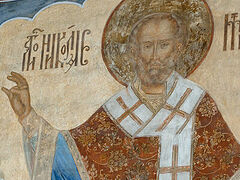
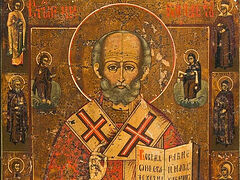
 St. Nicholas the Wonderworker
Dear brothers and sisters, Today we honor the memory of a great saint of God and wonderworker—St. Nicholas.
St. Nicholas the Wonderworker was originally from Asia Minor (the territory of what is now Turkey). He was born in the third century in the Lycian seaport city of Patara through the prayers of his parents who had been childless for a long time. His parents Theophan and Nonna came from a noble family and were very wealthy, which did not prevent them from being devout Christians, merciful to the poor and zealous for God. Having their child baptized with the name Nicholas, they raised him in faith and piety. Avoiding vain amusements, the boy Nicholas spent almost all his time reading the Holy Scriptures, in labors of fasting and prayer. He sometimes spent whole days and nights in the church of God in contemplative prayer and reading spiritual books. Soon the pious life of young Nicholas became known to all residents of the city of Patara. The bishop in this city was his uncle, who asked his parents to dedicate the boy Nicholas to the service of the Lord. The parents readily consented, because they had already made such a vow before their son’s birth. St. Nicholas was ordained presbyter in his hometown.
One day, the future saint came to the city of Myra, the capital of Lycia, where no one knew him. He lived like a beggar, but attended church services day after day. At that time, the Archbishop of Myra had died, and at the council the bishops tried in vain to elect a new hierarch.
Through their prayers, one of the elders had a vision that the first person to enter the church at midnight service should become the next archbishop. This turned out to be the humble and meek Nicholas. The new archpastor, warm-hearted and open, generous and kind, strict in fasting and prayer, became a true intercessor for the poor and destitute. He took care of his flock with great love. During the reign of Emperor Diocletian, a persecutor of Christians, St. Nicholas was imprisoned, but even in prison he preached and took care of his fellow prisoners.
The saint became famous for many miracles during his lifetime—he saved Lycia from famine; and during the outbreak of a rebellion, he helped three imperial commanders pacify the crowd and resolve the conflict peacefully. Having learned about the planned execution of three innocent convicts in the city of Myra, he arrived there and stopped the executioner’s sword. It is impossible to enumerate all the good works that the saint he did during his lifetime.
St. Andrew of Crete spoke of him as follows: “By his deeds and virtuous life, St. Nicholas shone in Myra like a morning star among the clouds, like the moon beautiful in its fullness. He was a brightly shining sun for the Church of Christ, adorning it like a lily at a spring, and was fragrant myrrh to it!”
The name of the great saint of God, St. Nicholas the Wonderworker, a speedy helper and intercessor for all who turn to him, became famous in all corners of the world.
Why is the image of this archbishop from a Byzantine province, who lived 1,700 years ago, so dear to us? He did not build magnificent churches, did not found any famous monasteries, and did not engage in politics at all.
By earthly standards, this was a simple and inconspicuous person. But seventeen centuries have passed since his repose, and the whole world still loves the saint, remembering his kindness and sensitivity to human sorrows and needs.
The deeds of the saint’s life are great. But the faithful love this great saint of God for the miracles he performed not only in the distant past. He was a quick and unfailing helper and intercessor at all times, and remains so today.
Let me give you several accounts of St. Nicholas’ miraculous help to people who suffered during the years of persecution of the Russian Church in the twentieth century.
 Nuns Magdalene (left) and Mikhaila (right) in Sergiev Posad
In one of the houses on Polevaya Street not far from the Holy Trinity-St. Sergius Lavra, there lived two nuns named Mikhaila and Magdalena. They had met in forced labor camps during the construction of the Shuya Tract (now part of the federal highway P-256) in the Altai territory in the 1930s. Both had been repressed on false charges—in fact, for their faith. Mother Magdalena was still a laywoman at that time (Igumen Vissarion, a monk of the Lavra, would tonsure her in 1970), and her secular name was Tatiana Mikhailovna Shurakova.
Prior to her arrest, she used to work at St. Elias Church in the Vyatka province, which, in addition to the main altar, had two more altars—in honor of the Most Holy Theotokos and St. Nicholas. She took three small icons to prison with her: those of St. Nicholas, the Prophet Elias, and the Mother of God. In the camp, Tatiana Mikhailovna worked as a nurse at the hospital. Sometimes, in her free time she would take these icons into the forest and pray fervently in front of them, crying, as if conversing with the saints of God: “Mother of God, I’m not a criminal, but they have sentenced me to ten years! I don’t agree. Let’s share them: a part for Thee, a part for St. Nicholas, a part for the prophet Elias, and a part for me. I won’t be able to bear any more.” Two and a half years passed (exactly a quarter of her term): they called her alone (while there were about 700 inmates in the camp) and said: “You’re free.” That is, what she had asked the Mother of God, the Prophet Elias and St. Nicholas for was fulfilled. Her ten-year term was divided into four…
Here is another story related by Konstantin Efimovich Skurat (1929–2021; the famous and respected professor of the Moscow Theological Academy). A repressed priest was starving in prison. Lent was approaching, it was Maslenitsa Week, and he thought: “They say that St. Nicholas helps all prisoners. Why won’t he help me?” And soon he forgot about it. At the end of Cheese Fare Week, he was called to the prison administration and told that he had received a package of food. The priest wondered: “From whom?” They answered: “It is unknown...”
And one more story. A certain Alexander from Tambov province, being an atheist, burned all the icons in his house in the 1920s. All of them were consumed by the flames, except for one of St. Nicholas. In the 1930s, Alexander was arrested, and in confinement he vowed that if he came out of prison alive one day, he would order a prayer service to St. Nicholas. In 1953, he was granted amnesty, returned to his village, and immediately asked a local priest to celebrate a prayer service to St. Nicholas. Thus, in the crucible of sorrows, with the participation of St. Nicholas, a miracle of the transformation of a human soul took place.
The miracles of St. Nicholas are innumerable. All Christendom knows its benefactor and honors him.
And today all of us have gathered at church to honor the memory of the saint, to ask for his help, to partake of his goodness, to resort to his pastoral wisdom and the ability to do good appropriately and savingly.
The saint’s Life testifies that his kindness was not mere human amiability and responsiveness. His kindness was gracious—granted to him by God for his pastoral zeal, it was combined with prudence and cheerfulness, and filled with the willingness to defend the faith. That’s how it is today too.
Let us pray to St. Nicholas, the great saint of God, that he may help us become good—good shepherds to some, and a good flock to others. Amen.