Statue of the "god" Cronus devouring his children. Nymphenburgh Palace. Munich, Germany.
The name of the ever-blessed Archimandrite Epiphanios (Theodoropoulos) fortunately needs no introduction today to the Russian or other Orthodox reader. Spiritual father, theologian, canonist, ecclesiastical writer—these standard epithets are insufficient to convey or exhaust the immense spiritual significance that Father Epiphanios (often called the Basil the Great of the twentieth century) still holds, above all for the Church of Greece, but also for the entire Orthodox world.
When acquainting ourselves with the legacy of Father Epiphanios, our attention was drawn to a series of his articles devoted to the theme of the “Hellenic-Christian synthesis.” Without now addressing the broader question of the interaction between Christianity and Hellenism (which has given rise to vast scholarly literature), we will focus on one important and, as it seems to us, particularly relevant aspect that this issue acquires in light of recent events. Namely, it seems that the writings of Father Epiphanios can shed light on the mindset of certain Greek hierarchs in their interchurch relations.
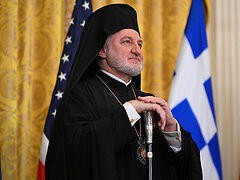
Thus, Ecumenical Patriarch Bartholomew, in the context of the Ukrainian issue, declared that “our Slavic brothers cannot bear the primacy of the Ecumenical Patriarchate and of our nation within Orthodoxy.” Setting aside the essential unfairness of this reproach, it should be noted that the ethnophyletic notion of “the primacy of our nation within Orthodoxy” undoubtedly shares the same roots as the concept of the so-called “Hellenic-Christian culture.” Considering the time when Father Epiphanios wrote his article, it is quite likely that this concept directly influenced the older generation of the Greek hierarchy.
It is important to understand that such ideas are not a commonplace within the Greek-speaking Local Churches (as is often assumed), but rather a theological and historical distortion—one that was challenged by the finest representatives of Greek Orthodoxy, among whom Father Epiphanios occupies a distinguished place.
We here present a translation of the first article in his series on the “Greek-Christian syntheses,” hoping, with God’s help, to translate the rest of these important writings in due course. The original Greek text is published in:
Ἐπιφάνιος (Θεοδωρόπουλος), ἀρχιμ. Ἄρθρα, Μελέται–Ἐπιστολαί. Τ. 1. Ἀθῆναι, 1986 (Ἔκδοσις Β΄).
“Hellenic-Christian Culture” and Saint Basil the Great
 Archimandrite Epiphanios (Theodoropoulos) Honorable Mr. Director!
Before me lies the text of my respected and beloved teacher, Mr. Panagiotis I. Bratsiotis,1 devoted to the defense and glorification of the so-called “Hellenic-Christian culture” (see the newspaper “Hellenic-Christian Education,” March–April 1958 issue). My humble self, of course, possesses not even one-thousandth of the erudition of the esteemed professor and of many other advocates of combining Hellenism and Christianity and merging Hellenic and Christian elements into some new creation (“Hellenic-Christian culture”). Yet this does not mean that I cannot entertain certain doubts on the matter.
Unfortunately, despite all the good will with which I have read and continue to read the periodically appearing writings of the proponents of this theory, I have not been able to convince myself that such a combination and fusion ever truly occurred—or that it could even be possible.
Both my humble self and many others see between Hellenism and Christianity not kinship and harmony, but chasms and abysses. The second, as we believe, is the negation and condemnation of the very essence of the first. Christianity has almost as much in common with Hellenism as it has with any other nation. This is because certain elements of Christianity—such as reverence toward God—are universal to mankind. Beyond this, what true kinship can we find between them? What specific and essential element did Christianity receive from Hellenism? And why should the very notion of “Christianity” be deemed insufficient, when Christianity already contains within itself—and from itself—all the sound and good elements of Hellenism (few as they are), while also possessing infinitely more divine and exalted truths, of which Hellenism could not even conceive?
Let me be forgiven for saying this, but I believe that any synthesis of Hellenic and Christian elements could occur only through a kind of spiritual alchemy. Such a synthesis seems to me strange and illegitimate—or, rather, unnatural. If I am mistaken, let someone enlighten me.
We hear the Apostle Paul cry out: The Jews require a sign, and the Greeks seek after wisdom; but we preach Christ crucified, unto the Jews a stumbling block, and unto the Greeks foolishness (1 Cor. 1:22–23)—and we tremble lest we mix the worldly wisdom with the sole saving “foolishness” of the Cross. We hear him teach that God hath made foolish the wisdom of this world (1 Cor. 1:20), and that it pleased God by the foolishness of preaching to save them that believe (1 Cor. 1:21); and we cannot imagine how these two could be reconciled.
Of course, the Greek nation,2 like every nation, has its own place in Christianity. But that place is the place of a follower, a disciple, a humble servant, and not that of a coequal partner. And if, in one way or another, it prepared the ground for the spread of Christianity, it thereby benefited first and foremost itself—for it was rescued from the mire and lifted from unimaginable poverty. (In fact, Judaism prepared the ground for Christianity far more, for from it salvation shone forth. Let us not forget, after all, that the God Whom we worship today is not the god—or gods—of Homer and Hesiod, of Plato and Aristotle, but the God of Abraham, and Isaac, and Jacob, and of their righteous seed.)
If the Greeks passed on Christianity to others, they were repaying a debt, not rendering a service—for who first brought Christianity to them? Was it not Paul, a Jew? Why then do we speak only of the service of the Greeks? And finally, if Christianity was written in the Greek language simply because it was widely known, that fact lays upon the Greeks an obligation, not a privilege!
My esteemed teacher believes that the matchmakers and initiators of the union between the Hellenic and Christian spirit were the great Fathers of the Church—and especially St. Basil the Great. Basil the Great!… I doubt that anyone else (after the Apostle Paul) rejected and condemned Hellenic, and, in general, worldly wisdom as sharply and as sternly as this Father of Caesarea did. I say this because I have seen many Fathers who disregarded and repudiated such wisdom, but never one who wept and lamented the time he had wasted studying it, as he did!
But before we hear the lament of this holy Father, it is necessary to emphasize a detail of great importance: Hellenic wisdom, when considered by itself (that is, without any comparison to the Gospel), is worthy of respect and even, at times, of admiration. It possesses a certain value and usefulness—just as the moon and the stars have value at night, when there is no sun. But when the day dawns and the sun appears, the moon and the stars fade away completely; likewise, before the unsetting and unwaning Sun of Truth—Christ the Savior—Hellenic wisdom, like all human wisdom, is revealed as bottomless folly. “They have become foolish, the clever disputers,” as we sing in the Akathist Hymn; “the makers of myths have withered away; the philosophers have proved unwise, and those skilled in words have been shown to be speechless. The webs of Athenian sages and rhetors are torn apart, and only the nets of the Galilean fishermen were not left empty.”3
Thus, whenever we see the Fathers showing favor toward Hellenic wisdom or acknowledging some benefit in it, they are speaking of it in itself. That Greek wisdom, considered on its own, has a certain worth—this is undeniable. But is there, in the writings of any of the great Fathers, a single place where such wisdom is praised in comparison with Christianity? Is there anywhere among the Fathers a suggestion that a union or synthesis of Hellenic and Christian spirit is possible? Whenever the Fathers consider Greek wisdom in comparison or contrast with Christianity, they do not weave for it crowns but scourges; they find in it not wisdom but madness and folly. They prepare for it not thrones beside—or even beneath—the throne of Christianity (as we do today with our so-called “Hellenic-Christian syntheses”), but pits, into which they cast it as vain and useless.
Yet let us conclude with the words of the great Basil himself. This passage holds special significance, for it is not some abstract teaching but a profound and deeply moving confession of his own soul.
Thus he writes, in his letter against Eustathius of Sebaste:
“Much time did I spend in vanity, and nearly all my youth I wasted in vain labor, striving to master lessons in that wisdom which God has turned into folly. But at last, as if awakening from a deep sleep, I turned my gaze to the wondrous light of the Gospel truth and saw the futility of the wisdom of the princes of this world that come to naught (1 Cor. 2:6). Then, shedding many tears over the pitiable life I had led, I longed to be guided into the study of the dogmas of piety as taught by the Church. And before all else, my concern was to correct, as best I could, the disposition of my soul, corrupted as it had been by long association with evil men…” (PG 32, col. 824).4
We think that any comments on so clear, so luminous, and so categorical a text are quite unnecessary.
With deepest respect and heartfelt gratitude,