St. Nicholas Church in Bratislava
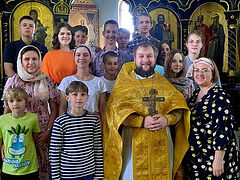
Slovakia is a predominantly Catholic country and the number of Orthodox Christians makes up for not more than one percent of its population, with most of them residing in its eastern region. In Bratislava, the capital city, there are only two Orthodox churches, the majority of parishioners consisting of immigrants from the Balkan countries (predominantly from Serbia) and the post-Soviet states. However, despite being small, the voice of the local Orthodox community carries weight in Slovakia: Orthodoxy is actually one of the three faiths (along with Catholicism and Protestantism), whose representatives have the right to teach the foundations of their faith at secondary schools.
Despite its small size, the voice of the Orthodox community carries weight in Slovakia
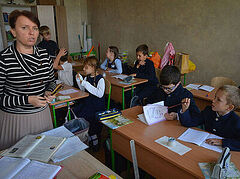
Actually, if speaking of Europe, the instruction of religion or faith-based disciplines in schools isn’t anything out of the ordinary there—after all, atheism is still out of favor in the West, despite all the secular trends of recent years. Slovakia is no exception. As I found out during the time I spent in this country, courses on “Religious Education/Belief System of the Orthodox Church in Slovakia” are offered in all grades—from first through twelfth, but generally on a very limited scale—not more than an hour per week. This is an elective subject, but the students (or, to be precise, their parents) are obliged to choose and study either about one of the confessions or secular ethics, just like it is in Russia. The program of the “Orthodox Belief System” offers an opportunity to modify the teaching process according to the level of complexity and depending on the students’ age. For example, in the first through fourth grades, schoolchildren study Bible stories and Orthodox feasts. Students in grades five through nine study the history of the Orthodox Church in Slovakia and the basics of dogmatic theology, while in high school, the students study comparative religion, focusing primarily on the difference between Orthodoxy and Catholicism. Textbooks and workbooks are approved by the Orthodox Church of the Czech Lands and Slovakia. This makes it possible to ensure adequate control over discipline content, adherence to the Orthodox belief system, and the absence of any kind of absurdity or fallacy.
A close look at the Slovak school textbooks reveals their conceptual likeness to the Sunday school curriculum in Russia and Belarus. For example, if we take a look at the workbook for the fourth grade, we can see that the topics studied are related to the life and miracles of Jesus Christ, the Most Holy Mother of God and St. John the Baptist, the suffering and resurrection of the Savior, as well as His teachings. The assignments differ by the level of complexity. They typically include elements of creativity to make lessons more interesting and exciting. For example, there is an assignment to compare the features of the biblical character with drawings. In another assignment—not too creative anymore—the students are asked to add the missing words into the Lord’s Prayer. At the same time, the full text of the prayer is also shown there, so that students won’t get confused or feel regretful about their inadequate knowledge of the words of the Lord’s Prayer. Therefore, the Slovak school teaches its students from an early age to master the biblical word and to understand prayer. Quite an example to follow for the Russian schools!
In the real world, though, not everything goes without a hitch. The Slovak priests and laity I spoke with have told me about the challenges faced by the teachers of “Orthodox belief system” curriculum. They generally don’t have many students, so they put together multi-age classrooms, from primary schoolchildren to teenagers, to study the discipline. Their competence, development, and interests certainly differ—so one has to be a stellar teacher to keep the attention of such a diverse classroom. As Fr. Lubos has noted, “children from the senior group ask all kinds of questions, they want to understand why we need to fast or go to church. The problem is that many of them come from nominally Orthodox families. Besides, not all schoolchildren have an interest in the subject, especially since schools usually put it last in the timetable.” However, father is confident that what these children are learning at school during religion lessons will bring good fruit—both for the children and their currently religiously uneducated parents.
Witnessing how religiously uneducated their parents are, the children won’t necessarily focus on studying religion at school conscientiously
According to Fr. Nikolai, who also teaches “Basics of Orthodoxy,” “textbooks and workbooks are poorly adapted to the number of hours it is studied at school (just one hour per week). Besides, they are written in outdated language.” Therefore, father uses his own learning materials, reading from the children’s Bible during lessons and offering analysis of biblical stories. As Father Nikolai has emphasized, “having a dialogue with students is important for me—even though my efforts unfortunately mostly come to nothing, because their parents remain unreligious, a typical situation these days.”
Why do these unreligious parents still choose Orthodoxy as an area of study for their children? What happens is that they formally belong to the Orthodox Church, whereas Catholicism or Protestantism remains the alien faith for them, and secular ethics doesn’t fit either. But seeing how secular their parents are, the children won’t necessarily focus on studying religion at school conscientiously, especially if this subject isn’t the main subject. On the other hand, content-wise, “Basics of Orthodoxy” is akin to what is studied in Sunday school classes, which many children never really attend due to lack of time, tiredness or lack of interest. Therefore, a competent, creative and engaging teaching of faith-based subject may serve well for the Orthodox outreach in Slovakia, at least among those Slovaks and immigrants who were baptized in the Orthodox Church.