Yuri Kugach. In the Kitchen
My Grandmother’s Prayer
I was the only child in our family. For the summer my parents would send me from Voronezh to my grandmother’s house in the countryside of Kursk region. There, I would immediately help with household chores; I learned how to take cows to pasture in the morning and get them in the evening, water calves, and hoe potatoes.
Every walk with my grandmother to the village store for bread was an adventure. At that time, there was still no asphalt in the village, and after the rain, mud stuck to my boots, turning every step into a trial. Sometimes I just didn’t have the strength to carry this load and had to jump out of my boots and slosh along the warm black earth barefoot. One day, I was bitten by our own dog. My grandmother carried me on her back to the nearest first-aid post several miles away, soothing me and cheering me up along the way.
Why do I dwell on the memories associated with my grandmother in such detail? Because it was she, Praskovya Fedotovna, who instilled in me the love for prayer. After all the housework, she would quietly come into my bedroom, make the sign of the cross over me and read “O Most Holy Theotokos” and “Our Father”. I still feel the peace and cordiality that came from her confidence in the power of prayer. The seeds of faith sown by a simple rural woman in my childhood played a significant role in choosing my life path.
Hardening My Character
On weekends, our whole family would go to a summer cottage near Voronezh. The most difficult task was to pick sea buckthorn (a very popular berry in Russia). The prickly tree, entirely covered with berries, pierced the skin with its thorns, the juice got into scratches and pricked my hands, but it was not my practice to give up. Once it took a whole week to harvest these medicinal berries. I coped with my task, and hid my scratched hands from prying eyes in the sleeves of my blouse for a week.
I often recalled this incident when I became a mother and my husband served at the Alexeyevo-Akatov Convent.1 There were many beautiful trees growing behind the convent’s fence, including sea buckthorn trees. After the service, we usually waited for my husband, admiring their orange clusters. The children listened to my story and tasted the beautiful medicinal berries, which are protected by such sharp thorns.
Marriages Are Made in Heaven
“Marriages are made in heaven”, they often say about the sacrament of marital choice. In our case, it was really so. I went to the country with my parents for ten years in a row and never met Alexander, although our mothers knew each other well. It turned out that Sasha (a diminutive form of the name Alexander) and I spent our entire childhood together—he at his summer cottage, I at mine. We helped our parents, went swimming in the river, and picked mushrooms. But surprisingly, we never crossed paths.
Once, my parents stopped by the Abakumovs’ house to say hello and suggested we meet for evening tea. Our acquaintance began. At that time, their only son was serving with the paratroopers in Germany. One day, I gave his sister my photograph, writing friendly words on the back and adding my home phone number. I still wonder why I wrote down the phone number that she already knew.
My future husband returned from the army and saw my photo on a shelf of the sideboard. “You immediately touched my heart,” Sasha confessed later. He took the photo, saw my phone number on the back and memorized it!..
It was an ordinary summer day. The telephone rang in our apartment. I picked up the phone, and even before I heard his voice, the word “Sasha” flashed through my head. A miracle!
“My name is Sasha,” he said.
Thus a new page in our lives began.
An Invisible Warfare
A year after the wedding, our son Oleg was born. There seemed to be no end to happiness. But soon the child began to be constantly, exhaustingly ill. When the doctors diagnosed him with bronchial asthma, my world collapsed. It was a huge blow to me—a young mother and a nurse who knows the seriousness of this disease. The joy of motherhood was overshadowed by the continuous, lingering fear for my child’s every breath.
Medicine has since moved far ahead by producing drugs that allow such children to live a full life. But in the early 1990s, we were virtually helpless. Every attack of suffocation was like a knife in the heart. Despair gripped me; I wanted to give up, crying and screaming from impotence. But I knew I couldn’t. “If I give up, who will help my son?” This invisible warfare for his breath hardened me and taught me the main lesson: You mustn’t capitulate to a chronic illness. You need to learn to live with it, fight with it, and find the strength for hope.
My husband was always near, my support. He studied, worked part-time, and devoted all his free time to our son and me. His steadfastness and love became an anchor for me, which did not allow me to drown in despair.
The Turning-Point
The ordeal with my son was just a preparation for what awaited me. One day, after catching a cold, I had a toothache. The conditions in the outpatients’ clinic were appalling; the nurse washed her instruments under the tap, and sterilization was out of the question. But in my acute pain I ignored it. That night, my temperature rose to about forty, and I fell into semi-delirium. The diagnosis sounded like a verdict: sepsis, blood poisoning.
At the age of twenty-two, my life started counting down. I had vision loss, blackouts, and was confined to a hospital bed. The doctors stated that I had a heart defect. It seemed like the end; I had become disabled, and my life had lost all meaning.
Comforting Angels
But in that pitch dark a miracle came to me again. There was a woman in the same ward who, like a comforting angel, began to tell me the Lives of the saints. Her stories distracted me from my gloomy thoughts, bringing back the desire to fight, step by step.
When the question of a heart operation arose, the head of the department, a religious woman, invited a priest to me. I was waiting for Fr. Nikolai as my last hope. After receiving unction, I cheered up and the long–forgotten feeling of relief appeared.

And one day, a nun was walking down the corridor towards me. Our eyes met, and she smiled and said, “When you recover, come to us at the Akatov Convent.” I wondered, “How will I recognize you?” she replied modestly, “I’ll stand with a cross—you’ll recognize me.” Later I learned that it was the mother-superior herself.
The Birth of a New Life
I spent three months at hospital: I was hospitalized in the winter, and was discharged when spring birds sang outside the window. My soul called me to the Akatov Convent. I started attending services there. The convent was a long way from my home, I hardly had any energy, but I didn’t feel the distance at all. I recieved this place with all my heart.
The news of my pregnancy was the final proof in my husband Alexander’s spiritual quest. Over the years of my ordeal he was by my side. His love and faithfulness were boundless. And under such circumstances, here was the miracle of the birth of a new life! The doctors doubted whether I could carry the baby full term and survive childbirth. Only my husband and I had no doubt—any child is a gift from God! Sasha decided to serve in the Church; he quit his secular job and entered a theological seminary.
Divine Providence
When I lay in the hospital blind and unable to move, my life was divided into “before” and “after”. But during that period my husband and I realized that life is not just a kaleidoscope of events—it is Divine Providence.
“Everything that happens, all these trials, are not in vain; it leads to something useful for the soul. Even if it is painful and unclear right now, this is our way,” Sasha comforted me then.
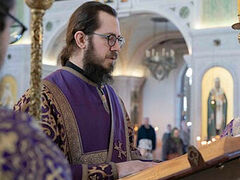
Time would pass, and all the pieces of the puzzle would fit together to give the full picture. Alexander would serve at the cathedral, and I would become a priest’s wife and a mother of five sons and five daughters.