The Monument to the Serbian martyrs killed by the Ustashi during the Second World War. Memorial Museum Stari Brod. Architect Novica Motika. Višegrad, sixteen kilometers from the border with Serbia. Photo: visegradturizam.com
The novel The Bridge on the Drina by Ivo Andrić, the remarkable Yugoslav writer and Nobel Prize laureate in literature, covers the period from the sixteenth to the beginning of the twentieth century and describes the life of Bosnians—Christians and Muslims—from the moment the bridge was built until the events of the First World War. It is a kind narrative about the inhabitants of Višegrad, legends, joys and sorrows, wars, uprisings, the change of generations, their interrelationships, sufferings, weighty reflections—the author conveys it all with love not only for his native land but also for the people who inhabit it. The Bridge on the Drina ends with the death of one of the main characters, Ali-hodja:
“But, however,” he reflected further, “if they are destroying here, then somewhere, one must assume, they should also be building. For there are, somewhere in the world, one must think, regions and people with sense, who remember God. And if the Lord has turned away from the unfortunate town on the Drina, then surely not from the entire earthly vale that stretches under the sky? But this will not remain here forever either. However, who knows? (Ah, if only to breathe in a little more air!) Who knows? Perhaps this foul faith that remakes everything, cleans, rebuilds, and renews, in order then to devour and destroy everything at once—perhaps it will seize the whole earth and turn the entire world of God into a desert for its senseless construction and barbaric destruction, a pasture for satisfying its insatiable hunger and incomprehensible pretensions? Anything is possible. Only one thing is impossible: It is impossible that the great and wise men endowed with spiritual generosity, who build eternal structures in the name of God for the adornment of the earth and the easing of human life, should disappear and die out in the world. Were it not for them, God’s mercy in the world would disappear and fade away. And that cannot be.”
Immersed in thoughts, the hodja walked ever more slowly and heavily…
History has shown with what self-forgetfulness people reject God’s mercy; if Andrić had described the events of the twentieth century, the bridge on the Drina would hardly give cause for optimism.
If the events of the end of the last century are eloquently testified to by the monuments in Višegrad and the Russian cross towering over the town—a memorial cross erected in gratitude to the Russian warriors who fought for the Serbs, their Orthodox brothers, in former Yugoslavia—then until recently, the persecutions of Christians in the nineteen-forties were spoken about only in whispers, if at all. But there were persecutions. From March to April 1942, here on the Drina, at the locality of Stari Brod, according to incomplete official data alone, six thousand Orthodox were killed for believing in Christ—elderly people, children, women, men. But the torments of the Orthodox began as early as 1941 and continued until the end of the war; it is just that in these two months they were most massive in this region.
 Names of the martyrs on the wall of the Museum-Memorial
It is about fifteen kilometers from Višegrad to Stari Brod , but the bridge is important here: the point is that on the famous bridge over the Drina in March 1942 there stood Italian guards who allowed people across it fleeing from Nazi terror only for bribes. No money—go wherever you want. And people were fleeing from all over Bosnia from the frenzied persecutors—the Ustashi—in order to save, if not their own lives, then at least those of their children and grandchildren, so as not to end up in the death camps built for the total “solution of the Serbian question” in Croatia. So tens of thousands of refugees had to bypass this bridge and seek another way to cross the river—to Serbia, where one could at least hide from the persecutors in the forests or rocks, for better or worse. In Stari Brod, the Ustashi discovered them, and arranged, as they said, a “pokol”—that is, a mass slaughter of the Orthodox.
 Višegrad bridge. Photo: ru.wikipedia.org
In Stari Brod, the Ustashi discovered them, and arranged, as they said, a “pokol”—that is, a mass slaughter of the Orthodox.
The Serbs' former neighbors, Muslims, willingly helped them—they were promised, in case of “cooperation” with the Nazis, the property and houses of their neighbors. Surviving witnesses say that girls, embracing each other, threw themselves into the river so as not to be dishonored by the Ustashi; mothers threw infants into the waves of the mountain rivers that had become full-flowing and jumped after them, knowing that on the shore there would be a much more terrible death. If a mother remained on the shore, the Ustashi tore the child from her hands and impaled it on a bayonet—they invented a multitude of ways to kill. The events in Bethlehem a little more than two thousand years ago do not seem so distant. And Herod is not some terrible figure from the past. Such martyrdom—and this is precisely martyrdom, because the Serbs were killed only for being Christians—was endured by thousands of people fleeing from the Nazi “Black Legion” under the leadership of Jure Francetić, one of the Nazi executioners. It is important to note that the martyrdom at Stari Brod is only one episode of the persecutions of the Orthodox at that time.
 Church in Stari Brod. Photo: visegradturizam.com
Why for long decades were the events at Stari Brod spoken of only in whispers? I think the answer here is clear: socialist Yugoslavia, the policy of “friendship of peoples” and the motto, “religion is the opiate of the masses.” In other words, exactly the same reason in Russia the authorities diligently hushed up the names and nationalities of those who burned villages and hamlets and killed their inhabitants in the Novgorod, Pskov, Leningrad regions, Belarus, and Ukraine.1 I repeat: from Višegrad to Stari Brod it’s only about fifteen kilometers, but until recently there was not even a normal drivable road there. If someone wanted to get there, he could do it only by boat—but by car? No way. But there is a living memory, and despite the vigilant socialist control over the loyalty of thoughts, the Serbs remembered and told their children and grandchildren why, for Whom, and at whose hands their parents, grandfathers, and brothers suffered.
The Serbs remembered and told their children and grandchildren why, for Whom, and at whose hands their parents, grandfathers, and brothers suffered.
Several grandparents of one of the relations of Protopriest Dragan Vukotić, who serves in the church in honor of the Tsar-Martyr Lazar in Višegrad, were killed by the Ustashi. Fr. Dragan says:
“I think the overwhelming majority of Orthodox families in the town and the entire surrounding area can cite similar examples. Yes, often, unfortunately, one can say that the Serbs are “more kin-loving than Christ-loving,” that is, they pay more attention to family ties than to faith; but in this case love for kin and love for God are united by memory and veneration for their martyrs who died for the sake of Christ.”
He sighs:
“In Soviet, communist times this topic was simply closed. It was forbidden. But we remember, we know. Moreover, immediately after the war, surveys of surviving witnesses, eyewitnesses of the torments were conducted. These testimonies were stored (and guarded) in archives throughout former Yugoslavia; it was impossible to publish them. I will add that former Ustashi felt quite at ease in communist Yugoslavia, often bore no responsibility for their atrocities, and many of them held leadership positions, living soul to soul with former “red partisans,” experiencing the same hatred for Orthodoxy (how strong the parallels are with the Soviet Union! —P.D.). However, over time, in 2007, we had the idea to erect a memorial cross, to collect as many testimonies as possible about their martyrdom. We worked in archives, published a collection of documents. Then, in 2014, we built a chapel, and a few years ago, in 2019, we arranged a museum-memorial; the author was the well-known architect Novica Motika from Zvornik. And quite recently we managed to lay a road from Višegrad to Stari Brod, to lay a pilgrimage route right to the place of the martyrs’ suffering. One of the tasks is to show people that martyrdom for Christ accompanies us all our lives, that this is a sign not only of the first centuries but of all subsequent times: And ye shall be hated of all men for my name’s sake. But there shall not an hair of your head perish. In your patience possess ye your souls (Lk. 21:17–19). Now, of course, the number of pilgrims has increased many times over; many for the first time are learning, discovering our history for themselves—terrible, but also holy.
The memorial and museum impress and terrify with their, I would say, silent scream: figures of the killed in the waters of the Drina, many made from surviving photographs; thousands of names of martyrs on the walls of the museum; frescoes of martyrs in the church; a bell—and nearby—the quiet surface of the river, wondrous mountains covered with greenery, the sun playing on the peaks… What man is capable of turning a reminder of paradise into when he consciously rejects his paradisiacal inheritance! Into a horrific place, believe me.”
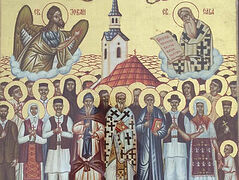
 Holy Martyrs of Stari Brod. Serbian icon We present several documents from the collection “The Sufferings of the Serbs During the Second World War in the Romanija Region and Other Parts of Eastern Bosnia.” In some measure, they can be compared to the sufferings of the martyrs of the Roman Empire of the first centuries.
-
“In October 1941, Ustashi, whose names I do not know, entered our village of Ljubogošte; they came from Sarajevo, and took away my husband Ostoja, son of Marko, sixty-five years old, and also took Vasa Ivanović, son of Trivko, fifty-four years old, and Jovo Veselinović, son of Vuk, seventy-five years old, and Stepan Stanišić, son of Foma, thirty-five years old, and took them to the place Buloge, where they killed them with a hammer to the head. Toma Stanišić from Ljubogošte found their bodies and the hammer with which they were killed. I have nothing more to say; I only ask that the criminals be punished. Stana Poljaković.”
-
“In September 1941, the Ustasha commander Stanko Mandić came to the village of Drecelj with his detachment, stopped in front of my house and shouted for me to come out. They started shooting, killed the domestic poultry, then entered the house. They cursed, shouted that this is not Serbia but independent Croatia, and that we should get out. He told my wife Rosa to accept Catholicism, otherwise let her get out to her Serbia. He drew a knife, threatened the children and wife, then took away all the livestock. Fifteen days later he returned and burned the house and barn… In October my wife returned to this place to see what happened to the house. The aforementioned Mandić found her, struck my son Miladin, who died within a day… This same Mandić killed Milan Vasiljević, twelve years old, Ilija Medjić, sixty years old, Gaja Gruić, fifty years old, Danka Gruić, thirteen years old, blind Nedja Vuković, thirty-five years old, Tadija Ivanović, fifty years old, Radovan Nikolić and two more people, forty years old… I heard that Stanko Mandić is at liberty and lives in Drecelj in his own house. Grujo Nikolić.”
-
“In February and March 1942, a detachment of Ustashi led by Ismet Mašić came several times to our village, and they killed 105 people—elderly people, women, and children… Besides the commander Mašić, Avdo Pašić from Žunove, now living in his own house; Alija Hasanpašić, now living in his own house; Pašan Čolaković, now living in his own house; Šahin Merdan, currently serving in the Yugoslav army, and many others whose names are unknown to us participated in the atrocity… There were no German atrocities on our land, because the Germans transferred all power to the Ustashi, and they committed the aforementioned atrocities. Pero Gavrić.”
Hundreds of testimonies, documents. In most cases, the reason for the murder is indicated: “Orthodox.” Protopriest Dragan Vukotić says: “In our world, which lies in evil, this is a very weighty reason. Holy martyrs, pray to God for us!”
Indeed, the bridge on the Drina could tell much. Ivo Andrić did not describe everything. But, remembering the martyrs of quite recent times, one can quote his words: “If not for them, God’s mercy in the world would disappear and fade away.”