Some Orthodox Christians are strongly opposed to the idea of welcoming the New Year in church. They say, “This is a secular New Year; it has nothing to do with us! We will celebrate the New Year on January 14.” Every point of view has the right to exist, but it is obvious that the overwhelming majority of people—including Orthodox Christians—celebrate the New Year from December 31 to January 1. I encountered widespread celebration of the Old New Year only in Georgia, in my childhood, when all our relatives would gather at the home of my grandfather Mikhail and grandmother Tamara in Digomi. They would roast suckling pigs, prepare bowls upon bowls of pkhali, make khinkali, and the women would prepare baklava and kozinaki from dough as thin as paper. Then everyone would sit down at the festive table, raising glasses of wine until morning, offering long, beautiful toasts, singing heart-rending Georgian songs, crying, kissing, rejoicing, and thanking God. We do not have such a tradition here.
As one experienced elderly priest once observed, it is naïve to set oneself against everyone else while demanding special consideration for an Orthodox way of life from people who have no intention of thinking about it at all. “If you want to convince someone of something,” he said, “don’t shout, don’t beat your chest—show it by example, so that people are inspired and want to share this Orthodox life of yours, with all its rhythms and customs.” It doesn’t work any other way.
In general, celebrating the New Year according to the secular calendar, if one does not approach it with excessive zeal, does not really interfere with the ordinary Orthodox rhythm of life. For us Orthodox Christians, December 31 is the feast day of Holy Righteous Simeon of Verkhoturye, the patron saint of the Ural land; in the Ekaterinburg Metropolia festive solemn services are held, and attending them is a great joy. At this time, services are taking place in the churches that prepare us for Christmas. For those who find the opportunity to attend them, they bestow a special spiritual atmosphere: calmness, inner attentiveness, and an incomparable, uplifting anticipation of the joy of the coming Nativity.
Sin lies not in the holiday itself, but in how it is celebrated. Welcoming the New Year in church can offer new spiritual sensations and enrich one’s inner experience. It is one thing to turn off the television, draw the curtains tight so as not to hear the festive fireworks, and go to bed—and quite another to greet the New Year together with the whole country, but in one’s own way, in an Orthodox way.
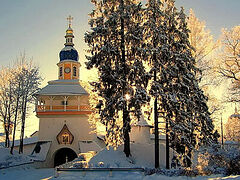
In my home cathedral, the Cathedral of the Protection of the Mother of God in Kamyshlov, where I serve, the New Year service begins on December 31 at 11:00 p.m. Not many people gather; those who come to the night New Year service are people who love the church, love the services, and love prayer. Because of this, there is a special prayerful atmosphere in the church: everyone prays together like one family, and every word of the service settles deeply into the heart. You can truly feel it. I have encountered something similar at early morning services in monasteries, but there the congregation is different—people who have long lived at the monastery: the brotherhood, the monks. Here, however, ordinary townspeople come, often after a full workday, after household chores and worries. They know why they are coming—to be with God, to pray in their native church. Compared to what the world offers, with its countless entertainments and pleasures, this is something of great value. Here they are—the people of God: few in number, not especially “spiritual” or outwardly impressive, but kind, sincere, and simple-hearted.
When fireworks and salutes began thundering outside, so loudly that the windows in the two-hundred-year-old cathedral walls started to shake, it felt as though we were truly on a ship racing over the waves in the midst of a raging storm.
At once the Gospel story came to mind—the one that happened to Christ’s disciples on the Sea of Galilee. Christ was sleeping in the boat, while a storm raged around them. The apostles struggled as best they could for their lives, and when they saw that their efforts were in vain, they lost heart and fell into despair. The Lord was there with them in the boat, but it was as though they did not notice Him—only when things became truly desperate did they rush to Him and rudely shake Him awake, saying, Do You not care that we are perishing? (Mark 4:38). In our own lives, when trouble strikes, we very often act in the same way. At the very last moment we remember that God is near, but instead of falling at His feet and humbly asking, we demand: “Do You not care that things are going badly for us? Save us! Fix our lives—don’t You see that we are in trouble, that we are perishing?” Then Christ rose and said to the disciples, “Ye of little faith!” And He commanded the storm: “Be still! Be silent!” (cf. Mark 4:39). And everything around them grew calm.
Beyond the walls of the church, the storm also subsided, and only prayer remained, along with the quiet little flames of the vigil lamps before the icons. “In peace, let us pray to the Lord!” Leaving our worries to the coming year—which is unlikely to be much better than the last—we did not lose hope and prayed to God as if for the very first time.
We did not know what the new year would bring—and no one today truly knows—but we believed that as long as we are with God, the year will be good. As long as we strive to preserve inner peace, forgive from the heart and pray for those we have offended, go to church, and, as best we can, keep God’s commandments—even the smallest of them—we will be standing on God’s side, answering “yes” to His love. And that means we will be able to overcome any hardships and trials.
At the end of the service, Fr. Artemy came out of the altar with a cross in his hand and said:
“Usually on New Year’s people wish one another happiness, success, health, and various blessings. But in the New Year, I wish you this: Always remain with God. In our times this is not easy, but let us always remember that when we take one step toward God, He takes two steps toward us.
“When a person is with God, everything will be well for him. Wherever he may be, whatever he may be doing, he will succeed, because God Himself will be helping him. Whatever challenges life sets before him, with God he will be able to overcome any difficulty. Amid the storms and trials of everyday life, he will always find the right path, because God’s love will light his way. The warmth of this love will warm everyone who is near him. For the greatest secret of God’s love is this: The more a person does for others, the more joy and happiness there will be in his own life.
May the Lord preserve you in the New Year!