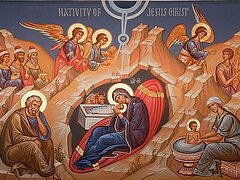
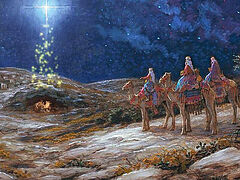
The Nativity of Christ. Artist: Ilya Repin. Photo: artchive.ru
The fullness of time was fulfilled when God sent His Only-Begotten Son into the world. Christ was born in the days of Caesar Augustus, when the Roman Empire stretched from Parthia to Britain, proudly calling itself the empire over all the earth. Then there went out a decree from Caesar Augustus that all the world should be taxed (Lk. 2:1), including Judea, which had been captured by the Romans sixty years prior and was now ruled by Cyrenius, the Roman governor of Syria. With this census, Augustus intended to assert his power, but the providence of God orders everything according to His own end.
Christ was born in Bethlehem, which means “house of bread.” Therefore, it pleased God to choose this place for Him Who is the Bread of Life, the Bread that came down from Heaven. And so it was, that, while they were there, the days were accomplished that she should be delivered. And she brought forth her firstborn Son, and wrapped Him in swaddling clothes, and laid Him in a manger; because there was no room for them in the inn (Lk. 2:6–7). The fact that no room was found for the Lord in the inn is deeply symbolic. The only place for Him on earth was the Cross.
It’s amazing that the first to bear witness to God’s appearance on earth were angels and shepherds—the simplest of people, who tended flocks of sheep perhaps intended for sacrifice in the Temple. And they were the first accounted worthy of seeing the Lamb of God Who takes away the sin of the world. The angel of the Lord said to them: Fear not: for, behold, I bring you good tidings of great joy, which shall be to all people. For unto you is born this day in the city of David a Saviour, Which is Christ the Lord (Lk. 2:10–11). This fulfilled the prophecy: For unto us a Child is born, unto us a Son is given (Is. 9:6). This is true joy—a great joy for all people. And this joy is immediately revealed: The shepherds find themselves in the light with the Angels—in other words, in Heaven. For man’s salvation consists in abiding in the presence of God, partaking of His life and glory. Heaven on earth; shepherds in Heaven. The everyday service of shepherds becomes the Holy of Holies, the place of God’s presence. The shepherds are citizens of heaven, while Christ, the Son of God, is a subject of Caesar!
Following the proclamation of the Nativity by one angel, a Heavenly host appeared, glorifying God. It is meet and right to unceasingly praise our God together with the angels: Glory to God in the highest, and on earth peace, good will toward men (Lk. 2:14). The glory of God has descended to earth, peace surpassing all understanding is given to mankind, and to the all-surpassing gift of Divine love they cannot but respond with their own love.
The angel said: And this shall be a sign unto you; Ye shall find the Babe wrapped in swaddling clothes, lying in a manger (Lk. 2:12). God wanted to show exceptional care for everything concerning the birth of the Son of God on earth. How can He reveal, as a clear and easily understandable sign for all, who He is—the One Who exists from the beginning—and what He wants to give to mankind? Throughout the entire history of the Old Testament, He led the Jews step by step with great patience, gradually clarifying the images of God as a warrior, which they too often understood only in an earthly sense, yielding to the influence of their neighbors, so they might finally understand that their God is incomparable to any other god.
But the final word about God, the supreme revelation of what He is for us, could only be spoken through God’s Son living among us with the same flesh and blood as us; and above all, by how He was born on Christmas night, as a Babe lying in a manger: And this shall be a sign unto you; Ye shall find the babe wrapped in swaddling clothes, lying in a manger.
Had it not been for the sudden light and the host of angels singing, “Glory to God in the highest,” the shepherds would never have dared to believe it, so far was what they saw from any idea they had of God. They could imagine everything beautiful and great about Him—everything, that is, save this fragile, defenseless, crying Being, whom His Mother pressed to Her chest. So defenseless, that without His mother’s milk, God couldn’t have lived as a man for even a day. The Creator of the world, Who gives food to all living things, would die from hunger. People have been trying to kill Him since His very birth. And He will die—struck by a perishable hand—He Who by His hand created man, nailed to the Cross by men. But first, He must pass through to the age of maturity, teach and show everyone why we are born and die. But for the time being He requires the palpable, day-and-night care of His Mother, the fullness of a mother’s love, without which God, Whose name is Love, can’t survive His infant state as a man.1
And all they that heard it wondered at those things which were told them by the shepherds. But Mary kept all these things, and pondered them in her heart (Lk. 2:18–19). The whole mystery of the Lord, revealed by His Pascha and His ministry on the Cross, is here. And the Mother of God partakes in this from the very beginning. From the Annunciation to the Resurrection, from His birth to His death, she secretly treasures all His human existence and all His Divinity in her heart.
The Holy Fathers say that God, by becoming so weak and vulnerable, willed to take upon Himself a risk. Such extreme weakness and such amazing vulnerability were for Him the sole means of revealing something essential about Himself and the love He has brought us. Nothing else could ever convey as effectively what remains concealed from us behind words that are far too easily uttered. God loves us, to the point of such abasement, to such dependence on our relationship to Him. That’s why, appearing in this way, God willed to be loved by us—who can be more loved than a newborn? And at the same time, He came in perfect openness and trust toward us.
Except ye be converted, and become as little children, ye shall not enter into the Kingdom of Heaven (Mt. 18:3), says the Lord. The mystery of the Divine Child reveals much about ourselves and our path. If God has chosen to draw near to us with the vulnerability of an infant, then we, in turn, can only stand before Him with the heart and face of a child—before God, but also before other men. And that’s not easy. We wouldn’t want to be born on straw, or to be dressed only in swaddling clothes, or to lie in a manger. Without even thinking about it, we prefer that our inner self—the child we carry inside us—remain untouched by others in its solitude. Perhaps most of all, we make sure that it’s clothed in the trappings of adulthood.
But appearances don’t change anything in our relationship with God or with most people. Nobody needs us with our elusive wealth and false spiritual achievements. Between God and man, and between men, as on this Christmas night, there can only be genuine love where there is defenselessness and poverty, humble care for the needs of others, and our complete openness and trust in the Lord—as with the Babe of Bethlehem and the Most Pure Virgin Mary. Only those who become like Him, through His gift, will enter the Kingdom of God.