In the name of the Father, and of the Son, and of the Holy Spirit. Amen. Today, the Holy Church celebrates the Week after the Nativity of Christ—the first Sunday after the Nativity in the flesh of our Lord Jesus Christ. The Gospel reading that the Holy Church offers us today tells us about a wicked act unprecedented in human history, when King Herod, having learned from the Magi who had come to Jerusalem of the birth of the King of the Jews, was sorely vexed and commanded the murder in Bethlehem and surrounding areas of all infants aged two and under, according to the time given by the Magi. The reason for the tyrant’s anxiety was his fear of losing his earthly power, and the unprecedented brazenness of this wicked act consisted in his rebellion against God’s Anointed—Christ; for having learned from the Magi and having gathered all the high priests and scribes, he asked them where the Christ must be born.
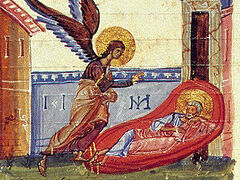
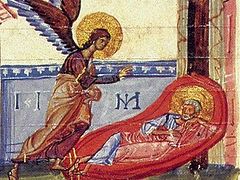
Citing the words of the prophet Micah, they told him, In Bethlehem of Judea. Thus did Herod seek the soul not of an ordinary infant, but the Anointed of God, Who had been foretold over 700 years before by the holy prophet. The kings of the earth were aroused and the rulers were assembled together against the Lord and against His Christ (Ps. 2:2), the prophet David tells us, pointing toward the Savior’s suffering on the cross not only on Golgotha, but throughout His whole life, beginning from his infancy in the Bethlehem manger. For according to the explanation of St. Athanasius the Great, the “kings of the earth and rulers” are Herod and Pilate. He that dwelleth in the heavens shall laugh them to scorn and the Lord shall deride them (Ps. 2:4) prophesies King David, as if peering through the ages at Herod put to shame when the angel of the Lord snatches the divine Infant from the hands of the bloodthirsty king, commanding St. Joseph the Betrothed in a dream to flee with the young child to Egypt.
When Herod dies, the angel of the Lord again appears to Joseph in a dream and says, Arise, and take the young child and his mother, and go into the land of Israel: for they are dead which sought the young child’s life (Matt. 2:20–21). Joseph submits to the divine command, but when he hears that Archelaus reigned in Judea in place of his father Herod, he was afraid to go there. However he received a revelation in a dream, and so he went to the land of Galilee. Why did he so fear Archelaus? Archelaus, son of Herod, was no less cruel than his father, cruelty being an inseparable companion of the passion of love of power. In a fit of morbid suspicion, he ordered—on the feast of the Passover—the destruction of three thousand Judeans, thinking that they were not loyal enough to him.
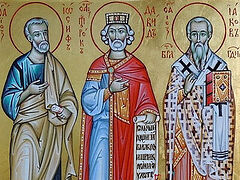
Today we also celebrate the memory of God’s prophet, David, St. Joseph the Betrothed, Apostle James the Brother of the Lord—the son of Righteous Joseph from his first wife Solomonia—and also a confessor of the Serbian Church, St. Dositheos, Metropolitan of Zagreb. The life of the Savior was from his very infancy a vale of tears, filled more with injustice than the solemnity of the divine Incarnation that the angels had announced. This also applies to the lives of those saints whose memory we celebrate today.
Let us recall the prophet David, the anointed king of Israel—what sorrows he had to bear, how he was pursued by Saul, how his own son rebelled against him, and how many grievous and humiliating things he endured before ascending the throne of his kingdom. And Righteous Joseph, having received the revelation from the angel and understanding the terrible responsibility given to him not by a man but by God, made his dangerous trip to Egypt. As Church tradition tells us, he was attacked by robbers and endured the hardships of travel through the desert.
Apostle James, the brother of the Lord and first bishop of Jerusalem, was cast out of the Jerusalem temple by cruel Jews for his confession of the incarnation of the divine-human nature of our Lord Jesus Christ.
And St. Dositheos endured no less terrible sufferings when, as a Serb, he was appointed to the cathedra of Croatia in Zagreb. He was a highly educated man, an ascetic, and a zealot of the patristic tradition. He ended up in a city where he was subjected to perhaps unprecedented mockery toward a bishop, beaten by fanatical Ustashi Catholics. After this beating he was put in a hospital, where equally fanatical Catholic nuns whipped him and yanked out all the hairs of his beard. Due to these sufferings he soon reposed in the Lord, and in the year 2000 was numbered among the ranks of confessors for the faith by the Serbian Orthodox Church.
When we contemplate these events, the question involuntarily arises in us: Why is there so much injustice in the world? Why was the murder of 14 thousand innocent babes allowed? Why did King David, St. James, and St. Dositheos have to suffer? What kind of justice is this?
If we think about the origin of word justice, we of course connect it with the word “righteousness”, “right”, “truth”, “the right side” [the word “justice comes from the Latin iustitia, which means “righteousness, equity”, ultimately from the root ius, “right, law”. In Church Slavonic, the word pravda also means “truth”]. There is the justice or truth that is within us, which compels us to give everyone his due. And although we do not achieve this exactly, when we nevertheless act with a truthful disposition, we do not stray far from the goal, says Basil the Great.
And he continues: “And there is a truth that reaches us from heaven, from the righteous Judge. A truth that at times corrects, at times rewards, in which much remains incomprehensible to us, because of the loftiness of the judgments contained within it.” His truth abideth unto the ages of ages, hymns the prophet David, as if by this showing that truth has a dividing line, the line at the threshold of eternity.
According to St. John Chrysostom, the prophet said this for those who are tempted by the misfortunes that unexpectedly befall some. The prophet David as if instructs them in this way: Do not be troubled by the appearance of people who are slandered, wronged, and who suffer innocently. There is an impartial judgment that renders to each according to his due. If you demand this judgment right away, then beware that you not pronounce it against your own self. These are terrible words. What should we do if our human righteousness is imperfect, while God’s judgment is hard to comprehend and mysteriously hidden from us. Blessed is he who is righteous according to God’s righteousness. His hope is concentrated on Christ. This perplexity is resolved for us by the great hierarch of the Russian Church, St. Ignatius (Brianchaninov).
Unhappy is he who is satisfied with his own human justice; if he does not need Christ, Who said of Himself, I have come to call not the righteous but sinners to repentance. But how can we bring our limited human imperfection—our imperfect minds, hearts, and sense of justice—to divine justice, which is at times incomprehensible to us? St. Ignatius gives us an explanation. Divine truth appeared to mankind in divine mercy and commanded us to be like unto God in perfect mercy, and not in some other virtue. Then our justice will soar high like an eagle into heavenly realms, will receive wings to reach the borders of eternity unto the ages of ages, and become able to cross this border between temporal existence and eternal existence. But could mercy really be so magnificent that it can clearly testify to us here on earth of a great and barely comprehensible divine truth? Yes, it can.
Once, as young men, we made a pilgrimage in the early 1980s to a very ancient monastery located not far from Tbilisi. This monastery is called Betania, which means Bethany in Georgian. There, we encountered an extraordinary event. The monastery was small, but services were held every day by the abbot John and the hierodeacon George. Pilgrims sometimes visited. At that time, it was very hard to reach the monastery. People able to reach this cliff only on foot, or an all-terrain vehicle.
So, one day a man came there named Guram. He was well known in Tsbilisi as a worthless drunkard who was always begging for money near the church, and they thought that he spent this money on drink or some other impious thing. Many held him in contempt, and perhaps it never even occurred to anyone what secret ascetic labors he performed.
As it turns out, he spent all the money he received on people in difficult circumstances, on widows and misfortunate children who had lost parents, or on those who suffered from incurable diseases and had no one to take care of them. And this man despised by all came to the monastery, confessed to the abbot, and told him his life’s secret. Soon afterwards, he reposed in the Lord.
And then, what happened? As if by God’s command, His Holiness Patriarch Ilia of Georgia and six bishops suddenly arrived at the monastery for no apparent reason, compelled by some strange urging of the heart, and they served this man’s funeral. The Patriarch and bishops saw him off to eternity. Thus, the commandment of mercy destroyed the wall of division between earthly justice and heavenly justice.
Let us be attentive and remember the power of this virtue, according to the words of Prophet David, I will confess Thee with uprightness of heart, when I have learned the judgments of Thy righteousness (Ps. 118:7). Let us learn through the judgments God, through God’s truth and righteousness, which can become for us easy not only to comprehend, but also to fulfill, on the path of our earthly sojourn. Amen.