Photo: komarovka.ortox.ru
In the name of the Father, and of the Son, and of the Holy Spirit!
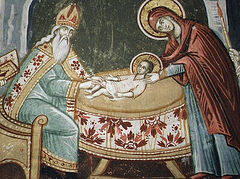
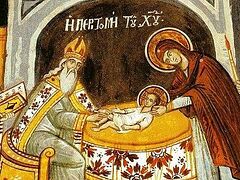
Today, on the eighth day after the Nativity of Christ, the Holy Church marks the feast of the Circumcision of our Lord Jesus Christ. The question arises: Why do we celebrate the performance of this rite of the Old Testament Law on the Lord—for it has long passed away like a shadow?
The Holy Scriptures explain its necessity by the fact that Christ did not come to abolish the Old Testament Law, but to fulfill it. This rite was established for all male infants among the Israelites as a sign of God’s covenant with Patriarch Abraham and his descendants. If Christ had not been circumcised, no one would have recognized Him as the promised Messiah, a scion of Abraham.
According to the interpretation of the Church Fathers, God the Son underwent circumcision in order to set people an example of strict observance of Divine ordinances and so that no one could later doubt that He was a true Man, and not a bearer of a phantom body, as some heretics taught.
It pleased God that the Most Holy Theotokos and Her betrothed, the Righteous Joseph, fulfilled everything consistent with the Old Testament Law, and the Divine Infant was circumcised and named on the eighth day, dedicated to God on the fortieth day, and from the age of twelve began to attend the Temple of Jerusalem annually, as we have heard in today’s Gospel reading. Thus, by His humanity, He observed the letter of the Law, but by His Divinity, having become incarnate for the salvation of the human race, He fulfilled the whole Law. So now for us everything external and ritual has become no more than a means to achieve an inner goal. In the New Testament, the rite of circumcision gave way to the sacrament of Baptism, of which it was the prototype.
The feast of the Circumcision of the Lord lasts for one day and is popularly known as St. Basil’s Day, since on this day in 379 St. Basil the Great, one of the greatest teachers of the universal Church, passed away. He represented a very beautiful example of the true “Circumcision of Christ” in the spiritual sense.
St. Basil was born in 330 in the city of Caesarea in Cappadocia into a pious Christian family. The saint’s father was a lawyer and teacher of rhetoric. There were ten children in the family, five of whom were canonized by the Church. St. Basil obtained an excellent education. It was said of him that he had studied every science to such perfection as if he had studied nothing else. He was a philosopher, a scholar, an orator, a lawyer, a naturalist, and had a profound knowledge of medicine. In the words of his contemporary and friend, St. Gregory the Theologian, “he was a ship as loaded with erudition as human nature can be.” But his mind was searching for the supreme Divine wisdom, so he went to the great desert-dwellers of Egypt, Syria and Palestine. A year later, St. Basil gave out everything he had to the poor, then traveled to Jerusalem and received Holy Baptism in the Jordan. On his return to Caesarea, St. Basil settled in a deserted place, where he struggled in hard labors, fasting and prayer. He also invited his friend, St. Gregory the Theologian. Soon, monks gathered around them, and a monastery was established. Guided by the Holy Scriptures, they wrote the rules of monastic life, which were later adopted by Christian monasteries.
In 370, St. Basil was called to a high episcopal ministry and labored in every cause to the point of self-oblivion: he fought against heretical Arians, preached, cared for the poor, and organized monasteries.
Over his short life, St. Basil wrote many works explaining the Holy Scriptures and the Liturgy, passed down from the apostles. He compiled the anthology called the Philokalia, composed numerous prayers, canonical rules, and rules for monastics. In his writings, he revealed the dogma of the Holy Spirit. He is praised as “the glory and beauty of the Church” and “the luminary and the eye of the universe”.
St. Basil the Great was the Heavenly patron of the enlightener of the Russian lands—the holy Prince Vladimir Equal-to-the-Apostles, who was named Basil in Holy Baptism. The prince deeply venerated St. Basil the Great and built several churches in Russia in his honor. St. Basil, along with St. Nicholas the Wonderworker, had been held in special veneration by the Russian faithful since ancient times.
Today during the Divine Liturgy we heard an excerpt from an epistle of the Apostle Paul, which reads: In whom also ye are circumcised with the circumcision made without hands, in putting off the body of the sins of the flesh by the circumcision of Christ (Col. 2:11). What does this mean? According to the teaching of the Holy Fathers, this “circumcision of Christ” consists in cutting off from the heart all the passions—anger, lust, envy, pride, vanity, avarice—all that prevents our hearts from being abodes of the Holy Spirit.
Indeed, we are not saved by the works of the Law, but by grace; but the grace of God is not something that belongs to us by right. It is a gift from God, and each one of us knows from the experience of our lives how difficult it can sometimes be to keep it. And therefore, the path of Christian life is essentially a painful and thorny one, joined with inevitable self-denial, and rejection and cutting off of everything that prevents us from following Christ.
People are full of all kinds of passions that have become ingrained in them like a malignant tumor, and only a serious operation can save our lives. Similarly, sin must be “removed surgically”, “circumcised”—that is, cut off from us so that we can remain healthy.
Therefore, every Christian should nip in the bud all these sinful thoughts, desires and intentions, be watchful every day and every minute without giving free rein to his eyes, ears, tongue, or any desires; not to allow himself any dreams, but to reject all evil, cutting it off and destroying it by invoking the name of the Lord Jesus Christ.
And the Lord helps us in this by sending us involuntary sorrows. If someone cannot, for example, overcome gluttony, drunkenness, or lust, the Lord sends him illness. If he is haughty or arrogant, the Lord humbles him before everyone else so he becomes a complete nonentity in the eyes of people. If a Christian is attached to earthly things and directs all his energies, desires, and dreams to gaining earthly well-being by hook or by crook (theft, deception, or by any other means), then the Lord will take away even all that he has. Thus, in addition to our labors in our own struggle against sin, the Lord also sends us involuntary sorrows as help in this struggle. From this continuous struggle with sin and involuntary sorrows is formed every Christian’s cross.
If a Christian truly understands his mission and the meaning of sorrows, he will bear his cross without a murmur. But if he doesn’t understand this, he begins to grumble and judge the Lord Himself: “Why is the Lord sending me sorrows, illnesses, and the like? Am I worse than others?”
Throughout our earthly lives, we must deny ourselves, cut off every sin from ourselves, bear the cross that the Lord has given us without grumbling and with gratitude, and beseech Him to help us lead Christian lives, die Christian deaths, and inherit the Heavenly Kingdom. Amen.