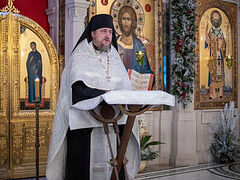
Photo: Dmitry Rogulin / gorvesti.ru
The Lord accepted Baptism from St. John the Forerunner, but He wasn’t baptized as we are. Outwardly, it looked exactly the same, but the inner content was different. If we’re baptized for the remission of sins, then the Lord, being sinless, didn’t need it; which is why St. John the Baptist asked Him: I have need to be baptized of Thee, and comest Thou to me? But the Lord answered him: Suffer it to be so now: for thus it becometh us to fulfil all righteousness (Mt. 3:14–15). For when the Lord was baptized in water, He sanctified the nature of all water. Thus, the Church sings: “This day the nature of waters is sanctified.”
That is, the Baptism of the Lord is the descent of God’s grace upon the water that we now receive with faith. But this feast is also called Theophany. Why? Because at the moment of the Lord’s Baptism, the entire Holy Trinity appeared; and thus on that day, a mystery hidden from the ages, from the nations, was revealed. Until that time, the Old Testament spoke about the Holy Trinity in a concealed manner, only in general terms and concepts. But it was spoken about.
For example, at Vespers, we read the Old Testament reading on the creation of the world. From the very first lines of the book of Genesis, the first book of the Old Testament, it speaks of the Holy Trinity, that God is one and yet threefold in Person: In the beginning God created the heaven and the earth (Gen. 1:1). According to the original text, written in ancient Hebrew, it literally says: “In the beginning, the Gods created the heavens and the earth.” “Gods” is in the plural because it’s speaking about the three Persons of the Holy Trinity. But “created” is in the singular because God is one, and threefold in Person. But this was simply stated there, without explanation of why the noun is plural and the verb singular.
Only today’s feast reveals this mystery of the Holy Trinity. “Gods” refers to God the Father, God the Son, and God the Holy Spirit, but They’re one Godhead, the one and indivisible Trinity. Thus, this feast is called Theophany because God appears in the Trinity: God the Son, our Lord Jesus Christ, receiving Baptism from St. John; the voice of God the Father bearing witness from Heaven that This is My beloved Son; and the Holy Spirit descending upon the Son in the form of a dove.
The Gospel says: Then was Jesus led up of the Spirit into the wilderness to be tempted of the devil (Mt. 4:1). So this moment is also special, spiritual. On the one hand, “the Savior, Who is grace and truth, shone forth,” as the Church sings (Exapostilarion of Theophany), and on the other hand, there’s a temptation. This spiritual law is always at work in our lives—there’s always a temptation on feast days. Grace is given, and it’s either immediately preceded or accompanied by temptation.
Abba Dorotheos, one of the spiritual guides of monasticism, writes that this is such a fixed law that no work stands firm without temptations. But because of our lack of spirituality and our sinfulness, we usually forget about it. And when temptation befalls us, instead of taking comfort, saying: “Well, that means everything’s in order,” we fall onto the devil’s hook, becoming troubled, irritated, and hostile towards one another; that is, we do exactly what satan tries to get us to do, forgetting the words of the holy Apostle James: My brethren, count it all joy when ye fall into divers temptations (Jas. 1:2)—because it means you’re on the right path. The Holy Fathers say the same, only in different words: If some work of God is being done and there’s no temptation either before, during, or after, then this work isn’t pleasing to God.
One spiritual writer, recounting that in a certain monastic community there were all sorts of frictions—both internal and external—adds: “Let the pious reader not be troubled by this; let him know that if he reads or hears anywhere about some community that it lives without internal or external temptations, then it’s one of two things: either this is untrue, or this community isn’t genuine.”
With God’s help, when doing something good, let us also strive to remember this rule and to rejoice when the Lord visits us with trials.