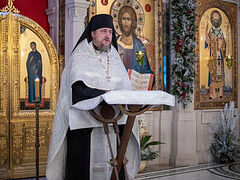
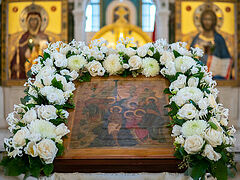
Hieromonk Athanasius (Deryugin), Dean of the Moscow Sretensky Monastery, answers our questions about the feast of the Baptism of the Lord and Theophany water.
 Hieromonk Athanasius (Deryugin)
—Fr. Athanasius, please explain the meaning and significance of the feast of the Baptism of the Lord to our readers.
—One of the names of the Baptism of the Lord is Theophany. On this day our Lord Jesus Christ came out to His public ministry. His Birth in Bethlehem took place more or less secretly, the Meeting in the Temple was not known to many either, to say nothing of all the previous events in the Gospel narrative. But the Baptism of the Lord was already His manifestation to the world. And we can say that it was the beginning of His active mission in this world, which in the earthly realm would end with His Passion on the Cross, Resurrection and Ascension. And as it is sung in the kontakion of the feast, “Today Thou hast appeared to all the inhabited world, O Lord, and the light of Thy countenance hath been marked upon us, who with knowledge sing Thy praise. Thou art come Thou are made manifest, Light that no man can approach.” On this day, the Lord appeared to the world, and His light has illuminated us. That’s why we celebrate this event.
In addition, through this event, the Lord showed the importance of Baptism for all of us. It is clear that the Baptism that St. John the Baptist performed was absolutely different from that which was performed over us. Our Baptism is much more complete. It is not just a rite, but a holy sacrament that gives us the opportunity to enter eternal life. But at the same time, by being baptized without having any need for it in His human nature, the Lord showed us that for everyone who wants to follow Him and to be His disciple, the sacrament of Baptism is necessary.
—Why is the Baptism of the Lord also called Theophany?
—For two reasons. Firstly, on this day, Jesus Christ revealed Himself to the world—that is, He clearly revealed Himself to everybody as the Messiah and Christ for Whom people had been waiting. Secondly, on this day, the Holy Trinity was most vividly manifested for the first time: Jesus Christ, Who came into this world; God the Father, Who cried out from Heaven: This is My beloved Son, in Whom I am well pleased (Mt. 3:17); and the Holy Spirit, Who descended upon Christ in the form of a dove. There had been other appearances of the Holy Trinity before, but more implicit. At the time of the Baptism of the Lord, it was the most obvious and the most vivid. That’s why we call this feast Theophany.
—Why did the Nativity of Christ and Theophany form a single whole until the fourth century, but now we celebrate two separate feasts at different dates?
—We do not know the exact day when Christ was born. That is why in ancient times the commemoration of both the Nativity of the Savior and His Baptism was on the same day. And the meanings of these feasts are similar. At the moment of His Nativity, Christ enters this world as an Infant. At the moment of His Baptism, He manifests Himself to this world as an Adult, as a Teacher, Christ, and the Messiah Whom mankind had been anticipating.
The date of the Nativity of Christ is also connected with the fact that it is the day of the winter solstice, when many pagans celebrated the feast of the sun. And so Christianity contrasts this pagan festival with the feast of the Nativity of Christ—the Sun of Righteousness Who has come into this world. Regarding the feast of the Nativity of Christ, which was still new at that time, there is a sermon by St. John Chrysostom, where he substantiates a separate celebration of the Nativity of Christ.
—The ancient name of Theophany is “the Feast of Lights”, or “the Day of Lights”. Why was it called that?
—Here, again, we are talking about the manifestation of Christ to this world—having previously been hidden, now He appears vividly as Light: I am the light of the world: he that followeth Me shall not walk in darkness, but shall have the light of life (Jn. 8:12). He appears as a lamp that was hidden, but is now placed onto a candlestick: Neither do men light a candle, and put it under a bushel, but on a candlestick; and it giveth light unto all that are in the house (Mt. 5:15).

And, indeed, this feast is also called the Day of the Enlightenment. That’s exactly what the liturgical books say—many texts are dedicated to this. And thus we are reminded that through Baptism we all received Divine light, and we must strive to preserve and multiply it. There used to be the following tradition: many people were baptized on the very feast when the Lord was baptized. They were baptized in memory of this. And in those days, when the sacrament of Baptism was performed in ancient times, the following baptismal verse is still sung: For as many of you as have been baptized into Christ have put on Christ (Gal. 3:27).
—Why are these words still sung during some festive services?
—There are several points here. Firstly, many parts of the service have preserved traces of historical tradition. Secondly, this verse is dedicated not only to those who are baptized. What are its words? For as many of you as have been baptized into Christ have put on Christ. This is a reminder to all of us who were baptized into Christ. Thank God, we were baptized. But have we put on Christ? Have we begun to live according to His commandments? Have we begun to conform our whole lives to what the Lord tells us in the Gospel? So every time we hear these words in church, it’s an occasion to think about that.

—Why did the Holy Spirit appear in the form of a dove at the time of the Baptism of the Lord?
—The Holy Spirit manifests Himself in different ways in different episodes of Church history. Later He would appear in the form of tongues of fire, on Mount Tabor—as a cloud. Here, He was in the form of a dove, because the dove symbolized the purest bird in the reality of Palestine at that age. The white dove was a symbol of purity and peace. Therefore, through this, the Holy Spirit showed His properties—His purity and peace, which He brings. The apparition in the form of a dove is about this.
—Why is water blessed twice on these feasts—on the Eve of Theophany and on the day of Theophany itself?
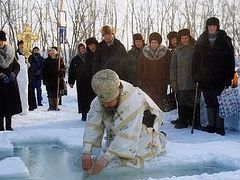
—I must say that this is a Russian tradition, which in itself has no mystical meaning. It’s just our custom to repeat this blessing. It must necessarily be performed on the eve of Theophany. Since its service is combined with the evening service—that is, it already refers to the next liturgical day—therefore, the Great Blessing of the Waters is performed. In Russia, it is customary to repeat it on the feast itself. There is no fundamental difference between the water that is blessed the day before and the water that is blessed on the feast itself. Both of them are called Theophany water. The rite of blessing is exactly the same.
—Is it true that all the water on Earth is sanctified on the feast of the Baptism of the Lord?
—In the service of this day, we hear the following verse: “Today the nature of the waters is sanctified.” How should we perceive this—as a real fact or as a beautiful poetic image? This is a difficult question. On the one hand, of course, through His coming into the world and through His Baptism the Lord has sanctified the nature of the waters in the sense that now the grace of God is given through water. We are baptized through water, and we are sanctified through drinking holy water. In this regard, yes, the nature of the waters is sanctified. And, on the other hand, if someone wants to apply this in practice, if he’s too lazy to go to church on the feast and uses tap water as holy on this day “because the nature of the waters is sanctified”, I am not sure that it is right. Although I must admit that we find examples in the history of the twentieth century when prisoners, persecuted Christians in the Soviet Union, could not participate in the Great Blessing of the Waters, and believing that on this day the nature of the waters was sanctified, they used plain water. And the Lord worked through it, too. So in some exceptional cases it is possible.

—How do we use Theophany water properly?
—The most important thing is to keep in mind that Theophany water, or the great agiasma, as it is also called, is a holy thing that is given to us so that we can be sanctified through it. And it must be used accordingly. There is a pious tradition to drink Theophany water every morning. It’s very good to do it as a kind of blessing for the day ahead. Some priests also advise us to drink Theophany water and sprinkle ourselves with it in some particularly difficult circumstances of life, or when we feel strong attacks of certain sinful passions. This is good and right as well. It is also advisable to sprinkle our homes and some objects of our everyday life with it. The main thing is to remember that we receive sanctification through this water. If we use it with reverence for these purposes, it is the most proper thing.
—Sometimes laypeople ask, what is the difference between Theophany water and holy water that you can take in any church every day (in such countries as Russia)?
—This is a very complex question, because it is hard to say if there are certain “degrees of holiness” and that “one water is holier than another”. Perhaps it would be inappropriate to say so. And, honestly, I don’t even know how to answer this question exactly. It is clear that we receive the grace of God through both waters. And it is clear that the water that is blessed on the feast of the Baptism of the Lord is special, because this kind of blessing is performed only once a year. And it is connected with our memory and even our spiritual participation in the event of the Baptism of the Lord. And I don’t even think it’s worth speculating about why this water is “holier” than ordinary holy water. Because it is impossible to make a table, a scale for the holiness of various Church objects; and it would be wrong to do so.
I would like to note the widespread miracle associated with Theophany water. This is the fact that you can keep it at home throughout the year, and it does not deteriorate or spoil. Although there are cases when it spoils. And This is a reason for a person to think seriously that he probably does something wrong. But usually, indeed, this water remains fresh over the year. This is yet more evidence that the Lord works through this water.

—Fr. Athanasius, do you have any wishes for the Orthodox parishioners in connection with the feast of Theophany?
—Yes, I do. Behave reverently when you come for Theophany water. Unfortunately, it happens that believers and church people can be very aggressive when it comes to something tangible. In general, it is a Russian trait: to want to receive more grace through something tangible that is given. We must never forget that we are in church, not in a market, and there is always enough holy water for everybody. And nothing terrible will happen if we get it five minutes later or if someone in the queue went in front of you or was impolite to you. But if after taking Theophany water we lose peace of mind, show anger or dislike for someone else, it will be very bad and no Theophany water will help us then. Therefore, while receiving all that the Church gives us for our sanctification, let us keep in mind that all this will be ineffective if we are not humble and if we do not live according to the commandments of God.