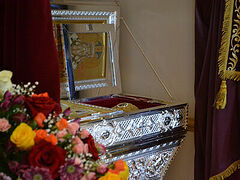
For 400 years now, the Holy Dormition-Vysha Monastery has been standing on the right bank of the Vysha River, not far from its confluence with the Tsna River, twenty miles from the city of Shatsk. Monasteries have always been a bastion of Russian statehood, its invisible shield of prayer, spiritual foundation, and defense. Many events took place as part of the anniversary celebrations in 2025, most importantly the transfer of the venerable relics of the monastery’s abbot, Archimandrite Arkady (Chestonov), to Vysha, which took place on August 20.
Having just concluded the monastery’s anniversary, let us go over the main pages of its history.
The history of the monastery is closely connected with that of the Russian state. In the sixteenth century, the construction of the Great Abatis Line began in Rus’. The defensive fortifications were created from forest barriers, alternating with palisades, earthen ramparts, and trenches in areas without forest cover. A separate southeastern part of the Great Abatis Line1 guarded the borders of the Ryazan land and stretched from Skopin to Shatsk. Located on the border with Mordovian settlements, from its very founding, Vysha Monastery served as an outpost, fulfilling the important missionary work of enlightening the local pagans.
No documents concerning the initial history of the monastery have been preserved. The earliest information is found in the Shatsk County cadastre for 1617. According to tradition, the monastery was originally located on the left bank of the Vysha. However, this wasn’t the most convenient place, as the territory was flooded every spring. At the place where they later relocated the monastery and where it is to be found to this day, the monks saw a light at night; they also noticed a large swarm of wild bees. In 1625, the abbot and brethren submitted a petition to transfer the monastery to “the great eldress Martha Ioannovna,” the mother of Tsar Mikhail Feodorovich Romanov, who was the largest landowner in the Shatsk region and contributed to the multiplication and strengthening of monasteries.
The monastery has gone through many periods throughout its long history: It was closed and abolished, but then, against all odds, like a mighty warrior, it rose again from oblivion.
Peter I’s Church reforms carried out in the early eighteenth century had a disastrous effect on monastic life. According to Metropolitan John (Snychev):
The convulsive era of Peter, which dispersed Russian antiquity in pursuit of European innovations, was replaced by a succession of placeholders who had little love for Russia and even less understanding of the unique features of its character and worldview… The Orthodox Church was humiliated and weakened: The canonical form of its governance (the Patriarchate) was liquidated, the confiscation of Church lands undermined the welfare of the clergy and the possibilities for Church charity, and the number of monasteries—beacons of Christian spirituality and Orthodox education—was sharply reduced. Autocracy as a principle of rule (presupposing a religiously conscious attitude toward authority as Church service, as obedience) was increasingly distorted under the influence of ideas of Western European absolutism.
At the end of Peter’s reign, in December 1724, the Vysha Hermitage was abolished and attached to the St. Nicholas-Cherneev Monastery, located not far from Shatsk. According to the inventory, only five people lived there: the builder Hieromonk Abraham, another Hieromonk Abraham, Monk Misail, Monk Philipp, and Monk Arseny.
However, the monastery was opened again a few years later, but its revival came with considerable difficulties.
During the reign of Empress Catherine II, in 1764, a secularization reform was carried out that further worsened the situation for the monasteries. In exchange for the confiscated property, some monasteries received state funding. Vysha Hermitage was turned into a supernumerary monastery, being maintained at its own expense. In the early 1770s, the Shatsk lands were engulfed by upheaval related to the Pugachev rebellion. In 1774, bandits entered the monastery and looted the Dormition Church. This attack caused great damage to the monastery.
It was only by the beginning of the nineteenth century that the monastery was able to strengthen its position. In 1799, it became part of the Tambov Diocese again. In 1800, Bishop Theophil (Raev) of Tambov and Shatsk, traveling around the diocese, found the Dormition-Vysha Hermitage in an extremely neglected state, and in order to restore it he decided to send an abbot there from the brotherhood of the Sarov Hermitage. Thus began a new period in the history of the Vysha Hermitage.
In the nineteenth century, it became a famous spiritual center of the Tambov Diocese. During the abbacy of Hieromonk Tikhon from 1800 to 1844, a stone wall with towers and cells in it was erected around the monastery, eight stone buildings for monastic cells were constructed, and a four-tiered stone bell tower was built in place of a wooden and dilapidated structure, with a church in honor of the Holy Life-giving Trinity on the second floor. Through the efforts of the abbot Fr. Tikhon, bells weighing 3,800 and 2,240 pounds were purchased. “The Lord Himself invisibly provided for the elevation of Vysha Monastery,” wrote Fr. Tikhon.
On March 7, 1827, by order of the Queen of Heaven, the Kazan Icon of the Mother of God, which was known for many miracles and which became known as the Vysha Icon, was transferred to the hermitage “for all time.” The icon was greatly venerated by believers, and many received help through prayers before the miraculous image, with numerous healings from the cholera that was raging in the surrounding areas.
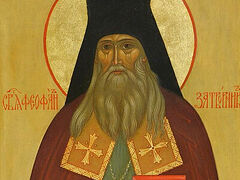
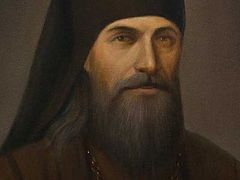
 Archimandrite Arkady (Chestonov) In 1862, Hieromonk Arkady (Chestonov) was appointed abbot of the monastery by Bishop Theophan (Govorov) [St. Theophan the Recluse]. Appointing Fr. Arkady, Vladyka Theophan prophetically said:
“Go, and then, God willing, I will come to you.”
During Fr. Arkady’s abbacy, the Vysha Hermitage was brought to exemplary order and a strict cenobitic charter was adopted, which fostered the development of the monastery and the spiritual labors of the brotherhood. Archimandrite Arkady combined two important qualities: He was a talented administrator and an attentive monk.
According to the testimony of Igumen Tikhon (Tsiplyakovsky), a disciple of St. Theophan:
In addition to the daily cycle of Divine services, the brethren are enjoined to maintain the unceasing Jesus Prayer in their hearts, saying it quietly with the lips, or with the mind alone, unceasingly during all their works… The elder assigns to the monk under his spiritual charge, according to his strength, a cell rule of prayer, consisting of a certain number of prostrations and bows from the waist with the Jesus Prayer said with a prayer rope. The purpose of this rule is most salvific for the monk, namely: to accustom him to unceasing noetic prayer, to the Jesus Prayer, for in this, according to the teaching of the Holy Fathers, lies the essence of monastic life.
The construction of the Church of the Nativity began in 1874. In 1881, on the southern side, outside the monastery walls, a complex of stone utility buildings appeared. After the completion of the construction of the Nativity of Christ Church in 1890, a new northeastern section of the wall was erected with an almshouse and corner tower. In 1875, the iconostasis was restored and wall paintings were made in the summer Cathedral of the Kazan Mother of God.
Under Archimandrite Arkady, Vysha Monastery conducted extensive charitable and educational activities. He said: “We receive from the world and must give to the world,” and he kept his word in practice. He was an honorary member of the Tambov Guardianship for Poor Students. Thanks to his efforts, the main building was reconstructed, and a church, hospital, and library were established at the Shatsk Theological School, where he served as honorary chairman and chairman of the Guardianship Council for Poor Students; a scholarship was even established at the school in the name of Abbot Arkady. He devoted much attention to spiritual education in Shatsk and the surrounding districts.

In 1883, with the advice and blessing of St. Theophan the Recluse, Fr. Arkady began construction of a second-class monastic school. The school had the best educational equipment at the time, a rich library, a violin class, and various educational laboratories. For example, the physics lab had a centrifugal machine, an air pump, a model of a steam engine, a microscope, a Holtz electrostatic machine, and so on. A magic lantern2 with pictures was bought for the students. A bookbinding workshop was organized. Up to seventy students from among the poorest peasant children lived in the school boarding house at the expense of the Vysha Hermitage. Hundreds of students received not only elementary education, but most importantly—Christian upbringing.
The monastery also funded the construction of a parish school in the village of Shamorga and a school and church in the village of Zolotaya Polyana.
To be continued…