The Shcheglovsky Monastery’s relic
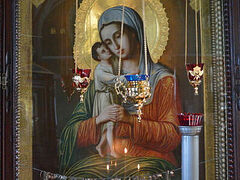
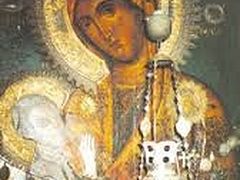
On January 12/25, the Orthodox Church commemorates the “Milk-Giver” Icon of the Mother of God. The original icon is kept at the Hilandar Monastery on Mt. Athos. However, this icon has always also been venerated in Russia, and its holy copies were known in our country too. One of them is located at the Shcheglovsky Monastery of the Theotokos and Greatmartyr Panteleimon in the city of Tula, the main church of which is the only one in Russia to be dedicated to the “Milk-Giver” Icon of the Mother of God.
 The “Milk-Giver” Icon of the Mother of God
In 1848, another copy of the “Milk-Giver” Icon became famous in Russia: it was brought here from Mt. Athos by Schemamonk Ignatius from the Skete of the Prophet Elias.
At the age of forty-three, the future founder of the Shcheglovsky Monastery of the Theotokos in Tula, St. Varsonofy (secular name: Vasily Ivanovich Makarukhin),1 originally from Moscow, venerated this holy icon in Moscow where it was staying for two months.
At that time, the “Milk-Giver” Icon was already venerated in Russia. It was reflected in the works of the spiritual poet Fyodor Glinka (1786–1880), Makarukhin’s contemporary. He wrote the epic poem, The Mysterious Drop, about a miracle of healing from wonderworking milk.
There is every reason to believe that during a solitary prayer in front of the wonderworking icon of the Most Holy Theotokos, Vasily Makarukhin became strengthened in faith. It was then that he decided to use the whole of his large fortune for a godly cause—to build a monastery in honor of the “Milk-Giver” Icon of the Mother of God. The miracle of this choice took place in Vasily Makarukhin’s heart in a still small voice (1 Kings 19:12).
The foundation stone of the church was laid in May 1860, and on September 8, 1864, it was consecrated in honor of the “Milk-Giver” Icon of the Most Holy Theotokos. Very soon after the consecration, in May 1865, the residents of Tula petitioned for the establishment of the Shcheglovsky Monastery of the Mother of God. It was followed by a petition of Vasily Ivanovich Makarukhin, and he directly offered a significant amount of money.
 St. Varsonofy And the following year, it was decided to petition for the foundation of a monastery in memory of the miraculous rescue of Emperor Alexander II from the assassination attempt on April 4, 1866. In June 1868, the Emperor approved the resolution of the Holy Synod: “For the decisions set out therein and for the humblest report of this matter, he most graciously deigned to write in his own hand: ‘I agree, and I thank you.’“2
Thus was the Monastery of the Mother of God established for the glory of God, for the joy of its builder and benefactor, as well as for the true comfort of all the citizens of Tula. It is written on the “Milk-Giver” Icon, placed in the monastery’s main church: “This holy icon was sent from Moscow to the newly established Shcheglovsky Monastery in the city of Tula on June 29, 1859.” The people venerated and revered this icon.
Having used an enormous sum of half a million rubles for the construction and decoration of the monastery, the benefactor also donated his excellent library and collection of ancient icons to the new monastery. In 1879, he moved to live at the monastery he had founded in Tula. For eleven years the benefactor lived in a wooden cell that he had himself built. In the early spring of 1890, Vasily Ivanovich took monastic vows, followed by the significant deterioration in his health on April 22. The next day, he received Holy Communion and Unction. Then the ascetic of piety took the great schema with the name Varsonofy in honor of St. Barsanuphius the Great. From that time on, he devoted himself entirely to prayer, partaking of the Holy Mysteries of Christ daily. On April 26, Schemamonk Varsonofy peacefully reposed in the Lord.
In the twentieth century, the spiritual life of the monastery was cut short. In the spring of 1922, the monks were expelled, and the church utensils were removed.
 The Shcheglovsky Monastery of the Theotokos
The “Milk-Giver” Icon of the Mother of God, which was painted in 1859 and installed by the Royal Doors, was lost during the troubled years. Another nineteenth century “Milk-Giver” Icon of the Most Holy Theotokos was transferred by one of the monastery’s monks, Hieromonk Varsonofy, to the Church of Greatmartyr Demetrius of Thessaloniki in Tula. This church was closed just before the Second World War and was reopened in 1946. The “Milk-Giver” Icon of the Mother of God was preserved by its rectors, and in due time it was transferred to the revived monastery. Now the relic is kept at the monastery’s Church of St. Nicander, the Hermit of Pskov, where services are celebrated.
Miracles from this icon occurred at the Church of St. Demetrius of Thessaloniki and still continue. Most often, young mothers and those who about to have children seek its help.
The akathist hymn to the Most Holy Theotokos “Milk-Giver” Icon was approved by the Holy Synod of the Russian Orthodox Church on December 26, 2019.
In conclusion, we will cite several cases of God’s help after prayers in front of this wondrous icon of the Queen of Heaven.
“The Doctors didn’t Believe It”
The brethren of the Shcheglovsky Monastery prepared for the annual Orthodox Fair in Moscow (a market of various Orthodox products). They took books, icons, newspaper issues about their monastery and booklets, blessed many sachets of small dried bread crusts at the “Milk-Giver” Icon of the Mother of God and went to Moscow.
Among the visitors to the Fair was a woman whose daughter lived in Italy. She had married an Italian entrepreneur who had his own business; they lived in concord and had a nice house. Her daughter had recently given birth to a baby, but she had no breast milk to nurse it. What doctors they hadn’t consulted, including luminaries of medicine! But none of them could help her...
The woman saw the “Milk-Giver” Icon of the Mother of God, inquired about it, and then bought both a copy of the icon and several sachets of dried bread. She explained that her relative was flying to Italy soon, and she would be given the icon and the dried bread so that her daughter could pray to the Mother of God and ask for help in front of the “Milk-Giver” Icon. And so it was done.
 The “Milk-Giver” Icon of the Mother of God All this happened on the first day of the Orthodox Fair, which lasted eight days. Towards the end of the monastery brethren’s stay at the Orthodox Fair, the same woman came running to it, found Abbot Philaret, his assistant Fr. Maxim, and asked them:
“Is there any dried bread left? I’ll buy all of them!”
They didn’t grasp it immediately: “What is the matter?”
“How many of them are left? Only eight-ten sachets? I’ll buy all of them!”
She told them:
“The baby was born. A day passed, two, three, but my daughter had no breast milk. All the doctors were powerless to help her. On receiving the ‘Milk-Giver’ Icon of the Mother of God from Russia, she prayed tearfully in front of it and begged for breast milk—not for herself, but for the sake of her baby. My daughter ate the dried bread and… believe it or not, the next day she had breast milk!
“The doctors didn’t believe it. The nursing mother came to the hospital, and a physician said to her:
‘It’s impossible—your mammary glands cannot produce milk.’
“But breast milk appeared! And the baby was fed with it!”
A Chalice for the Communion of infants
A miracle occurred at the monastery. A wealthy man resolved to reform and turn over a new leaf. His first marriage was without a church wedding. He and his first wife did not get on and eventually divorced, and the man decided to have a Christian family. He met a young woman and fell in love with her. After confession and Communion at a Moscow church, the young couple were engaged and then married in church.
The wife also had something to repent of: Before marriage, she had worked in show business—of course, she had not lived a Christian life, had not observed fasts, had been promiscuous, had sinned, and had had abortions. The Lord awakened her conscience: she came to sincere repentance and, like her husband, made up her mind to improve.
They moved to Tula and began to live happily. And they wanted to have a baby (he was thirty-four and she was twenty-eight at the time, and they were well off). But six months passed, then a year, then another, and the third year began, but they still couldn’t conceive a baby…
 A. Kartashov. The Wedding
With his opportunities and her connections, they consulted all the best and most reputable doctors in Moscow, but to no avail—the woman just couldn’t conceive. The doctors would say that she had had too many abortions and had done this or that wrong.
The young husband knew that there was a miracle-working “Milk-Giver” Icon of the Mother of God at the Shcheglovsky Monastery, before which people who had family problems or suffered from infertility prayed. But he had not attached any importance to it before, and now he remembered it. He approached the abbot, Fr. Claudian, seeking his help:
“Please recieve my wife.”
She arrived, and they had a serious conversation with the priest. Then she repented of her past immoral actions and other sins. A prayer service was celebrated in front of the “Milk-Giver” Icon of the Mother of God with the reading of the akathist to it. Then the priest anointed the woman using holy oil from an icon lamp in front of the wonderworking icon. Next he gave the woman a small bottle of oil to anoint herself. She took an icon and the holy oil home.
That was during Lent.
And soon after Trinity Sunday the happy husband came running to the monastery:
“Father, my wife is pregnant! We went to the doctors, who were really puzzled. We want to thank the Mother of God!”
The family came to the monastery, taking their future grandmother with them. They prayed together in front of the “Milk-Giver” Icon of the Mother of God. And then the Lord enlightened the happy husband that they should give some gift to the monastery.
The monastery had no Chalice for the communion of infants. He traveled to Moscow, bought such a Chalice, and donated it to the monastery.
Perhaps also for his child to receive Communion from this Chalice in the future.
“Father, twins!”
This miracle occurred after sincere repentance. A military man and his wife were childless. The husband and wife had first decided to live for themselves, then devoted all their energies to their careers; the husband rose to a senior military rank, and the wife became an effective specialist in a large factory management. They also looked forward to the time they would be given an apartment and would not have to wander around hostels or rent houses. Then they started furnishing the new apartment. And they finally realized that years were passing, but they still had no children. So it turned out that it was too late to have children. The doctors warned the couple about possible consequences and advised them not to take such a risky step at the age of forty. They bluntly said that the woman would not be able to conceive for medical reasons.
And the family appeared to have lost the meaning of life: they had built their careers, had a nice home, but there was no joy. The husband began to look askance at his wife, and she had doubts about her happiness. The woman regretted having spent her young years so unwisely and began to eat her heart out, looking for a way out.
One day during a conversation with people, she learned that there was the wonderworking “Milk-Giver” Icon of the Most Holy Theotokos at the Shcheglovsky Monastery. The woman came, found the abbot, Fr. Claudian, and asked him to hear her out. She told him about her sorrow and her great desire to have a child.
 Archimandrite Claudian (Larkov)
“Father, I have no idea what I should do. Of course, I have consulted doctors, and they told me, ‘It’s too late.’ But I do want a baby, and my husband looks askance at me.”
On the father superior’s advice, she attended a service at church, confessed and received Communion, crying her eyes out in front of the holy icon. She implored the Mother of God to send her a baby. And everything was sorted out by the grace of God. Almost six months later the joyful woman arrived at the monastery and told the priest: “Father, twins! I had an ultrasound scan, and the doctors saw that I have twins. They promised to help me.”
We can add that there are numerous healing miracles in Russia from wonderworking copies of the “Milk-Giver” Icon of the Most Holy Theotokos. Several married couples had been childless for many years and, according to the doctors’ verdicts were doomed to childlessness. However, after prayer at the “Milk-Giver” Icon, the Lord granted them all healing from infertility.
It should be noted that they are all locals, the ins and outs of whose lives are known by word of mouth. People also know about the healings of several cancer patients, also locals. There are two known cases of local doctors’ children being miraculously cured. In both cases, the parents recorded in writing that they had resorted to all possible medical techniques and that treatment was ineffective.3 Marvelous are Thy works, O Lord!