Part 1: The historic roots of Russophobia
Part 2: “Reactionary Peoples Will Disappear from the Face of the Earth…”
Part 3. Russophobia from Marx to Lenin
Lenin’s Doctrine of the “Decolonization of Russia”
 The ideas of Marx and Engels about the Russian Empire as a “prison of peoples” standing in the way of progress, which need to be liberated from the Great Russian oppression and to return to the allegedly enslaved peoples the lands taken from them, was taken up by their faithful disciple V. I. Lenin and made the cornerstone of Bolshevik policy. In the theses, “The Tasks of Revolutionary Social-Democracy in the European War,” in August 1914 he proclaimed:
“The lesser evil would be the defeat of the tsarist monarchy and its troops, oppressing Poland, Ukraine and a whole number of peoples of Russia, and inflaming national enmity to strengthen the oppression of Great Russians over other nationalities and to strengthen the reactionary and barbarous government of the tsarist monarchy.”
And he set the task:
“The struggle against the tsarist monarchy and Great Russian, panslavist chauvinism, and the preaching of revolution in Russia, as well as the liberation and self-determination of the peoples oppressed by Russia.”1
In the summer of 1915 Lenin writes the programmatic work, “Socialism and War,” where he ranks the Russian Empire among the slave-owning colonial powers oppressing humanity, although Russia was never either colonial or, much less, slave-owning. Yes, from century to century the Muscovite Tsardom, and then the Russian Empire, expanded geopolitically both peacefully and militarily, but this had nothing in common with Western colonialism and slavery. Lenin knew this perfectly well and nevertheless called Russia the most backward country, and the Russian monarchy—the most reactionary political system on earth, which also did not correspond to reality.
In this work, Lenin advanced the doctrine of the destruction of historical Russia,2 which he also set forth in the book, Imperialism, the Highest Stage of Capitalism.3 He divided the territory of historical Russia into “metropolis” and “colonies”: of 22.8 million square kilometers of the territory of the Russian Empire, Lenin assigned only 5.4 million to the “metropolis,” and the remaining 17.4 million he classified as “colonies.”4 That is, Lenin limited the territory of Russia to the Russian Plain (“Muscovy”), everything else being Russian “colonies” that needed to be liberated from the “Russian yoke.”
Lenin writes:
“Nowhere in the world is there such oppression of the majority of the population of the country as in Russia: Great Russians constitute only forty-three percent of the population, i.e., less than half, and all the rest are without rights, like aliens. Of the 170 million population of Russia about 100 million are oppressed and have no rights. Tsarism wages war for the seizure of Galicia and the final strangling of the freedom of the Ukrainians, for the seizure of Armenia, Constantinople, etc. Now in Russia for every two Great Russians there are from two to three rightless ‘aliens’: through war tsarism strives to increase the number of nations oppressed by Russia, to strengthen their oppression and thereby to undermine the struggle for freedom of the Great Russians themselves. The possibility of oppressing and robbing foreign peoples strengthens economic stagnation, for instead of the development of productive forces the source of income is often semi-feudal exploitation of ‘aliens.’ Thus for Russia’s part the war is distinguished by extreme reactionariness and an anti-liberation character.”5
Russia and the Russian people in the eyes of the Bolshevik leader appear as robbers and oppressors of a multitude of “rightless aliens,” although they constituted more than half of the ruling elite of the Russian Empire, and the national outskirts enjoyed special privileges—unlike the European colonial powers that mercilessly plundered their colonies. But Lenin does not see this point-blank, yet he sees the “barbarous oppression of the Great Russians,” from under which the peoples of the Russian Empire must be liberated, and the empire itself dismantled.
Having returned from emigration to Petrograd, Lenin declared at the seventh party conference at the end of April 1917:
“Why should we, the Great Russians, oppressing a greater number of nations than any other people (?!—A. M.), refuse to recognize the right of Poland, Ukraine, Finland to separation? <…> We are indifferent, neutral to separatist movements. If Finland, if Poland, Ukraine separate from Russia, there is nothing bad in this. What is bad about it? Whoever says this is a chauvinist.”6
And speaking in December 1917 at the first congress of the military fleet, Lenin uttered:
“They tell us that Russia will fragment, break up into separate republics, but we have nothing to fear from this. No matter how many independent republics there are, we will not be afraid of this. For us what is important is not where the state border runs, but that the union between the working people of all nations be preserved for the struggle against the bourgeoisie of any nations.”7
Here it is, Lenin’s doctrine of the destruction of Russia in all its glory!
It is important to know that before the October Revolution not a single territory that was part of the Russian Empire that declared a desire for independence received recognition from the central Russian authority. Even the Provisional Government headed by A. F. Kerensky did not dare to take such a step, entrusting the fate of Russia and its national outskirts to the All-Russian Constituent Assembly. But the Bolsheviks, having seized power, immediately began to recognize the independence of territories breaking away from Russia, providing a legal basis for this. On November 2 (15), 1917 the Council of People’s Commissars of the RSFSR adopted Lenin’s “Declaration of the Rights of the Peoples of Russia,” which stated:
“Executing the will of these Congresses [of workers’ and soldiers’ deputies], the Council of People’s Commissars has decided to base its activities on the question of nationalities in Russia on the following principles:
-
Equality and sovereignty of the peoples of Russia.
-
The right of the peoples of Russia to free self-determination up to separation and the formation of an independent state.
-
Abolition of all and any national and national-religious privileges and restrictions.
-
Free development of national minorities and ethnographic groups inhabiting the territory of Russia”8.
“The interests of world socialism are higher than national interests, higher than the interests of the state,” Lenin declared in 1918.
The second point of Lenin’s declaration repeats the ninth point introduced by Marx into the program of the First International about the destruction of Russia through its disintegration “on the basis of applying the principle of the right of nations to self-determination.” Citing this point of Lenin’s declaration, the Bolsheviks began to recognize the independence of all “national” territories breaking away from historical Russia. Finland was the first in December 1917; Ukraine, the Baltics, the Caucasus, and so on followed. By the spring of 1918, as Lenin himself admitted, “nothing remains of Russia except Great Russia,” and he explained the Bolsheviks’ position:
“We do not defend great-power status…, not national interests, we assert that the interests of socialism, the interests of world socialism are higher than national interests, higher than the interests of the state.”9
The course of historical events in the world and the Civil War in Russia changed the views of Lenin and his entourage. Realizing that alone they would be crushed, the Bolsheviks began to create, in the space of the Russian Empire “for the struggle against world imperialism,” a union of states of a new type. In June 1919 the first project appeared for the creation of the Union of Soviet Socialist Republics of Europe and Asia consisting of six Soviet republics then proclaimed: Russia, Ukraine, Belorussia, Latvia, Lithuania, and Crimea.10 It was not destined to be realized, but according to its pattern in December 1922 the Soviet Union was created.
 Poster demanding the creation of the Third International. July 1917
According to the plan of Lenin and the Leninists, this union was to be created, to which new members would voluntarily join, for centuries. For these purposes in the spring of 1919 the Third Communist International (Comintern) was created. Speaking at the founding congress, Lenin defined its purpose as follows:
“The Communist International is the union of workers of the whole world striving to establish Soviet power in all countries”11.
And in the manifesto of the Comintern it was solemnly proclaimed:
“The Communist International is the party of revolutionary uprising of the international proletariat. <…> The Communist International has declared the cause of Soviet Russia to be its own cause. The international proletariat will not sheath the sword until Soviet Russia is included as a link in the federation of Soviet republics of the whole world.”12
This idea was iconographically fixed in the coat of arms of the Soviet Union, which depicts the hammer and sickle against the background of the globe, and in the anthem of the Comintern the refrain sounded:
“Long live the World Soviet Union.”
The Bolshevik-Leninists in their own way Europeanized Russia, creating instead of the single geopolitical space of the Russian Empire, where there were two national-state formations (the Kingdom of Poland and the Grand Duchy of Finland), a patchwork quilt of national republics, oblasts, regions, the “main” ones able to freely “self-determine”—although Russians in these republics were deprived of such a right. As a result, the outwardly unitary Soviet Union turned into an incubator for growing political nations and states, and when the incubation period came to an end, the nationalist elites—who had been nurtured by Soviet power—led their republics out of the “fraternal” Union of SSRs, which was facilitated by the betrayal of their country by the leadership of the Communist Party of the Soviet Union. Thus the Russophobic idea of Marx and Engels—embodied by Lenin—about the disintegration of historical Russia through the self-determination of the peoples inhabiting it, played a fatal role in the fate of the Soviet state created by the Bolshevik leader, providing a legal basis for its disintegration.
Lenin, being a faithful disciple of Marx and Engels, like them hated the Russian Empire and was an inveterate Russophobe. Among all the peoples inhabiting historical Russia, Lenin singled out the Great Russians in a negative way and called Russian people “slaves,” “boors,” “flunkeys,” “derzhimordas” (brutish, tyrannical policemen—Ed.), “scoundrels and rapists,” and even “Great Russian rabble.” He applied no such “epithets” to any other people or its representatives.
The crown of Lenin’s aggressive Russophobia is his letter to V. M. Molotov dated March 19, 1922 concerning the seizure of church valuables—supposedly to help the starving—although the Russian Orthodox Church itself collected more valuables for this purpose than the Bolsheviks seized from it. But Lenin took advantage of the moment to strike at the Orthodox Church, which for a thousand years had been the spiritual bond of the Russian people. In his letter, full of hatred for the Russian Orthodox Church, Lenin wrote:
“At the party congress, arrange a secret meeting of all or almost all delegates on this question together with the main workers of the GPU, NKJU and Revtribunal. At this meeting, pass a secret decision of the congress that the seizure of valuables, in particular, of the richest lavras, monasteries and churches, must be carried out with merciless resoluteness, stopping at nothing and in the shortest possible time. The greater the number of representatives of the reactionary clergy and reactionary bourgeoisie we succeed in shooting on this occasion, the better”13.
 Letter to V. M. Molotov for members of the Politburo dated March 19, 1922
This action had not a humanitarian but a purely political underpinning with the aim of discrediting the Russian Orthodox Church in the eyes of the Russian people and undermining its influence. None of the church valuables seized by the Bolsheviks went to help the starving. Church silver was used for minting Soviet silver rubles during the monetary reform of the early nineteen-twenties, and everything else was sold abroad, mainly to finance the world revolution. Aid to people dying of hunger was provided by international humanitarian organizations, primarily the American Relief Administration (ARA).
Lenin’s Russophobia is a large and special topic. It has been written about fragmentarily, and it is quite fully covered in the book by the author of these lines,14 where, among other things, for the first time facsimile documents of the German Foreign Ministry are presented about Lenin’s betrayal of Russia during the First World War and the financing of Lenin and his party (then the faction of the RSDLP) by the German government.15 In the autumn of 1914 at a debate of Russian social-democrats in Bern Lenin stated: “We, the Great Russians… are capable only of oppressing foreign peoples; Russia should be amputated to Kiev, Odessa, Riga and Libau,”16 that is, cut off from the Baltic and Black Seas—which shocked all those present.
But this is a rehash of Engels’ article, “The European War,” and it was precisely in this way that Lenin “amputated” Russia. Lenin’s Russophobia has deep personal and ideological causes, and it cannot be understood without taking into account the Russophobic ideology of Marx and Engels. And all the above allows certain conclusions to be drawn.
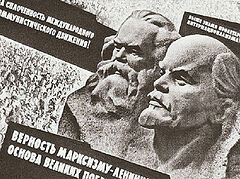
Reflections at the stone block with Marx
The anti-Russian and Russophobic ideology of Marx and Engels organically fits into the centuries-old European tradition of hatred for the Russian people and fear of Russia, sometimes turning into paranoia. One of the deep causes of European Russophobia is the fact that it is impossible to distinguish Russians from other European peoples; we belong to the same Europoid race. But in our worldview, character, and way of being we are different, which is largely explained by the vast geographical spaces of Russia—hence the rejection of us by Europeans and at the same time the desire to make us the same as they are, by any means. Nothing comes of it, this enrages Europeans and gives birth to hatred of us and Russophobia. Another worm gnawing at the European soul is their envy of our geographical size and natural riches, which they have been trying to seize for hundreds of years. The fusion of hatred, envy, arrogance (this is the reverse side of the inferiority complex born of envy) and fear gives birth to European Russophobia, fueled by various political and historical circumstances.
Marx and Engels, being European Slav- and Russophobes, perceived Russia through the prism of European (primarily German) interests and saw in it an obstacle to the implementation of revolutions in Europe, and through them—their globalist utopias. Hence their “class” hatred of Russia, the Slavs, and the Russians. Engels wrote that “hatred of the Russians was and remains the first revolutionary passion of the Germans.” This applies to Engels himself, who considered all Slavs (except the Poles) “counter-revolutionary nations” that must disappear from the face of the earth.
Marx and Engels, as thinkers of the West who advanced the communist doctrine of the restructuring of the world under the aegis of the advanced Western states on the principle of “center—periphery,” saw in Russia a peripheral hostile “barbarous country” hindering the progress of humanity (European revolutions), which together with the Russian people must be destroyed, by waging against Russia and Slavdom a “struggle not for life, but to the death” by methods of “the most resolute terrorism.” In other words, they called for the genocide of the Slavs. In this sense the Slav- and Russophobic ideology of Marx and Engels dovetails with the ideology of European racism and Hitler’s Nazism. It must be clearly realized that Marx, Engels, de Gobineau, Houston Chamberlain, Alfred Rosenberg, and the like are all berries from one European field. The worldviews of these people were different, but all of them related the same way to Russia and the Russians (as do the current Euro-Russophobes). Their obscurantist Russophobia is alien and hostile to us. And if Marx and Engels considered the Slavs and Russians their enemies, then they must be treated in exactly the same way and perceived in the same way.
In Soviet times, Marxism-Leninism was a sacred cow and the ideological basis of Soviet ideology and the Soviet state. No person (even Stalin) could subject this doctrine imported from Europe to criticism. At best it was “creatively” rethought. But the communist ideology in its original form has long been dead, and the state built on it has sunk into oblivion. And we still have not subjected Marxism-Leninism to critical analysis in its Russian-Russian context, and have not answered the question: How does this ideology relate to our present life and the concept of the Russian world? How because of this ideology and the national policy of the Bolsheviks historical Russia shrank like a shagreen skin to a geopolitical stump under the abbreviation RSFSR, and after the collapse of the USSR found itself thrown back to its early sixteenth-century western border, and the Russian people became the most divided people in the world? Speaking on March 18, 2021 on the occasion of the seventh anniversary of the reunification of Crimea and Sevastopol with Russia, the President of the Russian Federation V. V. Putin said:
“In the 1920s, the Bolsheviks, forming the Soviet Union, for some reasons still incomprehensible today, transferred significant territories, geopolitical spaces to quasi-state formations. And then, having collapsed themselves, having collapsed their party from within, having collapsed the Soviet Union, they led to Russia losing colossal territories and geopolitical space.”17
During the years of Soviet power historical Russia lost five million square kilometers of territory torn away in favor of the “fraternal” republics. Perhaps it is time to understand the ideological underpinning of this geopolitical and civilizational catastrophe, for which we are paying a terrible price, returning with great blood the primordially Russian lands of Donbas and Novorossia, once torn away from Russia by the Marxist Lenin and his successors? And we will continue to pay. The current communists pretend that they have nothing to do with it, as if it were done by the Mensheviks or the SRs. But it was done by the Bolshevik-Leninists, and their successors—the current communists—must either give a principled assessment of the deeds of their predecessors, or bear moral and political responsibility for it before the Russian people.
 Monument to Karl Marx on Teatralnaya Square in Moscow opposite the Bolshoi Theatre. Photo: fotoload.ru
And one more thing, long festering. On June 22—on the Day of National Remembrance and Mourning for the victims of the European invasion led by Germany against our country—Russian communists headed by their leader march with unfurled banners to the boulder-like monument to Marx opposite the Bolshoi Theatre to honor the memory of a man who together with his friend Engels considered Russian people not Slavs, but a mixture of Mongolian and Finnish tribes, “Muscovite barbarians” and enemies of European revolutions, who must be destroyed.
Why are our cities and villages full of memorial signs to two European boars who hated Russia and called for our extermination?
I want to ask the communists: Have you read the works of Marx and Engels? Have you read what they write about the Slavs, Russia, and the Russian people? If you have not read it—read, and if you have read (after all, this is your catechism!), then why do you go to bow to their idols, and even on June 22? However, this can be understood. Communism has long turned from an ideology into a neo-pagan political religion with all its inherent attributes, to which belongs the worship of idols. A pagan cannot refuse his idols, even if they humiliate him, trample him, and crucify him. Refusal of idols means refusal of his religion, therefore the communists are so zealous about their “Peruns,”18 with which all the cities and villages of Russia are stuffed. Hundreds of streets, squares, and metro stations were named in their honor. The communists bowed and will bow to their gods. Let them bow. But communists are not Russians, I mean not “blood and earth,” and communist ideology does not recognize nations, but only classes. In the complete works of Lenin there are no words about the national interests of Russia at all! But the overwhelming majority of us are not communists. The multinational Russian people, having recovered from the disease brought from Europe, rejected the communist utopia and returned to its primordial faith and values, and the communists constitute an insignificant minority. This is the rotten party of a dead idea. But then why are our cities and villages full of memorial signs to two European boars who hated Russia and called for our extermination? They despised and trampled us, and we honor them. Are we a nation of masochists? Of course not. Then why do we need this European rubbish insulting our national consciousness and dignity? Is it not time to throw it out of our life? Not suddenly, perhaps gradually, but it needs to be done. It is necessary to cleanse the Russian soul of alien European “values” and German idols. There should be none in Russia, at least not in such quantity.