In the name of the Father, and of the Son, and of the Holy Spirit!
Dear fathers, brothers and sisters! One of the preparatory Sundays before Lent is called the Sunday of the Prodigal Son because of the reading of the famous parable from the Gospel about the immeasurable and boundless love of the father and the relations between his sons: the younger, who squandered all his possessions and abilities, and the elder, unwise, jealous and supposedly just. The generally known example of the prodigal son’s behavior, the motives of the elder son’s words opposed to him, and the father’s all-covering mercy have become models of communication in society and sources of inspiration for culture. With all the parable’s concentration on the character and behavior of the younger prodigal son, the main image for you and me in terms of repentance is certainly the merciful heart of the father that prefigures the Father Almighty—God the Father.
 Nikolai Losev. The Parable of the Prodigal Son, 1882
In their truthfulness and the vividness of their passions the sons underscore the immutability and constancy of the father’s love for his children. The younger one wanted to take his share of the inheritance and leave his father’s house. Being lenient towards the freedom of an unreasonable and immature son, the father let his child go in peace. Freedom and permissiveness are intoxicating, and everything given by the father was gradually squandered and lost. Everything happened just as the father’s compassionate heart had foreseen. But the weak, albeit independent, young man couldn’t be helped—he was far away. Let’s skip all the horror that the younger son went through in a faraway land, describing it briefly: And he would fain have filled his belly with the husks that the swine did eat: and no man gave unto him (Lk. 15:16). Let’s leave it on the prodigal son’s conscience, because we are talking about the father.
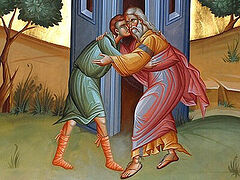
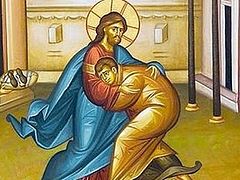
 Albrecht Dürer. The Prodigal Son. 1497 The father waited and prayed, flaring up with righteous anger, weeping and cooling it down with tears. He hoped to see his wayward son. We see him running out to meet his son when he was still far from home, which means that the father would do it regularly. Do you know why we can say for sure that the father’s prayer was answered? Because the prodigal son did not fall into despair. The lost young man had slid into the most humiliating and destructive state, but he took heart, came to his senses and did not seek a way to end his worthless life. Having sunk to the very bottom and ended up in the gutter, the sinner pushed off with all his might and started rising to the surface. Firstly, the father’s inexhaustible patience became a support that served the prodigal son for a push. Secondly, the father’s prayer became the power that lifted his son from the bottom, because the young man hoped to see his father’s face and ask him for a job.
The confession of the prodigal son who realized that he deserved no better than a servant’s position was so profound that it concerned not only the petition to his parent, but also the violation of the God-given order in the universe: I have sinned against Heaven (Lk. 15:18). The returned son’s ineffable joy was so great that it overwhelmed the owner of the house; and garments, presents and a feast, as well as the service of the father’s servants, all came in great abundance, which caused the elder son’s envy. From the Ascetic Homily of St. Ignatius (Brianchaninov) we can learn what the images of the elder and younger sons mean, and what the father’s inheritance, the faraway country, the squandering of the inheritance and other things from this parable of the Lord are.
We cannot pass over in silence the father’s wise love, which extends to the elder son as well. We remember that the latter is presented as doing everything according to the rules, fulfilling the father’s will, but suddenly envying the feelings that were on the parent’s face at the sight of the younger, albeit prodigal, but still his own son. First, the father revealed to his elder son that he was always with him, which means that he was protected and in grace; and secondly, that everything belonging to the father also belonged to him—that is, his kingdom—for glory. Teaching love by love itself took place in front of everyone in the house! And let us eat, and be merry (Lk. 15:23), the father said to his elder son, for this my son was dead, and is alive again (Lk. 15:24). The father’s love filled with joy is a love that does not remember the sins of the younger son and the offense he inflicted, as well as the father’s openness and approachability to the elder son.
 Rembrandt van Rijn. The Prodigal Son in the Tavern (self-portrait with Saskia). The seventeenth century The story of St. David the Robber-Chief1 illustrates the words of this parable about the ineffable love of God for anyone who opens up His heart to Him. The abbot of a monastery kept refusing to receive an elderly man. “Do you know who I am? I am David, the robber-chief!” He and his gang had done a lot of evil to people, but one day, deeply thinking about his life, he was filled with the fear of God, abandoned everyone and everything and decided to retire to a monastery—but the abbot would not let him in. “Unless you accept me, I’ll revert to my old ways, bring my gang here and ruin your monastery!” David warned the abbot menacingly. I hope you guess that everything ended well and eventually the former robber-chief was tonsured. And, as his Life says, after many years of ascetic labors he even performed miracles.
There is joy in the presence of the angels of God over one sinner that repenteth (Lk. 15:10). Amen.