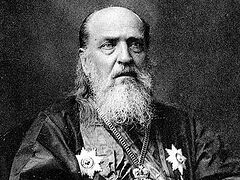
St. Nicholas Equal-to-the-Apostles, Archbishop of Japan
Missionaries are servants of God and the word. They are like the lilac and cherry tree in bloom, like a light breeze blowing in the midday heat. There are great figures in our Holy Orthodox Church whom God charged with enlightening whole nations, which sat in the region and shadow of death (Mt. 4:16). Peoples with a different mentality, they seem to “walk on their heads” because they live in a different part of the globe. One of these figures is St. Nicholas Equal–to-the-Apostles, Archbishop of Japan. On February 3/16, the Church commemorates the enlightener of the Land of the Rising Sun.
2025 marked the 155th anniversary of the establishment of the Russian Ecclesiastical Mission in Japan and the fifty-fifth anniversary since the Orthodox Church in Japan received its autonomy and St. Nicholas of Japan, Equal–to-the-Apostles, was canonized.
St. Nicholas (born Ivan Dmitrievich Kasatkin on August 1, 1836) lost his mother early, and his family lived in poverty. Despite this, he was sent first to the Bely Theological School (now in the Tver region), and after graduating from it—to the Smolensk Seminary. By the way, Ivan had to walk about 100 miles to get there—he could not hire horses because of his poverty.
After graduating from the seminary with honors at the state’s expense, the future saint was sent to the St. Petersburg Theological Academy. He showed his extraordinary abilities there, and everybody believed that Ivan would become a professor, but God ordained otherwise. St. Nicholas had never considered taking up the monastic life before; it had simply never occurred to him.
When Ivan saw an announcement of an opportunity to go to Japan as rector of the embassy church in Hakodate, he did not react in any way and went to the Vigil. But during the service, he experienced an amazing inner change, and after the Vigil Ivan went straight to the rector of the Academy and said that he wanted to be a monk, not a married priest, and would like to go to Japan. Vladyka Nektary accepted his request.
On June 23, 1860, Ivan Kasatkin became a monk. A few days later, he was ordained hierodeacon, and then hieromonk. At the end of June, he departed from St. Petersburg—it was going to be a long journey.
 St. Nicholas Equal-to-the-Apostles, Archbishop of Japan
The scope of this saint’s personality is striking. Archbishop Nicholas was a gentle but iron-willed man, and an excellent administrator. His amiability was combined with inflexibility towards those whom he deemed necessary to educate with rigor or to instruct. It wasn’t easy to earn his trust. A man of great intelligence and immense love for God, his native land, and flock, the saint studied Japanese for seven years and complained that there were not 100 hours in a day and that he could not devote them all to learning the language. The teachers took turns during the day to rest, but St. Nicholas continued to study, so he hired several teachers at once. In total, the saint knew seven foreign languages.
In his diaries St. Nicholas complained about some people around him, whom he had himself chosen and who, according to him, were unfit for the high Mission in Japan. The saint was irreconcilable with laziness, neglect of the holy cause of preaching, and disorderliness. His heart was burning for the Mission.
“March 4, 1871. Midnight. Shanghai.
“What on earth is this? What have I done to deserve so much trouble? Ah! Somebody is to blame! Have wisdom and be able to choose people! If you’ve failed to choose good ones, then try to make the bad ones good! We will try our best—may God give us time for it! I have been thinking a lot about how to deal with my ‘treasures’, and I’ve decided on one thing so far: to be in equal terms with everyone, to avoid any reproaches, harsh words and outbursts: if you start teaching, nothing comes out anyway; they get offended—not only a colleague, but also a servant, and they start acting even worse; if you keep silent, it’s bad again—they think that you’re angry and behave even worse. From this time on may my word be that of meekness, extreme leniency, and love. Won’t it do some good? And then, maybe, little by little, I can guide one and the other. If not, then the servant can be sent to Russia at any time; Fr. Gregory can also be sent to Russia right after I fix up Fr. Anatoly in Nagasaki and Zabelin in Hyogo. It seems that some good will come from them, especially the latter if he arrives.”
“June 15/27, 1893. Tuesday. Fukushima. Tokyo.
“My general impression is that the Lord wants His true Faith to take root in Japan. There are undoubtedly good Christians everywhere in the churches here; there is evidence of God’s gracious help everywhere. However, the harvest truly is plenteous, but the laborers are few (Mt. 9:37); perhaps they would be enough, but they are very bad… The Lord enlightened the world through the twelve apostles, but those twelve men had the strength of 12,000. There are 120 catechists here today, but they don’t have one twelve–thousandth of one apostle’s strength. The only hope is in the Lord our Savior. Do Thy will here, O Lord, as Thou dost it in Heaven! Show Thy power here, as Thou showest it worldwide! Enlighten this country with the Light of Thy true teaching through the prayers of Thy Most Pure Mother, the holy angels, the holy apostles, and all saints!”

Despite his iron will, which everyone around St. Nicholas noticed in him, he saw in himself dreaminess and a soul as fragile as glass:
“December 20, 1876/January 1, 1877.
“The beginning of 1872 ended all too slyly. What an exaltation! It’ll go to the grave with me. I feel I express myself wildly even to myself, writing a diary, but how can you avoid phrases with which you were inculcated from childhood? The phrase is torment, and everything that should make you turn gray is higher. Thank God, my hair is not gray. It means that our nature is healthier than our upbringing. And if our upbringing goes in the direction of our nature, we will become heroes instead of the petty people we see before our eyes, including myself. Yes, nature gives birth—that’s God’s work; our upbringing or the lack thereof spoils it—that is our tragedy. Well, what did your nature give you and what did your upbringing spoil? Nature gave me common sense and not a very bad character, while upbringing turned common sense into a paradoxical dreaminess, and a good character into an anxious and suspicious soul as fragile as glass.”
St. Nicholas had many sorrowful moments in Japan. They threw stones at him and mocked him as he walked through the streets in his vestments. The Japanese detested foreigners. Despite the difficulties, when staying in Russia St. Nicholas missed Japan and longed to return to his peaceful corner of the world:
“September 28, 1879. Friday:
“The same endless thought about Japan and the Mission! Warmed up and expanded mentally, I’m more positive about the Mission; so, the main care here is the Mission too; and forever, and everywhere there are only the Mission and Japan; for me there is no hiding from these, and I will never find anything different and better on earth, no other happiness but the Mission and Japan. So what did I pine for in Japan? What was the soul seeking? You can’t run away from what has become frozen to it, and my sole happiness on earth is progress with the Mission. It’s true!
“Wasn’t I happy every morning in Japan—even happier than in the family of F. N. (Fyodor Nikolaevich) when returning from a Dogmatics class at the Catechism School? The soul is also warmed and enlarged, and I would like to talk on and on, striking down all evil, all lies, untruths, Catholicism, Protestantism and everything that is against Christ! Yes. That’s probably the only true happiness on earth for me! May God grant me to return there as soon as possible and never be bored there or want to go back to Russia! Reading these lines, when beset with vexation or melancholy in Japan, may God grant that I always calm down and sober up from the weekly thought of seeking happiness if only on a temporary vacation in Russia. Is it really happiness? On the contrary, isn’t it a misfortune? Ghastly boredom during the journey; I’m still running about like a madman—no peace, no rest; endearments and pleasantries no longer make me glad—I’ve heard a lot more of them in Japan than I can hear in Russia; the prospect of a meeting with my family is not particularly inviting—I’ll probably see them and get bored within two days. As for friends, even if I meet with the best ones, all I will think about is Japan. Eh, the grass is always greener on the other side!
“However, perhaps a change of places and faces is important in sparing and renewing strength—that is, rest. But in this case, you can rest in Japan, changing one place for another and one person for another—that is, traveling around Japan from church to Church or going to the mountains for a while. May I never miss Russia in Japan from now on!
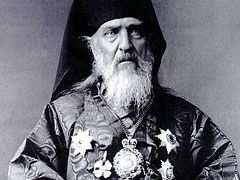
 St. Nicholas Equal-to-the-Apostles, Archbishop of Japan
“I would probably not have pined away before, but the many troubles I went through, the need to get some faces and colors out of my mind, the financial need, the shortage of staff—all this made me come here from Japan. And here, may God help me finish my affairs as soon as possible and go to my peaceful corner! How kindred and sweet everything there is to my soul! And how restless and devoid of true pleasure everything is here! I’m tired of being here.”
In his letters to St. Innocent (Veniaminov), the apostle of Siberia and Alaska, the outstanding missionary St. Nicholas shared his thoughts on the importance of the Mission, its successes and needs. He had met St. Innocent at the very beginning of his path. St. Innocent even sewed him a velvet cassock, because St. Nicholas’s one was past repair. With the support of St. Innocent, the Holy Synod set up an Orthodox Mission in Japan. They had a close spiritual bond. St. Innocent cared for and helped St. Nicholas in every possible way in the work of the Mission.
An excerpt from one of his letters to Metropolitan Innocent (Veniaminov): “Japanese books have opened before me, at least half-opened; Japanese speech flows freely, albeit with errors. As much as possible, I have striven to pursue my main goal; I cannot boast of success, but something has been done—the four Gospels, the Acts, the Apostolic Epistles, several Epistles of the Apostle Paul, a brief Sacred History, the Full Orthodox Confession by St. Dimitry of Rostov, Catechism for catechumens, and the morning and evening prayers have been translated from Chinese into Japanese; the orders of reception of people from other faiths into Orthodoxy and of Baptism have been translated from Church Slavonic.
“On May 18 of this year, three Japanese were baptized after a long period of catechizing. I trained these Japanese to be preachers, but alas! I have come to the final conclusion that there is little hope for Japanese as preachers. To teach others, you need a clear and extensive knowledge of the Christian faith. Here you often have to deal with atheists—pretend ones, like all atheists in the world—but nevertheless stubborn and with dialectical subtleties defending some self-invented ‘vital spirit’, the Confucian impersonal heaven, or the male and female principles.
“If such an atheist finally renounces his beliefs, then he wants to know Christianity in all possible details. Is it possible to train a Japanese so that he can be able to answer everything—a Japanese with no fundamental education and, most importantly, with no skill at learning anything systematically? The present generation, perhaps with individual fortunate exceptions that I have not encountered yet, cannot be counted on at all. All that can be expected from newly enlightened Japanese is catechism, mainly among the common people and under the direct supervision of a missionary.
 A group of Japanese Orthodox clergy headed by Archbishop Nicholas of Japan
“I’m the only missionary here so far, and privately at that. Catholicism has long deployed its phalanxes of missionaries here; Protestantism is not far behind it. And Orthodoxy? Are we afraid to be alongside them? But it does not become an Orthodox to be afraid of a Papist who adores his Pope almost like the ‘fourth Person of the Holy Trinity’, or a Protestant who is almost ready to split with himself in terms of his religious beliefs. We have no money and no people! But when will Russia with its seventy million residents, stretching around half the globe, find a few thousand rubles and several dozen people to fulfill one of the most important commandments of the Savior? Catholicism and Protestantism have spread all over the world. This is almost the only corner of the earth where Orthodoxy could offer its pure and blameless mite. Will Orthodoxy do nothing here either? No, it can’t be so; God will provide!
“It is with these words (‘God will help’) that I went to Japan; I go to bed and wake up every morning with them; they have become absorbed into my flesh and blood. For seven years I struggled with the Japanese language, complaining almost daily that there were not 100 hours in a day and that I could not devote them all to learning it. Many times, the doubt whether there would be any benefit from my labors crept into my soul, and—Lord have mercy—there was nothing more depressing than these doubts! Learning also attracted me many times—Japanese history and all Japanese literature are truly untapped treasures. Everything would be new and interesting in Europe, and the work would not be in vain. But learning will find itself many sons without me; let others sacrifice their energies to it—mine are entirely devoted to missionary endeavors. It is only out of despair that I would decide to become a stepchild of learning; but despair is still out of the question.”
A missionary will always understand a missionary. St. Nicholas Equal-to-the-Apostles maintained friendly relations with other prominent missionaries, including St. Makary (Nevsky), Metropolitan of Moscow and Kolomna. Here is an excerpt from one of his letters to Metropolitan Makary:
“The Russian Ecclesiastical Mission in Japan. Tokyo. November 30, 1906.
“Your Eminence was ‘glad that I returned to Japan.’ But I had never thought of leaving it and am very far from such a thought; I will say frankly that I was genuinely saddened to learn that I had been made an archbishop; the very thought that I would have to leave the Mission for a while and go to the Synod saddened me, while the vicar did not have that duty. Now I am reassured that there will be someone to leave the Mission to; a vicar is coming here, and I will be really pleased to visit my Fatherland for the first time in twenty-six years. As for ‘rest’—when I read your lines about it, I burned with shame at the mere thought that Your Eminence might have thought that of me. To ‘rest’ for a missionary as long as he still has if only a crumb of strength to serve his cause seems so incongruous to me that I have never attempted to try on a robe of ‘rest’ even in my dreams.
“Your Eminence wrote, ‘I would be happy to die in the furrow, which by Divine Providence I was assigned to plow and sow.’ Here are your own thoughts about ‘rest’—mine are exactly the same. And may the Lord grant us according to our thoughts!”
Sometimes we make plans and think about how it should be or will be, but the Lord ordains everything differently and for the better—in a way that we could not have imagined. Ivan Kasatkin could not have imagined what kind of service awaited him. The miraculous change that he experienced, the revelation from God helped him turn the “steering wheel” of his destiny by 180 degrees. And as we can see, the decision was right; he was able to understand God’s will for himself, because the Lord does not give everyone such a vocation—to enlighten other nations with the light of the Gospel. It’s incredibly complicated. It requires an iron will and self-discipline, great faith, remarkable talents, intelligence and wisdom. That is why such a thorny and somewhat sorrowful path was the only saving path for St. Nicholas of Japan. If he had chosen another one, perhaps he would not have been able to bear so much good fruit for the Lord.
 Funeral of St. Nicholas of Japan
But the Lord gives everyone strength and talents precisely for the mission that is assigned to them. And it’s dangerous not to understand or not to know what your mission is, or even worse—to turn away to another path; because by doing what is in tune with God’s will, salvation becomes easier to attain. The Lord Himself will help us then—our path, even if it is thorny and lies through the desert or the taiga, will be good for us, just as for St. Nicholas of Japan a foreign land, at first so unfriendly, eventually became his second home on earth.
St. Nicholas Equal-to-the-Apostles fell asleep in the Lord on February 16, 1912. Before his repose, Vladyka uttered the word “Resurrection” several times in his delirium. At a quarter past seven in the morning a great church bell announced the archbishop’s death.
A large crowd of people gathered for the funeral; Emperor Meiji personally ordered him to be buried within the city of Tokyo and sent a wreath. No other foreign missionary had ever been vouchsafed this privilege.
St. Nicholas Equal-to-the-Apostles became an apologist for the Orthodox faith in Japan. Over Vladyka’s fifty years of ministry in Japan, he gathered a flock of more than 30,000. He left behind a cathedral, eight churches, 175 chapels, 266 communities, one bishop, thirty-four priests, eight deacons, and 115 catechists.
Thus, the path of St. Nicholas of Japan is like that of an Orthodox “samurai” who does not strike with a sword, but with the power of the word of the Gospel, and guides those whose hearts respond to this path.