Photo: pravmir.ru
In the name of the Father, and of the Son, and of the Holy Spirit!
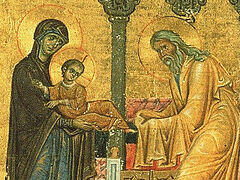
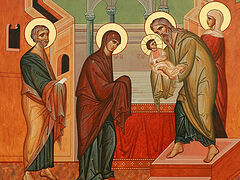
Today the Church celebrates the great feast of the Meeting of the Lord. It commemorates the meeting that took place 2,000 years ago in the Temple of Jerusalem, when Righteous Simeon the God-Receiver, after waiting a very long time, was led into the Temple by the Holy Spirit. He was promised that he would not die before meeting the Lord’s Christ. Driven by the Holy Spirit, Righteous Simeon came to the Temple and took the Divine Infant into his arms. It was the most important event in his life. This is what he had anticipated for many years. Interestingly, the Gospel says, Behold, there was a man in Jerusalem, whose name was Simeon; and the same man was just and devout, waiting for the consolation of Israel: and the Holy Ghost was upon him (Lk. 2:25).
We tend to believe that the time before the coming of Christ was dark and that every human soul was under the power of the devil’s sin. St. Diadochus of Photike (the fifth century) once said that before Baptism the devil lives in a person’s heart, and after Baptism he is cast out. In fact, this is more of a metaphor than full-fledged truth, because we know from the Holy Scriptures about numerous prophets and saints of the Old Testament who were righteous, performed good works, confessed God, and avoided sins as much as they could.
Likewise, St. Simeon the God-Receiver lived a righteous life. He knew God as much as he could. However, the most important event of his life was that meeting with the God-Man. He could not recognize Christ in this Infant by any external signs or by any other way. Only the Holy Spirit could reveal it to him. We know that Christ is like us in His humanity: He is consubstantial with us in His humanity and consubstantial with God the Father in His Divinity. Taking the Infant Son of God into his arms, the Righteous Simeon prophesied that This Child is set for the fall and rising again of many in Israel; and for a sign which shall be spoken against (Lk. 2:34).
What is a sign which shall be spoken against? It is the very truth that God appeared in the flesh and that our God is not the abstract god of philosophers. Our God is not some “universal god”, but the All–Good, All-Righteous, and Almighty God. It is the God Who became incarnate, for Jesus Christ Himself said: I am the door: by Me if any man enter in, he shall be saved, and shall go in and out, and find pasture (Jn. 10:9). There is no way to God other than through Jesus Christ and through the recognition that He truly became incarnate, but did not fuse with humanity, as some heretics claimed. In Jesus Christ Divinity did not absorb humanity, but He is precisely perfect God and perfect Man.
This truth is offered to all Christians in order to assimilate it first with our minds, so that we can confess the Divinity and humanity of Christ; not only that He became incarnate, but also that He suffered for us, was crucified, died and rose again. But besides that, He ascended to Heaven with His body; He did not abandon His humanity as a “worn-out garment”, but it was with His humanity that He ascended to Heaven and now sits at the right hand of God the Father. He will remain in this state forever, for the Church confesses that the two natures in Christ co-exist without confusion, unchangeably, indivisibly, inseparably. In other words, Christ will forever remain both fully Man and fully God in one Person, and will forever retain His two natures. This is a great truth. It elevates you and me, for it turns out that Christ is our kin, which is called humanity.
St. John the Theologian shows that this sign which shall be spoken against—this cornerstone of the Christian faith, the dogma of the Incarnation—is central to all of us. He said that Every spirit that confesseth that Jesus Christ is come in the flesh is of God: and every spirit that confesseth not that Jesus Christ is come in the flesh is not of God: and this is that spirit of antichrist, whereof ye have heard that it should come; and even now already is it in the world (1 Jn. 4:2-3). We often judge people, dividing them into good and bad, honest and dishonest; whereas St. John the Theologian divided them into those who confess Jesus Christ as God Who came in the flesh and became man, became incarnate, and those who do not recognize this.
And from the very beginning, at the Ecumenical and Local Councils, the Church constantly struggled to articulate the doctrine of the Person of the God-Man. And it may seem to all of us that ancient dogmatic disputes have little to do with our daily Christian life and reality. And yet, we lose a lot when we do not understand and do not even try to comprehend our faith not only with our lives, but also with our minds; when all these dogmatic truths about the God-Man Christ are not engraved on our hearts and our souls; and when we gradually slide towards a common belief in a “just God”, without keeping the thought that was firmly established in our minds at the beginning. However, it is not enough just to confess Christ Who is come in the flesh—it is not enough just to believe together with the whole Church; for this faith is still rational in us.
For example, the Righteous Anna the Prophetess, who is also mentioned in today’s Gospel reading, spent most of her long life within the Temple precincts and did not leave it, devoting all her time to fasting and prayer in order to meet Christ (cf. Lk. 2:36-38). So every Christian in his life, accepting faith first with his mind and reason, is called to ensure that these truths become the reality of his heart, his daily bearing of the cross; that what he simply professes with his mind becomes the life of his heart; that his very life in Christ is the fulfillment of the commandments, patient endurance of sorrows, sufferings and difficulties of this life; that these Divine truths are imprinted upon and assimilated by his heart, and his meeting with Christ takes place.
For many of us—I think for most of us—it’s yet to come. This is the very meeting that St. Seraphim of Sarov spoke about when he said that the true aim of our Christian life is acquiring the grace of the Holy Spirit. It is the grace of the Holy Spirit that, having come into the human heart, makes these truths of Divine dogmas a living faith—the faith of the heart. And when the Holy Fathers spoke about the Divine revelations that they had experienced, they said that they had not comprehended or learned anything new from these revelations. For the very truths that the Church teaches Christians suddenly came alive, began to live their full-blooded life in the Holy Fathers’ hearts, were assimilated, and became an unshakeable faith that leads every Christian to eternal life.
Amen.