This series of publications is dedicated to how a layman can connect his home prayer with the broader Church prayer. In the first part, we spoke of the liturgical cycles and the books connected with them, as well as how to find texts that are read or sung in church every day in these books. In the second part, we analyzed the daily cycle as a whole and spoke of which prayers from the daily services can be read throughout the day to get closer to fulfilling the commandment to pray without ceasing. Now let’s examine in more detail the services that can be read according to the lay order, first analyzing the rite of Small Compline, which can (and even should!) be read at home as evening prayers.
The Lay order
In general, what is the “lay order?” It’s the way of reading a service without a priest. Logically, the lay order doesn’t include the celebration of any Sacraments (therefore, the Liturgy, for example, can’t be read as a lay service), or any of the elements of the services that require a priest or deacon such as censing and the exclamations at the litanies. However, at those points when censing is called for in the services in church, you can burn some incense in your home censer, and all the litanies can be replaced by saying “Lord, have mercy” a certain number of times. But, in fact, the lay order is only reading and singing everything that the reader would read and the choir would sing at a regular church service.
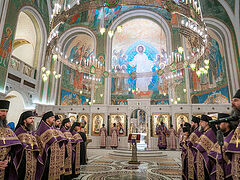
 After the lay Nativity service at the Church of Sts. Seraphim and Nicholas in Tiksi, Yakutia
It’s hard to say for sure, but I doubt the lay order is taught anywhere specifically, except in some missionary courses that anticipate situations where a missionary might find himself at some remote parish having to lead the services without a priest (this happens quite often in mission work). In cases like that, it’s simply inestimable if a missionary knows how to celebrate the lay order of the daily services, and not just read akathists and morning and evening prayers—which is also good of course, but not quite in keeping with Church worship.
Of course, if you have the chance to go to church, nothing can replace common prayer there—and it’s not just that “specially trained people” will read and sing everything according to the Typikon. The most important thing is that we pray conciliarly in church. But there are various situations. For example, the feast of a saint that’s especially dear to you falls on a weekday and you can’t get to church, or some other circumstances. Of course, there are online broadcasts of the services now, but first, they still might not be at a good time for you, and second, your level of engagement from just watching a broadcast is incomparably lower than for someone who’s reading the liturgical texts himself!
I won’t even mention readers and singers, who by reading the lay order of the daily cycle of services can practice singing and keeping the Typikon in a calmer setting at home. As for regular parishioners, it’s good for anyone to know how to read the lay order of the services, helping them stay connected to the Church’s rhythm even when they can’t go to church: on important feasts when they have to work, while traveling, on vacation, or during a COVID lockdown...
Small Compline
Let’s start with the simplest thing—how to read Small Compline according to the lay order. Interestingly, in Greece, Small Compline is included in prayer books as the evening prayer rule, so it’s quite common and familiar to everyone. The Russian tradition doesn’t have Small Compline in its prayer books, but you can find it in the Horologion. Although the liturgical day begins with Vespers, and Compline is the second service of the Church day after Vespers, in the Horologion the services are ordered according to usual days and begin with the Midnight Office, so Small Compline is placed at the end, between Great Compline and various appendices.
So, if you have the Horologion (printed or electronic), the easiest option is to simply read through the entire order of Small Compline from beginning to end:
— The usual beginning: The exclamation for a lay service: “Through the prayers of our Holy Fathers…” Glory to Thee, our God, glory to Thee. O Heavenly King and the Trisagion prayers through the Lord’s Prayer. Lord, have mercy (12x). Glory, both now.1
— O come let us worship God our King… (3x)
— Psalm 50 (Have mercy on me, O God…)
— Psalm 69 (O God, be attentive unto helping me…)
— Psalm 142 (O Lord, hear my prayer…)
— Evening doxology (Glory to God in the highest…)
— Nicene Creed
— It is Truly Meet…
— Trisagion prayers through the Lord’s Prayer
— Troparion of the day (according to the weekly cycle),2 troparion of the church3
— Troparion to all Venerable Fathers: O God of our fathers…
— Troparion to All Saints: Adorned in the blood of Thy martyrs throughout all the world…
— Glory. With the saints give rest…
— Both now. Through the intercessions, O Lord, of all the saints and the Theotokos…
— Lord, have mercy (40x)
— The prayer, Thou Who at all times and at every hour…
— Lord, have mercy (3x). Glory, both now. More honorable than the Cherubim…
— Through the prayers of our Holy Fathers…
— Amen. Prayer to the Theotokos: O undefiled, untainted, uncorrupted, most pure, chaste Virgin…
— Prayer of Antiochus the Monk: And grant unto us, O Master…
— Most glorious, Ever-Virgin…
— My hope is the Father…
— Glory, both now. Lord, have mercy (3x). Dismissal for lay services: “Through the prayers of our Holy Fathers…”
At the end, you can read the prayer, “O Lord, lover of men, forgive those who hate and wrong us…” from the evening prayers—it’s similar in meaning to the litany the priest would say at the end of Compline.
As you can see, the order of Small Compline isn’t complicated at all. And if you read it from the Horologion, you don’t have to know this order yourself, you just have to prepare the troparia (for the week and the church) beforehand and read everything from start to finish, not forgetting to add the exclamation, “Through the prayers of our Holy Fathers…” where the priest would read an exclamation were the service in church. The service itself is short and doesn’t take much longer than evening prayers. And it’s a real service from the daily cycle! Even in monasteries, Small Compline is rarely served with a priest, so they read it the same way, according to the lay order.
What Else Can Be Included in Small Compline?
If you want to add something else to Small Compline, there are several possibilities! The first option is to follow Athonite tradition and include the Akathist to the Most Holy Theotokos in Compline—that same Akathist, in the proper sense of the word, that’s read during Great Lent on the feast of the Salutations to the Most Holy Theotokos on the Saturday of the Theotokos, which you can find in any prayer book. In Athonite monasteries, the Akathist is either read in its entirety daily, or another common tradition is to divide it into four parts, just like it’s divided on the Saturday of the Akathist: On Monday—Kontakion 1 (To thee, the Champion Leader), then from Ikos 1 to Kontakion 4, and Champion Leader again; on Tuesday—Champion Leader, then from Ikos 4 to Kontakion 7, and Champion Leader; on Wednesday—Champion Leader at the beginning and end, with Ikos 7 through Kontakion 10 in between; on Thursday—Champion Leader, then everything from Ikos 10 through Kontakion 13 (read or sung thrice), then Ikos 1 and Champion Leader. These four parts of the Akathist are read at Compline between the Nicene Creed and It is Truly Meet alternately from Monday to Thursday, and on Friday the entire Akathist is read.
Another option is to include the canon to the Theotokos from the Octoechos. As we said in the first part, the Octoechos contains the services for every day of the week for all eight tones. So, among other liturgical texts, the Octoechos has a canon to the Theotokos for every day of every tone—fifty-six canons! In Greece, these canons are published in a separate book called the Theotokarion. There’s also the New Theotokarion, compiled by St. Nikodemos the Hagiorite in the eighteenth century, which includes sixty-two canons to the Theotokos in various tones. Most of them were found by St. Nikodemos in various Athonite monastery libraries and had never been published before then. They’re also divided by tone and day of the week (the “extra” six complete the collection as an appendix), and for each canon, St. Nikodemos wrote another four stichera in the same tone. I strongly advise you to read these canons, regardless of how interested you are in the Typikon and whether you’ll include them in Compline or read them separately—they would be a great adornment for the home prayer of any Christian! But if we’re talking about Small Compline, the canon to the Theotokos is read after the Nicene Creed, and the stichera4 are read or sung immediately after It is Truly Meet, before the troparia for the day or church.
This is perhaps a footnote, but for those who are interested, I’ll note that in the Paschal period, the canon to the Theotokos is supplemented with three-ode canons from an appendix in the Pentecostarion. As we said in the first part, the word “triodion” means three hymns; that is, a canon with only three odes. So they only have three odes instead of the usual eight.5 The Theotokos canon and the Triodion canon are combined by reading the odes from the Triodion, and the rest from the Octoechos. For example, at Compline on Sunday evening, there’s a canon with the first, eighth, and ninth odes. That means, we read the first ode from the Triodion, odes three to seven from the Octoechos, and eight and nine from the Triodion.
I’d also like to note that special, incredibly beautiful canons are read in Compline during the forefeast periods for Nativity and Theophany. Hymnographers wrote them in imitation of the canons of Holy Week. Just as remembering the events of Holy Week is necessary for proper preparation for Pascha, it’s also important to remember before Nativity how the Theotokos and St. Joseph the Betrothed traveled to Bethlehem before the Savior was born. The forefeast of Nativity begins on December 20/January 2, and the forefeast of Theophany on January 2/15. The canons for Compline are found in the Menaion, in the services for the pre-festal period.
Finally, let’s talk about how the Menaion service to a saint can be transferred to Compline. Of course, not all liturgical texts will “fit” into Compline, but the canon and several stichera can be easily transferred, and these are the most essential elements. And the Typikon even allows you to read the service to a saint not only from that day, but from several days earlier or later.
What does it mean to “transfer a service?” For example, you have a special veneration for a saint, but he’s a little-known ascetic and your regular church doesn’t even sing his troparion on his feast day. If a service has been written to this saint and you have the text of the canon and stichera, then you can read the lay Compline at home and after the Nicene Creed, read the canon to the saint (either instead of a canon to the Theotokos or together with it), and after It Is Truly Meet, sing or at least read the stichera to the saint. And if you don’t have a chance to read the service to a saint on his exact feast day, you can do so several days before or after. If you move a service to Compline, it’ll still be a more complete service than if you simply read all the texts to the saint from the Menaion, as we suggested in the first part, because the combination of ancient prayers (primarily the Psalter) with hymnography is the foundation of all the Church’s services.
On certain days of the Church year, the canon to the Theotokos from the Octoechos is omitted entirely, but I don’t want to overload the reader with these nuances—there’s probably already too much new information for beginners as is.
In the next part, we’ll talk about the lay order for the Midnight Office and the Hours, and in the fifth and final part, we’ll try to deal with Vespers.
To be continued…