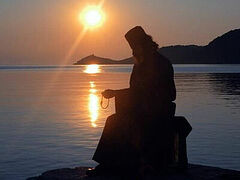
There is an important and truly fundamental theme that should be mentioned. I would call it an “apologia for reading the Great Canon of St. Andrew of Crete”. The fact is that today there are people, including churchgoers, who fail to understand why such a canon is necessary. They live by this principle: “Christ has come, and therefore we must rejoice. Why did you introduce some Canon of St. Andrew of Crete and now oblige us to weep and lament?... Do you have nothing else to do? Lent is an unnecessary thing; we only torment both ourselves and our loved ones to no avail, there is no benefit in it, while Pascha will come and be joyful anyway. So there is no sense in suffering for forty days and throughout Holy Week in vain. It is better to do good for someone, but fasting is pointless...” But according to Eastern Christian tradition and the understanding of life in God from the time of St. Anthony the Great and up to the Holy Fathers of the twentieth century, repentance is an integral part of a truly Christian life and a constant of human existence in this world. And it is a very fundamental, essentially New Testament and Gospel principle. As long as a person lives in this world, he must repent. And, according to the Holy Fathers, joy is precisely the fruit of repentance. A person is joyful to the extent that he remains in a state of repentance. And any joy that is not born in repentance will not be true, proper, and salvific. And if repentance and remembrance of your sins lead to despair and despondency, then in fact it is already not repentance and has nothing to do with it.
Repentance is by no means a contradiction to the famous words of the Apostle Paul that we should always rejoice (cf. 1 Thess. 5:16). If we always remained in a state of repentance, we would have constant joy. St. Symeon the New Theologian calls this paradoxical work “joy-making repentance” and “joy-making sorrow”—that is, sorrow that makes you capable of rejoicing. Of course, you can rejoice without sorrow, but this joy will be just emotional, contrived, feigned, sometimes flattering, sometimes false, and sometimes simply fatal. And in order for the soul to develop, repentance is vital. Because a person remains in a state of spiritual death and separation from God, and the Savior comes to him to save him. Repentance is the action of someone who understands his existence as needing salvation. That is, when a person laments and weeps, he testifies that he needs a Savior, salvation, help and protection; he needs a Redeemer—Someone Who will forgive and heal him. Repentance brings a person to such a state that he begins to cry out to the Lord, and it helps him take the right place in the face of God—that is, to acquire humility.
We could talk a lot about humility. But its essence lies also in the fact that it is the ontologically correct position of man in relation to God. Man is a creation, and God is the Creator, so man is aware that he is infinitely small in the face of what is infinitely large. God is the Source of his life, and humility is merely a statement of the fact that he is nothing and God is everything. God alone has the fullness of what man can receive. And humility is not about forcing yourself or breaking your own character. Someone who has truly humbled himself has realized who he is and Who God is, and accepted it as an obvious fact.

But humility is also important because it is a property of God. He is the only One Who is truly humble. That is why, by humbling ourselves and taking our natural position of the creation in the face of the Creator, in repentance we acquire Divine energies through which we assimilate humility as a Divine quality. We humble ourselves in the likeness of our humble God Who humbles Himself. Therefore, I repeat that humility is the only proper, accurate and reliable form of human existence before God. Christ says, Learn of Me; for I am meek and lowly in heart (Mt. 11:29). That is, all other modes of human existence before God will be wrong and deceitful. And, as noted above, there is only one effective way to humble yourself: it has been called repentance for many centuries. For this reason, the theme of repentance is given so much attention in the Orthodox Church. Among other things, both Lent and the Great Canon of St. Andrew of Crete are needed for this purpose.
And there is one more point that I would like to focus on. It happens that a person may not be used to repentance at all. And although in general he is not against it and is even ready to come to confession and tell the priest about the sins he has committed, this will not be repentance—just a list of some of his mistakes. But when someone starts listening to or reading the Great Canon of St. Andrew of Crete, the first feeling he experiences is shock. It is because everything he hears there is the truth, and no one likes the truth. Repentance is a shocking thing, because no one but a humble person likes to hear the truth. And only someone who is humble will endure the Last Judgment, which is the truth about us, without any embellishments, distortion or depreciation.
Any repentance teaches us to stand before this truth. Repentance is entering slowly, as if sidling into this ocean of light. And if you just barge in there immediately, you may not be able to bear the truth about yourself and damage your soul, lose your mind, or fall into despair when you suddenly realize how terrible you really are in the eyes of God. And in order to show people the truth about how God sees them, the Canon of St. Andrew of Crete speaks very honestly about harsh things. They may seem far-fetched to us, but in fact they reveal the truth to us.

Nowadays, it has become customary to pay attention only to the Gospel words that God loves, forgives and saves everybody. But there are also other words in the Gospel, and it is important to remember that the Gospel message contains a duality. The Gospel speaks not only about mercy and love, but also about judgment. And we must always keep in mind this duality of the Gospel message. So when we repent, we must pay attention to this “judgment component” of the Good News. Let us recall, for instance, the Parables of the Talents (Mt. 25:14-30), of the Wedding Feast (Mt. 22:2–14), and of the Ten Virgins (Mt. 25:1–13); or the famous words of Christ that there are two paths (and gates)—the wide one leading to perdition and the narrow one leading to eternal life, with few entering it (cf. Mt. 7:13–14).
The Canon of St. Andrew of Crete was written with the remembrance that there are some very harsh, “condemnatory” words in the Holy Scriptures. And we must not forget about this, because otherwise we won’t have the strength to judge ourselves truthfully. And we have to condemn ourselves. The Apostle Paul makes it clear that he who fails to judge himself will be condemned together with the world (cf. 1 Cor. 11:31–32). We have no choice but to judge ourselves. And the Great Canon of St. Andrew of Crete, especially its Old Testament part, is the condemnation, first of St. Andrew of Crete of himself, and then our own condemnation of ourselves.
From the book, Where Shall I Begin to Weep for the Action of My Wretched Life? Reflections on Selected Troparia of the Great Canon of St. Andrew of Crete