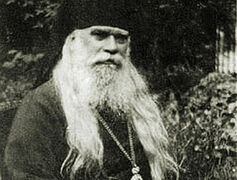
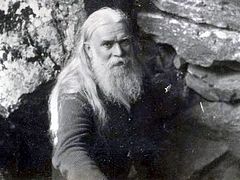
February 13/26 in the Church calendar is the commemoration day of St. Seraphim (Sobolev) of Sofia, Archbishop of Bogucharsk. On this day seventy-six years ago, “Grandpa (Dyado) Vladika”, as the saint is often referred to in Bulgaria, reposed in the Lord. By Divine Providence, hailing from the land of Ryazan, he was destined to serve in the Bulgarian land. In February 2016, St. Seraphim was canonized by the Russian Orthodox Church of the Moscow Patriarchate. Let’s take a closer look at his life.
 St. Seraphim (Sobolev) of Sofia
The future archbishop was born on December 1, 1881, into a pious family and named Nikolai. From childhood, he was very serious, pious and affectionate. After graduating from the Ryazan Seminary, in 1904 he entered the St. Petersburg Theological Academy, where he was loved for his quiet and endearing nature. Metropolitan Benjamin (Fedchenkov; 1880–1961), who was a year ahead of him at the Academy, recalled him in his essay, “Becoming a Monk”: “But our other friend, Nikolai S., was always affectionately called Kolechka because, among his friends—and often even among those older in age or rank—he displayed an unusual kindness and tenderness of manner. He would walk through the study rooms where students worked at their desks and, for no reason at all, greet them with:
‘Hello, my dear ones!’
“Or he would pat someone on the shoulder, stroke their head—without asking whether they wanted it or not… Sometimes, he would say to me: ‘Vanechka! Let me kiss you, my dear—I love you!’”1
Student Nikolai was in the throes of choosing whether or not to become a monk. As Metropolitan Benjamin continued, “But before him stood a difficult question: ‘Will I be able to endure it?’
“And so began the torment of doubt… A year passed, then another. The question remained unresolved. Then, following Father F.’s advice, he went to seek counsel from an elder. But the elder gave him an ambiguous answer: ‘You may go, or you may not. You wish to be a monk, but you would also make a good priest...’ Kolechka was not satisfied with this… And once again, he longed for monasticism.”2
The future saint addressed this question in writing to St. John of Kronstadt, but received no reply. Finally, he prayed from the bottom of his heart in front of an icon of St. Seraphim of Sarov, which had been given to him, and opened his Life. And he read there: “Save yourself, and save your brother.”
“And soon, ‘Kolechka’ was no more; in his place stood Hieromonk Seraphim, so named at his tonsure in honor of his beloved saint who had miraculously resolved his doubts.”3
Having become Monk Seraphim in 1908, the future saint was ordained hierodeacon and immediately hieromonk. In the same year, at the St. Petersburg Theological Academy, he defended his thesis on a rare and purely monastic subject, “The Doctrine of Humility According to the Philokalia.”
After graduating from the Academy, he was appointed assistant inspector of the Kaluga Theological School. At that time, Fr. Seraphim was in close contact with the great spiritual elders of the Optina Monastery.
 The Kaluga Theological School Building
In 1912, he was appointed rector of the Voronezh Theological Seminary, at that time one of the worst in Russia. In this position, the considerate and affectionate Hieromonk Seraphim strove to understand the needs of his students, eventually turning the seminary into a highly respected educational institution.
The Revolution broke out. In 1918, the seminary was closed by the Bolsheviks, and the rector moved to the Monastery of St. Tikhon of Zadonsk (dedicated in honor of the Nativity of the Theotokos). One of the monastery elders predicted his imminent departure from his homeland. When the Red Army entered the city of Voronezh, Fr. Seraphim, along with his brother, Hieromonk Sergius, left the city in an open carriage with coal.
On reaching the Crimean land, he became the rector of the Tauride Theological Seminary. In 1920, Fr. Seraphim was consecrated bishop. When the Bolshevik horde reached the Crimea, after some doubts and hesitations, Vladyka Seraphim left his motherland on the last steamer named Chersonesos, departing from the Crimean coast together with the cadets and the commandant of Sevastopol.
In 1921, the saint ended up in Bulgaria, where, with the blessing of the holy Patriarch Tikhon the Confessor, he became the administrator of Russian Orthodox parishes. St. Seraphim’s long and fruitful ministry on Bulgarian soil began. The base of his ministry was St. Nicholas Church at the Russian Embassy in Sofia. In 1934, he was elevated to the rank of archbishop.
At the new place, Archbishop Seraphim lovingly tended his spiritual flock and in every possible way took care not only of the Russian emigrants, but also of the Bulgarians. The church he was assigned to soon began to gather a large number of worshippers. They testified to a special presence of the grace of God at the services headed by Vladyka Seraphim. No wonder, since he was a great faster and a champion of the Jesus Prayer, and was spiritually nurtured by Athonite monks who often stayed in Sofia. The Archbishop tried his best to help the Athonites in their difficult situation. This is how one of the elders of Holy Mount Athos spoke of him: “He is a man of holy life. He is all love. I have never seen such a bishop before.”
This is how the Bulgarian Metropolitan Hilarion of Dorostol (1913–2009) recalled him: “He could often be seen walking through the streets of the city. He had an imposing posture—tall, stately, with a friendly face, and long fair hair falling in waves down his back. Generous to all in his fatherly spiritual love, he gave his archpastoral blessing to all who greeted him… At that time the veneration of and filial devotion to Archbishop Seraphim was very great among the Russians and Bulgarians alike.”4 It is known that one day during a service at which St. Seraphim prayed, a young girl exclaimed in the simplicity of her heart: “Vladyka, you smell of Paradise!”
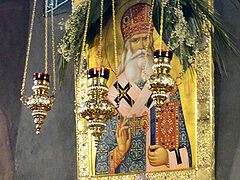
 Fresco in the crypt of the Russian representation church in Sofia: “St. Seraphim, Wonderworker of Sofia”
The humble Archpastor of Sofia taught from the ambo: “Undoubtedly, we will not become like Christ and His true disciples in works of Christian love overnight. First of all, we must acquire a humble disposition of heart and stop judging our neighbors… Whenever condemnatory thoughts arise in our souls, we must think like this: ‘Yes, my brother in Christ has fallen today, but I will fall tomorrow; he has sinned, but if I were him I would have sinned even more. But he will repent, and I will not repent…’ When our neighbors are being judged in our presence, we must stop this condemnation by silence, by changing the topic of the conversation, or by saying, ‘My friend, let us remember the words of Christ, Judge not, that ye be not judged (Mt. 7:1).’ If this is how we think, feel, and behave, then A genuine Christian—that is, humble and non-judgmental—disposition will appear in our hearts. As long as we don’t have one, we are not Christians, even if for the sake of Christ we have done many great deeds and even given our bodies to be burned… For non-judgment on our part alone God will forgive all our sins.”5
In his sermon on Forgiveness Sunday, he taught: “Judging others is the beginning of our perdition… According to the teachings of St. Isaac the Syrian, we will not be pure until we begin to regard ourselves as sinners and our neighbors as saints… Of course, it is not easy to acquire a non-judgmental heart. It requires the great work of combating our pride and the feeling ingrained in our consciousness that we are better than others. But unless we wage this struggle, we will never be able to forgive our neighbors, will never receive forgiveness from God for our sins, and will not inherit the Heavenly Kingdom of Christ.”6
St. Seraphim also gave the following spiritual instructions: “Do not judge and do not be angry—then you will feel good and calm at heart, and the grace of God will be with you, helping you ward off all arrows of the enemy… It is easy to humble yourself before God, but it is hard to do it before men. It is necessary to bear insults from people… the most important thing is not to judge. The root of all carnal sins is judging… Meekness and humility are above all—without them, bodily labors are nothing… In essence, love is humility, and humility is love.”7
In 1945, Archbishop Seraphim asked His Holiness Patriarch Alexei I (Simansky) to receive him into the jurisdiction of the Moscow Patriarchate. The request was granted. In his declining years, he established the Convent in honor of the Protecting Veil of the Most Holy Theotokos in the Knyazhevo neighborhood of Sofia and took an active part in its arrangement. As the convent’s sisters noted, Vladyka was endowed with the gift of clairvoyance, but he concealed it in every possible way. During his lifetime, people received healing through his prayers.
St. Seraphim fell asleep in the Lord on February 26, 1950.
The saint’s contemporary, Archimandrite Alexander (Petranov), left such memories of his personality and spiritual gifts: “It was a great blessing for the Bulgarian Church that Archbishop Seraphim lived and served among us, that he encouraged us with his faith and theological mind, and poured out the wealth of his beautiful soul upon us. His life was full of miracles, and for his great humility God bestowed on him the gift of clairvoyance as well. Nothing was hidden from him… As a violet that blooms in a secluded place of the forest, and no matter how much it tries to hide—it will nevertheless reveal itself with its gentle fragrance; so also Vladyka Seraphim—no matter how much he tried to cover up all his virtues with humility, the wondrous manifestations of his grace-filled and clairvoyant soul became apparent to all who came into contact with him. He possessed so much love that he could warm all his neighbors with it... When our elder passed away, I was deeply grieved. Depressed, I prayed at his coffin for a long time. That night I lay down to rest after a hard day. Suddenly, I had a dream: Vladyka, who was on his deathbed, suddenly got up, embraced me and said tenderly, ‘Although I am dead, I will always be alive for you!’ This is how he answered my prayer and consoled me in my sorrow.”8
 St. Seraphim’s burial place in the crypt of the Russian representation church in Sofia
Archbishop Seraphim’s spiritual son, Archimandrite Panteleimon (Staritsky), delivered the following eulogy at his funeral: “His love for Christ was manifested by his extraordinary love for his neighbors, to which all of us gathered here are witnesses. We will never forget the kindness of Vladyka who often repeated: ‘I am not only your father, but also your mother!’ He would also repeat the words of St. Ambrose of Optina, ‘Affection received—eyes renewed.’ Indeed, people who came to him for his blessing and counsel felt comfort and tenderness. Our Vladyka had the grace-filled ability both to move hearts to tears of repentance and comfort those in sorrow… Vladyka passed away quietly and peacefully. A smile was on his lips in the final days of his life. He predicted his repose in advance and did it again five days, and then four days before his repose; and he tried to console others as long as he was able.”9
“Grandpa Vladika” was buried in the crypt of St. Nicholas Church in Sofia. To this day the faithful flock to his burial place to seek his prayerful intercession before the Throne of God.
Let us turn to St. Seraphim in prayer as well: “Ever aflame with divine zeal, Thou wast revealed as a pillar of Orthodoxy shining forth in the city of Sofia, and by thy piety thou didst bring many people to Christ, O good shepherd, Holy Hierarch Seraphim, pray to Christ God to save our souls” (Troparion, tone 4).