Photo: Romfea
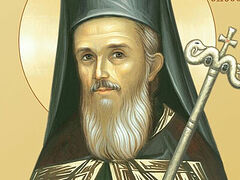
The following is the story of a miraculous healing by St. Kallinikos of Edessa (1918-1984), as testified to by Metropolitan Hierotheos (Vlachos) of Nafpaktos, who personally knew the saint. St. Kallinikos was canonized by the Patriarchate of Constantinople in June 2020.
***
I am publishing a new miracle of St. Kallinikos, Metropolitan of Edessa, which occurred in the case of a young child who had been diagnosed with an extremely aggressive brain cancer.
The account comes from the child’s grandmother, who worked in healthcare in a senior position.
I’m not publishing names, but I can confirm that these are my own spiritual children.—Metropolitan Hierotheos of Nafpaktos
At your suggestion, I’ve written up and am sending you the history and progression of our grandson’s (N.) illness. Little N. was born on March 30, 2021, and at nine months of age was diagnosed with an extremely aggressive brain cancer. The type was AT/RT, with a 73% mortality rate. We were told that only 700 cases had ever been reported worldwide, and just three in our country.
Everything moved very quickly—tests, results, medical decisions about how to treat the disease. Our little boy was deteriorating by the hour. He was taken into emergency surgery after showing severe neurological decline.
The operation was expected to take many hours, as the tumor was large—8 centimeters. Before he went into the operating room, we gave the staff an icon of St. Kallinikos and a small wooden box containing a tiny fragment of his holy relics. All the doctors were discouraged and held out no hope whatsoever. They were preparing us for the worst...
Our little one pulled through—the tumor was removed in its entirety, and he was taken to the ICU. He spent ten days there, and due to COVID restrictions his parents were only allowed to see him on the fifth day. That was the day he began to come around and respond to his surroundings.
The ICU doctor told them it was remarkable that he had woken up so well after such a difficult surgery, and said that the boy had a saint watching over him. And he did. Right there beside his pillow, sealed in a sterile envelope, were the icon and the relics of St. Kallinikos. That whole time, the saint had been at our little one’s side, keeping watch over him.
The months that followed brought many more surgeries, three rounds of heavy chemotherapy, three high-dose treatments, one septic episode, and two seizures. For a full year all of this went on—and yet the child seemed as though he weren’t sick at all. Every evening his mother would anoint him with holy oil from various saints and the relics of St. Kallinikos, and cover him with the prayer shawl of Eldress Galaktia.
For a year, the hospital was home—for our grandson and his parents alike. There were two other small lesions in his brain: one disappeared, but the other, located near the brainstem, remained unchanged. This troubled the doctors, but further surgery had been ruled out given how dangerous the tumor’s position was.
The only remaining step was radiation therapy—but that couldn’t be done until he was at least three years old. So we waited for him to grow, while in the meantime he continued on a mild oral chemotherapy.
When we began making arrangements in March 2024 for treatment in Italy—a specialized form of radiation called proton therapy—his doctors recommended that for better results, surgery should be performed first to remove as much of the remaining tumor as possible, ideally all of it. The neurosurgeon who had performed the first operation refused to take the case, citing the danger involved and the risk that our grandson might not survive the procedure.
In our desperation we also sought the opinion of specialists in the United States—Boston Children’s—who were in favor of attempting to remove part or all of the tumor.
The new neurosurgeon we consulted gave us the following odds: a 50% chance of reaching the tumor without complications such as nerve paralysis; a 25% chance of removing a portion without complications; a 20% chance of being unable to access it at all; and a 5% chance of everything going wrong…
He also warned us that the operation would be very difficult and lengthy. We told little Nikolakis that the doctor was going to remove a small ball that the illness had left inside his head. To put our minds at ease, the anesthesiologist let us know that they’d placed the icon of St. Kallinikos and his relics beside him for the entire duration of the surgery, as we had requested.
To our astonishment, after just two and a half hours the doctor came to tell us the surgery was finished, everything had gone well, and he had managed to extract material for a biopsy. The anesthesiologist told us not to worry if the boy slept a great deal afterward, given the extent of the procedure.
But when his mother walked into the recovery room, she found him talking, singing, and full of joy. He looked up at her and asked, “Mama, is the little ball gone?” The nurses and the anesthesiologist who were present asked, “What little ball?” And the boy answered: “The little ball that was in my head. Panagia and St. Kallinikos took it and threw it into the sea!” And he said it again—twice more.
From a medical standpoint, and according to the medical literature worldwide, as the doctors explained to us, when multiple lesions are present in the brain it’s almost impossible for them to represent different types of cancer. For that reason, all the lesions had from the outset been classified as AT/RT—Atypical Teratoid Rhabdoid Tumor.
One day before we were about to book flights to Italy, we received word that the pathology laboratory of the University of Athens, after extensive testing, had concluded that the tumor wasn’t malignant—it was benign. If that wasn’t a miracle, what was? In medical terms, he was clean.
The doctors informed us that this was only the third recorded case in the world of a patient having both AT/RT and a separate benign lesion in the brain simultaneously.
As a result, he was spared radiation therapy, spared the serious complications that a second major surgery could have caused, and all treatment was discontinued entirely.
His doctors can’t believe that he is not only alive, but thriving. With this embryonal type of tumor, 87% of young children don’t survive beyond the age of two or three.
Our little one turns five in a few months and is attending preschool like any normal child. I’ll close by sharing that on the 7th of this month, the doctors announced that his most recent MRI—taken on November 4, 2025—shows that the benign tumor has died off completely.
Thank you. I apologize for going on at such length, but I wanted you to have the full picture of everything our little one went through.
I’m deeply grateful and thank you for everything. Glory to God, to the Most Holy Theotokos, and to Sts. Kallinikos and Eldress Galaktia, who’ve been with us from the very first moment, strengthening and comforting us.
Please pray for us.
***
P.S. Your Eminence, our family has been granted a miracle. The entire journey our little one has been on is beyond belief. Every doctor and the entire medical community had written him off. We felt the presence of the Theotokos and St. Kallinikos so vividly that it gave us hope and strength.
What struck everyone was that throughout chemotherapy—treatment that is severely toxic and dangerous—our grandson didn’t have a single episode of vomiting, not a single complication, and endured it all as though it were happening to someone else. From the very beginning, God’s presence and mercy over him were plain to see.
Our little one has a deep love for St. Kallinikos—he venerates his icon, sings hymns to him, and so on. May God have mercy on us. And please, we ask for your prayers, that we may bear whatever His love permits for us.
Please pray for us.