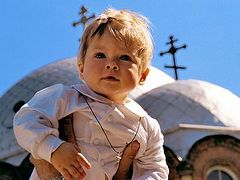
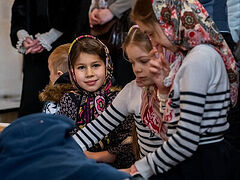
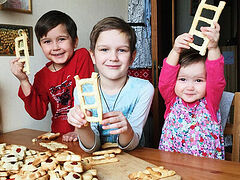
How early should children begin to fast? According to the teaching of the ancient Fathers, a healthy infant does not fast only while still nourished by its mother’s milk—that is, approximately until the age of three. (In antiquity, Jewish women nursed their children until about three years of age.)
Alongside the necessity of observing the fast to some degree, care must also be taken to guard children against the habit of overeating or of eating too frequently and outside the appointed times. In this regard, St. Theophan the Recluse gives parents the following instruction:
“One must feed a child in such a way that, while fostering bodily life and providing strength and health, one does not kindle in the soul a passion for sensual pleasure. One must not say, ‘The child is small.’ From the earliest years it is necessary to discipline the flesh, which inclines toward coarse matter, and to train it in self-mastery, so that in adolescence, in youth, and afterward, one may easily and freely govern this need.”
As children grow and their characters and inclinations become clearer, parents must show tact concerning the measure of their fasting. For example, one should not deprive them of sweets against their will, nor impose during fasting days such a reduction in the quality of food as would go beyond the normal bounds of the Church’s rule. For weak or sick children, of course, allowances and relaxations of the fast may be made.
Likewise, older children (young men and women) should not be forced to observe all the strict rules of the fast if they are greatly burdened by them. In such a case, fasting will bring no benefit to the soul and may even harden it. The Lord said, “I will have mercy, and not sacrifice” (Matt. 9:13). The whole meaning of fasting lies in voluntary restraint and self-limitation. Therefore, in order that the customary norms of fasting not become heavy for them in later years, children should be accustomed to fasting from their earliest age.
On Abstinence in Food
Fasting of the body is food for the soul.
Remember that Adam in Paradise was not beneath you in perfection; he imagined he could do without fasting—and what came of it?
—Innocent, Archbishop of Kherson
Who among the animals is as strong as the lion? Yet because of his belly even he falls into nets, and then all his might is humbled.
—St. John the Dwarf
Beware of measuring fasting merely by abstinence from food. Those who abstain from food yet behave wickedly are like the devil, who, though he eats nothing, nevertheless does not cease from sinning.
The prince of demons is the fallen day-star; and the chief of the passions is gluttony.
—St. John of the Ladder (Climacus)
He can never attain perfect purity who hopes to acquire it by abstinence alone, that is, by bodily fasting, unless he understands that abstinence is necessary so that, having subdued the flesh by fasting, he may more easily enter into warfare with the other passions.
—Venerable Abba Serapion
On Spiritual Fasting
Bodily fasting implies: restraint in food; the use of a particular kind of food; and infrequent eating.
Spiritual fasting likewise must include: restraint of outward impressions—the food of the soul; that is, the information a person is accustomed to receiving daily in enormous quantities; control over that information, meaning the quality of the nourishment the soul receives, excluding what inflames the passions; and infrequent “intake,” that is, periods of solitude, silence, stillness, and being alone with oneself, which give a person the opportunity to recognize his sins and to attain the chief aim of fasting—repentance.
Our passions are closely bound to sensory images. A passion appears in the mind in the form of a sinful image; conversely, a sinful image perceived from without arouses passion in the heart (the venerable Syncletica called the eyes “windows of death”).
In our time, the stage upon which human passions are continually displayed in all their variety, intensity, and refinement is the television. It resembles a source of constant radiation, irradiating the human psyche with deadly strontium.
Television keeps a person in a state of passionate tension, as though within the space of its screen were concentrated all sensory emotions—lust, cruelty, crime. What a person in former centuries might have encountered only a few times in life, and then accidentally (for example, the sight of a murder), he now sees every day.
The soul has three faculties: reason, emotion, and will. Through inseparable attachment to television, the will becomes weakened, like that of those who frequently undergo hypnosis; the feelings grow dull and demand ever sharper sensations and new “stimulants”; and the mind becomes enslaved by the succession of images that compel it to live in a kind of fantastical world, in an unending phantasmagoria.
The intellect has two powers: imaginative and verbal expression. Excessive, uncontrolled information develops the lower mechanical memory but suppresses creative strength and energy. The mind becomes flaccid and passive, living off the opinions and ideas of others. The images seen on the television screen revolve in the subconscious, rise up in memory, flicker in dreams like phantoms. Thinking becomes superficial, and speech becomes loquacious. The protective powers of the psyche are exhausted, unable to cope with the avalanche of impressions.
Where then is there room for silence, for prayer of the heart? A person does not see himself; it is as though he lives not in a home but in a theatre with performances that never cease.
The Holy Fathers teach that there are three kinds of activity of the mind: contemplation, which is born in the silence of prayer; reasoning; and imagination—imagination being the lowest form of thought, joined to sensory passions and fantasy. The Fathers command us to abide in prayer, to give place, when necessary in practical life, to rational reflection (while knowing its measure and limits), and to struggle against imagination as against an adversary. Television promotes the opposite: the development of imagination, the suppression of the mind’s creative power, and the loss of prayer. A person who spends the time of fasting before the television is like a glutton and a drunkard who swallows everything indiscriminately, without even chewing his food, yet imagines that he is keeping the fast according to all the rules of the Church.
From: Readings For Every Day of Great Lent, Ed. N. Shaposhnikova (Moscow: Danilov Monastery, 2025).