Lent, traditionally known as the Holy Forty Days of Lent, is much more than temporary abstinence from certain foods. It is the sacred heart of the liturgical year, a thoroughly thought-out spiritual route that leads the faithful to the climax of the Christian calendar—the feast of the Resurrection of Christ. Its very name, rooted in ancient languages (Greek “τεσσαρακοστή” and Latin “Quadragesima”), serves as a direct reference to the forty-day stay of Jesus Christ in the desert, where He fasted and prayed to prepare for His ministry. However, this New Testament pre-image did not immediately find a clear chronological framework in Church practice. The historical formation of Lent was a long and amazing journey marked by a variety of local traditions, theological conceptualizations, and the gradual crystallization of a unified approach.
The origins of this period are rooted in the practice of the early Church and are not so much ascetic as deeply communal and educational in nature. Surprisingly, Lent originated as an act of Christian solidarity and support. It was inextricably linked with the institute of catechism—a lengthy, usually three-year preparation of adult candidates (catechumens) for receiving the sacrament of Baptism, which was solemnly celebrated on Holy Saturday. The fullness of the Church—the faithful who had already been baptized—consciously joined their future brothers and sisters in the feat of fasting and repentance, creating a unique atmosphere of shared spiritual anticipation and concentration. Lent would become a time of intellectual and moral strain for the entire community, which in the weeks preceding Pascha focused on the final stage of catechumens’ training, which even included an examination on knowledge of the basics of faith and the Holy Scriptures.
The transformation of Lent from a period of preparation of converts to a time of personal repentance for every believer occurred in the era following the Edict of Milan, when Christianity became the dominant religion of the Roman Empire. With the disappearance of the institution of adult catechumens (as infants began to be baptized as well) Lent acquired a new, universal meaning. However, its duration remained varied for centuries. As the fifth–century Church historian Socrates Scholasticus noted, the period before Pascha varied significantly in length: in Rome they fasted for three weeks (excluding Saturdays and Sundays), in Greece and Alexandria for six weeks, elsewhere for seven weeks, and even shorter periods could symbolically be called “the forty days of Lent”. According to researchers, the authority of St. Athanasius the Great, whose Paschal Letters of the 330s demonstrate the transition to this norm, played a decisive role in establishing the forty-day period. The final formalization of the duration of Lent occurred later: in the West by the sixth and seventh centuries four days had been added to six weeks, starting from Ash Wednesday; and in the Byzantine tradition a forty-eight–day cycle was formed, including a separate Holy Week and Palm Sunday, with exactly forty fasting days from Monday of the first week to Friday of the sixth week.
The modern perception of Lent is often reduced to a strict diet, but its original essence in early Christian practice was fundamentally different. The main ascetic dimension was not the ingredients, but the time of its consumption. The faithful observed “dry fasting until the ninth hour”—that is, total abstinence from food and drink until about three in the afternoon, symbolically uniting with the hours of the Savior’s Passion on the Cross. After that, a regular meal without frills was allowed, while the food was not divided into the categories of “fasting” and “non-fasting”.
The situation had begun to change by the fourth and fifth centuries, when, under the influence of the powerful authority of monasticism, which emerged from the Egyptian and Syrian deserts, the ideal of radical abstinence penetrated the Church life. Imitating ascetics and hermits, laypeople began to focus ever more on plant-based foods—bread, vegetables, beans and fruits. Meat as a luxury product and a symbol of the carnal was gradually excluded from the Lenten diet. It is noteworthy that fish, being an ancient secret symbol of Christ (the Greek abbreviation “IΧΘΥΣ” stood for “Jesus Christ, Son of God, Savior”) and an inhabitant of waters unaffected, according to Genesis, by the curse of the earth after the fall, was allowed for a long time.
The development of attitudes towards Saturday and Sunday is also interesting: initially, these days, especially Sunday as “little Pascha”, were regarded as a legitimate break in fasting to gain some strength, as St. John Chrysostom wrote. However, over time, striving for greater strictness, especially in the Eastern monastic tradition, dietary restrictions were extended to these days as well, albeit in a relaxed form, consolidating the priority of asceticism over the original liturgical logic.
There is the single and unchanging essence of Lent behind all the external variety of fasting practices in different Christian denominations. First of all, this is a school of deep, conscious repentance (metanoia), which does not mean just a feeling of guilt, but a fundamental change of mind and way of life. This is a time of intensified prayer and reading of the Holy Scriptures, doing charitable acts and consciously combating spiritual idleness. The liturgical life of this period was developed as a subtle educational tool guiding the faithful on the path of spiritual ascent. For instance, in the Orthodox liturgical system every Sunday has a special theme. After the Triumph of Orthodoxy on the first Sunday of Lent, the following Sundays are dedicated to the memory of the pillar of hesychasm (St. Gregory Palamas), the author of the classic manual on spiritual life The Ladder (St. John Climacus) and the greatest monastic as a model of repentance (St. Mary of Egypt). These figures serve as living beacons, showing us the way from the struggle with passions to deification (theosis). The climax of this ascent is the mid-point of Lent, the Sunday of the Veneration of the Holy Cross, when the Life–Giving Cross is solemnly carried out of the altar to the middle of the church. It is not a mere accident, but a spiritual culmination, reminding us that the purpose of Lent is not self–improvement for yourself, but being crucified together with Christ in order to become worthy of resurrection with Him.
In the Orthodox tradition, which inherited and systematized monastic ascetic experience, Lenten discipline is regulated by the Church Typicon with almost scientific precision. Here abstinence in foods turns into a complex and dynamic system of spiritual asceticism, where every day has its own “degree of strictness”. Lent begins and ends most strenuously: during its first week and Holy Week the eating of dry food is prescribed. During the other weeks the discipline changes cyclically: Mondays, Wednesdays and Fridays are days of strict dry fasting (uncooked food without vegetable oil, usually once in the evening); on Tuesdays and Thursdays hot food is allowed, but again without oil; Saturdays and Sundays are days of relaxation, when vegetable oil and a little wine are allowed. This gradation is not a coincidence: it follows the liturgical rhythm, where Wednesday and Friday are days of remembrance of the betrayal and Crucifixion of Christ.
Special regulations concern the feasts: fish is allowed only twice—on the Annunciation of the Theotokos (unless it falls in Holy Week) and on Palm Sunday. On Lazarus Saturday, which precedes the Entry of the Lord into Jerusalem, fish is prohibited, but caviar is allowed as a symbol of future joy and new life. This strict hierarchical system has one goal: not to harm health, but to curb bodily needs in order to make the mind more sensitive, the will stronger, and the heart more open to prayer and inner work.
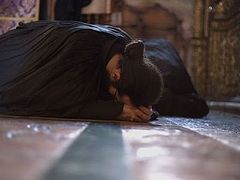
The Lenten mood is created not only by personal effort, but also by the whole structure of Church life, which these days acquires a special, concentrated tone. Services become very long, filled with penitential hymns, frequent prostrations, and the reading of the Great Canon of St. Andrew of Crete. The most joyful and solemn elements temporarily disappear from day-to-day life—molebens and pannikhidas are not served (except in special cases) and the celebration of the sacrament of marriage is postponed. The appearance of church changes as well: flowers, precious ornaments, and light covers are removed; the Royal Doors open less often. Clergy dress in dark, most often maroon, purple or black vestments, the color of which symbolizes both contrition and the royal dignity of the Passion on the Cross. This outward austerity and the lack of festive atmosphere are by no means the cultivation of despondency. On the contrary, it is a powerful liturgical and psychological device that helps the faithful “enter into themselves”, cutting off the vanity and long-winded noise of the world in order to hear the quiet voice of conscience and turn to the main thing—the careful work of purifying the heart. Having passed through centuries of complex historical and liturgical formation, for millions of believers Lent remains not just a tradition, but a living, annually repeated journey from the darkness of sin and distraction to the light of genuine freedom and Paschal joy.
Lent is above all the path of Divine mercy towards us and our reciprocal movement towards It, and therefore we should take it with discernment and spiritual insight, keeping in mind that The sabbath was made for man, and not man for the sabbath (Mk. 2:27). Try to observe the fast with zeal and reverence, but without fanaticism and self-torment, for the Lord desires mercy, and not sacrifice (Mt. 9:13). If your health, age, hard work, or other objective circumstances do not allow you to obey the strict rules in full, do not be embarrassed or discouraged.
The essence of fasting is not in exhausting the body, but in curbing passions, cultivating the spirit and strengthening the will. Determine together with your spiritual father or an experienced pastor the measure of abstinence in food that will be within your strength and will not affect your health, because health is a gift from God, and its reasonable preservation is our duty. Remember that Lent is not only about abstaining from animal products, but above all abstinence from evil words, anger, judging, vain entertainment and everything that separates us from God. Spend more time in prayer, reading the Holy Scriptures, good works, and reconciliation with others. May your physical abstinence, even if it is moderate by necessity, become the basis for more zealous and attentive spiritual work, so that, having purified your heart and strengthened your faith, you may meet the Radiant Resurrection of Christ with joy and peace in your souls.