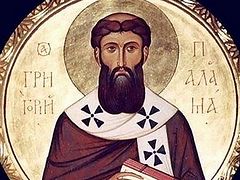
The Holy Church has dedicated the second Sunday of Lent and the week following it to St. Gregory Palamas (1296–1359), the defender of the doctrine of Divine energies. Let us turn to his principal work, The Triads in Defense of the Holy Hesychasts, and recall his dispute with Barlaam of Calabria.
 The work by St. Gregory Palamas, The Triads in Defense of the Holy Hesychasts, is one of the key works of Orthodox theology and asceticism. It was written in the fourteenth century in response to the criticism of hesychasm by Barlaam of Calabria (c. 1290–1348), who denied the mystical communion of Hesychast monks with God, their visions of uncreated light and argued that the knowledge of God is obtained only through rational and philosophical reflection.
The problem considered in The Triads is more relevant to us than ever, because scientific rationalism and skepticism now prevail, and many people tend to reject spiritual experience as subjective or illusory. This is reminiscent of the position of Barlaam of Calabria, who denied the possibility of real communion with God and reduced the knowledge of God to philosophical speculation. Besides, in conditions of information overload and stress, many people need spiritual practice. And the practice of hesychasm, which St. Gregory championed, offers a path to inner stillness and concentration on God, helping Christians control their thoughts.
The dispute began with Barlaam, who, after talking with Athonite Hesychast monks, started asserting that by practicing the Jesus Prayer and seeing the Divine light, they were “falling into the heresy of Messalianism”, which taught that through prayer a person could see directly the essence of God. Barlaam also denied that the light that Hesychasts see during prayer could be uncreated. He believed that this light was either a created phenomenon or a figment of the imagination. He also criticized the psychosomatic practices that Hesychasts applied to concentrate during prayer, such as breathing control and a certain body position.
Defending the practice of hesychasm in his work, St. Gregory Palamas expounded the teaching on uncreated Divine energies and substantiated the possibility of real partaking of God by man through prayer and ascetic practice.
The theologian distinguished between two paths of knowing God: the philosophical one, which works through rationality, and the mystical one, which works through experience. The philosophical path that Barlaam advocated is based on logic and studying the Holy Scriptures. However, St. Gregory emphasized that this is not enough for full knowledge of God and that the true knowledge of God is in the experience of communion with God. The mystical path practiced by hesychasts enables a Christian to be united with God, because it allows him to partake of the grace of God.
St. Gregory Palamas criticized Barlaam for reducing the knowledge of God to rational knowledge, and distinguished between God’s essence and His energies. He said that God is above the human mind and that His essence is unknowable to the created mind. However, although the essence of God is unknowable, a Christian can partake of God through His uncreated Divine energies. And through the grace of God, or Divine energies, we can be united with God.
 St. Gregory Palamas Thus, the doctrine of Divine energies makes it possible to explain how a Christian can know God in spite of His transcendence. For St. Gregory it was important that the light that Hesychasts see is uncreated Divine energies, and that such light is a real manifestation of God. Therefore, the theologian searched for evidence in the Bible and directed our gaze to the Gospel episode of the Transfiguration of Christ on Mount Tabor, where the disciples saw the Divine light. He also mentioned several more passages from the Holy Scriptures where Divine energies were revealed. For example, the story of the Prophet Moses, who went up on Mt. Sinai to receive the Tablets of the Covenant from God. The mountain was covered with a cloud, and the glory of the Lord appeared in the form of a consuming fire. The light that was seen by the Israelites was a manifestation of the Divine presence. Also, when Moses came down from the mountain, his face was shining with radiant light. And during the exodus from Egypt the Israelites walked through the wilderness, led by a miraculous pillar of fire by night and a pillar of cloud by day. According to St. Gregory, that light, too, was uncreated Divine energies that guided and protected the people of God.
Another example was the famous story of the Apostle Paul on the road to Damascus. He was surrounded by a flash of light from heaven, which was so bright that he was blinded. The light was accompanied by the appearance of Christ and had a Divine nature. And there are other places in the Bible. Thus, St. Gregory refuted Barlaam's allegation that the Divine light is a created phenomenon, since partaking of Divine energies is a way by which a Christian can actually partake of God. That would be impossible if the light were created.
For the authoritative theologian, the concept of hesychia plays an important role in the work of salvation and knowledge of God. According to St. Gregory, hesychia is not just an outward stillness, but an inward state of mind and heart in which a Christian renounces worldly vanity and passions. This state allows him to focus on prayer and contemplation of God.
To attain hesychia we need to watch our thoughts, because they distract us during prayer and lead us into a state of distraction. Here we must reject thoughts immediately rather than enter into a dialogue with them. This, in turn, requires continuous watchfulness and prayer. The mind must be collected and directed inward in order to avoid wandering. This naturally requires constant effort and forcing yourself.
 The practice of the Jesus Prayer helps in attaining inner stillness, since it enables a Christian to focus his mind and heart on God. The Jesus Prayer was often accompanied by specific techniques that included focused attention on some body points, such as the abdominal area or the heart, as well as controlled breathing. Renowned ascetics, such as Sts. Nikephoros the Hesychast and Gregory of Sinai (c. 1265–1346), often mentioned these techniques in their writings in connection with the performance of the Jesus Prayer. Although the chief purpose of these practices was to deepen the state of prayer, monks also used them to achieve contemplation of the Divine light. Nevertheless, these somatic practices were of secondary importance, as they were regarded as useful auxiliary techniques for the best possible concentration during prayer.
Thus, The Triads of St. Gregory Palamas became an important contribution to Orthodox theology. They not only defended the practice of hesychasm, but also developed the doctrine of uncreated Divine energies, which became the basis for understanding grace and deification (theosis) in the Orthodox tradition. And for modern Christians, hesychasm can become a support and a path to inner peace, deep faith and unity with God.