Fr. Stephen Freeman
The nature of secularism is the notion that anything at all exists apart from God – that is – that it has an independent existence. This is the very heart of modernity’s self-understanding: the world and all that is in it is self-existing and does not require God for its existence or well-being. This is a radical notion and is inherently atheistic. That someone might believe in God is not necessarily forbidden, but such a belief is purely a matter of individual preference and has nothing to do with the world as it actually is.
Some describe modern secularism as a “dis-enchantment” of the world – a denial that the world has anything special or sacramental about it. A thing is a thing is a thing. Of course, a corollary to this is the notion that human beings are just things among other things. That those who are infected with a secularist world-view (and there are many – perhaps a majority) too easily find themselves battling emptiness and depression. Their lives have little wonder, while beauty is nothing more than a concept, as non-existent as God.
This is not the Orthodox Christian faith. The earliest Christianity in the British Isles is often described as “Celtic Christianity.” This is nothing other than the Orthodox faith as it was encountered among the Celtic believers in the British Isles when Christianity from the continent met it in 597 A.D. in the mission of St. Augustine of Canterbury. There would have been much in common between the two (continental Christianity in the West at that time was itself Orthodox). Of course, one of the greatest exemplars of the Orthodox faith in Celtic Britain was St. Patrick of Ireland ( 385-461 A.D.). He himself was not Irish but what we today would describe as “Welsh” (“Briton”).
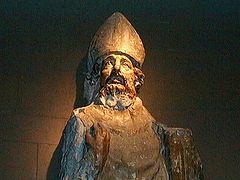
 St. Patrick What he preached and taught was the Orthodox faith. We have a wonderful legacy from his ministry, a hymn known as “St. Patrick’s Breastplate.” In it, we hear a reflection of what it means to understand creation as sacramental. St. Patrick describes something more than a person’s subjective impressions of creation. He “binds to himself” the “powers” of the things he sees and describes. He is, in prayer, literally wrapping himself in the “energies” (an Orthodox theological term) of what he sees around him. This is not magic – it is an affirmation of the true nature of creation and our relationship to it.
The world has not been “dis-enchanted,” unless we believe the manifold proclamations of secular lies. Things are not things. “Heaven and earth are full of Thy glory,” we declare to God. Creation is infused with beauty and declares the wonder of the Creator. St. Maximus went so far as to describe the “three incarnations” of God: in the Scriptures, in creation, and in the God-Man, Jesus Christ.
St. Patrick sees creation for what it is. His voice, reaching us down through the centuries, teaches us how to see. Later this month, a fair part of the world will celebrate St. Patrick’s Day. There will be an excess of beer, an over-abundance of the color green, and an indulgence in more than a little silliness.
If, however, you love St. Patrick, you would do well to pray his breast-plate, perhaps, even to commit it to memory. It will teach you to see the world. Take a good look, then have a cup of tea.
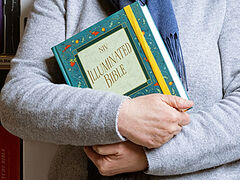
When my book, Everywhere Present: Christianity in a One-Storey Universe, was translated into Russian, the editor suggested adding a chapter with St. Patrick’s Breastplate translated into Russian. And so it was. I wish it had been in the English original. St. Patrick lived, prayed, and sang in a One-Storey Universe. God give us grace to do the same!
+++
I bind unto myself today
The strong Name of the Trinity,
By invocation of the same
The Three in One and One in Three.
I bind this today to me forever
By power of faith, Christ’s incarnation;
His baptism in Jordan river,
His death on Cross for my salvation;
His bursting from the spicèd tomb,
His riding up the heavenly way,
His coming at the day of doom
I bind unto myself today.
I bind unto myself the power
Of the great love of cherubim;
The sweet ‘Well done’ in judgment hour,
The service of the seraphim,
Confessors’ faith, Apostles’ word,
The Patriarchs’ prayers, the prophets’ scrolls,
All good deeds done unto the Lord
And purity of virgin souls.
I bind unto myself today
The virtues of the star lit heaven,
The glorious sun’s life giving ray,
The whiteness of the moon at even,
The flashing of the lightning free,
The whirling wind’s tempestuous shocks,
The stable earth, the deep salt sea
Around the old eternal rocks.
I bind unto myself today
The power of God to hold and lead,
His eye to watch, His might to stay,
His ear to hearken to my need.
The wisdom of my God to teach,
His hand to guide, His shield to ward;
The word of God to give me speech,
His heavenly host to be my guard.
Against the demon snares of sin,
The vice that gives temptation force,
The natural lusts that war within,
The hostile men that mar my course;
Or few or many, far or nigh,
In every place and in all hours,
Against their fierce hostility
I bind to me these holy powers.
Against all Satan’s spells and whiles,
Against false words of heresy,
Against the knowledge that defiles,
Against the heart’s idolatry,
Against the wizard’s evil craft,
Against the death wound and the burning,
The choking wave, the poisoned shaft,
Protect me, Christ, till Thy returning.
Christ be with me, Christ within me,
Christ behind me, Christ before me,
Christ beside me, Christ to win me,
Christ to comfort and restore me.
Christ beneath me, Christ above me,
Christ in quiet, Christ in danger,
Christ in hearts of all that love me,
Christ in mouth of friend and stranger.
I bind unto myself the Name,
The strong Name of the Trinity,
By invocation of the same,
The Three in One and One in Three.
By Whom all nature hath creation,
Eternal Father, Spirit, Word:
Praise to the Lord of my salvation,
Salvation is of Christ the Lord.
Translated by Mrs. Cecil Francis Alexander (1889)