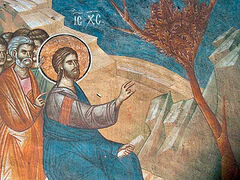
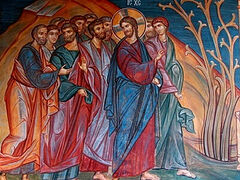
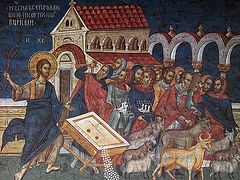
Now in the morning as he returned into the city, he hungered. And when he saw a fig tree in the way, he came to it, and found nothing thereon, but leaves only, and said unto it, Let no fruit grow on thee henceforward for ever. And presently the fig tree withered away. And when the disciples saw it, they marvelled, saying, How soon is the fig tree withered away! Jesus answered and said unto them, Verily I say unto you, If ye have faith, and doubt not, ye shall not only do this which is done to the fig tree, but also if ye shall say unto this mountain, Be thou removed, and be thou cast into the sea; it shall be done. And all things, whatsoever ye shall ask in prayer, believing, ye shall receive. (Mt. 21:18–22).

Let us bring forth fruits worthy of repentance to Christ
From the sticheron of the day
The days of Holy Week have from ancient times been dedicated by the Church each to a special commemoration, and each is called Great.
In the divine service of Great Monday the Holy Church invites the faithful to accompany Christ, to be crucified with Him, to die for Him to the pleasures of life, so that we may live with Him. In mystical contemplation, bringing together the events of the Old and New Testaments, it shows us the innocent sufferings of the Savior to come in the Old Testament type of the chaste Joseph, who was innocently sold and humiliated by the envy of his brothers, but later restored by God. “Joseph,” says the Synaxarion, “is a type of Christ, because Christ also becomes an object of envy for His fellow tribesmen, the Jews; he is sold by a disciple for thirty pieces of silver, is placed in a dark and narrow pit—the tomb—and, rising from it by His own power, reigns over Egypt—that is, over every sin—and utterly conquers it. He rules over the whole world, mercifully redeems us by the gift of mysterious wheat and feeds us with heavenly bread—His life-giving Flesh.”
From the Gospel events the Holy Church commemorates the withering of the barren fig tree. The withered fig tree, according to the Gospel, was for the apostles a significant sermon on the power of faith and prayer, without which man is spiritually dead before God. In the understanding of the Holy Church, the barren fig tree depicts the assembly of the Jewish people, in which Jesus Christ found no true fruit, but only the hypocritical shadow of the law, which He rebuked and cursed; but this fig tree also depicts every soul that does not bring forth the fruit of repentance. Besides the narration of the withering of the fig tree, the morning Gospel edifies us with the parable spoken by the Savior on this very day about the unrighteous vinedressers, who first killed the servants of their lord sent for the grapes, and then the son of the lord himself. In this parable one cannot but see the terrible condemnation of Christians who boldly violate the apostolic and patristic commandments, and thereby continue to crucify the Son of God by their transgressions. In the Gospel reading at the Liturgy, the Holy Church reminds us of the fate of the apostate Jewish people and the end of the world, as they were prefigured by Jesus Christ. By the depiction of various and great calamities and signs of the destruction of Jerusalem and the end of the age, the faithful are exhorted to have, amid evils, magnanimity, detachment, patience, prayer, and spiritual vigilance, and are consoled by the Savior’s promise of the spread of the Gospel throughout the world and the cessation of afflictions “for the sake of the elect.”
Law of God (Sretensky Monastery edition)
HYMNS FROM THE SERVICE OF GREAT MONDAY
Behold the Bridegroom cometh in the middle of the night, and blessed is the servant whom He shall find watching, but unworthy is the servant whom He shall find heedless. Beware, therefore, O my soul, do not be weighed down with sleep, lest you be given over to death and be shut out of the Kingdom. But rouse thyself and cry aloud: Holy, Holy, Holy, art Thou, O our God! Through the Theotokos have mercy on us!
Troparion, tone 8
I see thy bridal chamber adorned, O my Saviour, and I have no wedding garment that I may enter there. , Make the robe of my soul to shine, O Giver of Light, and save me.
Exapostilarion after the 9th Ode of the Canon
O brethren, let us fear the punishment of the fig tree, withered because it was unfruitful; and let us bring worthy fruits of repentance unto Christ, who grants us His great mercy.
Sticheron at the Aposticha, tone 8
On Holy Week
We are entering today into difficult days, into the days when we remember the Passion of Christ, into the days when it will not be easy for us to come to the temple to endure the long services, to pray. Many will ask themselves the question: is it worth going when the body is so tired, when thoughts are scattered, when there is no inner concentration and real participation in what is happening?
Then remember what was happening in the days of the Passion of Christ—how many people there were, both good and terrible, who would have given much to escape from the horror and exhaustion of those days. Those who were close to Christ—how their hearts were torn, how their last physical and spiritual strength was exhausted during these few terrible days... And how hundreds of people probably wanted to escape from this week, to be free from what was happening: from anger, from fear, from horror...
But life did not let anyone escape these events; the Most Pure Virgin Theotokos could not depart from the Passion of the Lord; the disciples of Christ could not hide from their horror, even in those moments when fear prevailed and they tried to hide from the people’s wrath. Neither could Nicodemus, Joseph of Arimathea, the secret disciples of Christ, or the faithful myrrh-bearing women go anywhere, or forget what was happening… There was nowhere to go, because horror dwelt in their hearts, because horror gripped them from without and from within. And there was nowhere to go for those who with hatred, stubbornly and maliciously, sought the murder of Christ.
And so, when you remember this—will you not find a place for yourself in the temple during these days of the Passion? Their thoughts were confused, their hearts grew cold, and their strength was exhausted; but they lived this event. And what will happen in these days is not a dead remembrance of something that once passed; it is an event that stands at the heart of our days, upon which the life of our world and our own life are founded. Therefore, whatever you may be experiencing, however little you—we—may be experiencing it, let us go to these services and immerse ourselves in what they bring to us. Let us not try to force any feelings out of ourselves—it is enough to look; it is enough to listen; and let the events themselves—because they are events and not remembrances—break us in body and soul. And then, when not remembering ourselves but thinking about Christ, about what is really happening in these days, we reach that Great Saturday when Christ rested in the tomb—peace will come upon us also. And when at night we hear the news of the Resurrection, then we too will suddenly come to life from this terrible numbness, from this terrible death of Christ, the dying of Christ, in which we will have partaken at least a little during the days of the Passion. Amen.
Metropolitan Anthony of Sourozh
From: Readings For Every Day of Great Lent, Ed. N. Shaposhnikova (Moscow: Danilov Monastery, 2025).