In the name of the Father, and of the Son, and of the Holy Spirit!
Dear brothers and sisters, today is Holy and Great Thursday, a special day of the year when the Holy Orthodox Church commemorates the institution of its most important sacrament—the Holy Eucharist. The Savior spent Holy Wednesday in solitude, and the day came on which the Passover lamb was to be slaughtered. The law designated the fourteenth day of the month of Nisan—that is, “between the two evenings”, or around twilight—for slaughtering the Passover lamb. But the scribes and legalists argued about the meaning of this expression. According to one version, we should understand it in the sense of the period between sunset and dusk; according to another version—in the sense of the interval between the afternoon sun’s decline and the actual sunset. The latter seems to be more correct: the Passover supper would take place at the time of a standard evening meal.
The whole day would be noisy and hectic in Jerusalem, because not only the locals, but also all arriving pilgrims were busy buying, slaughtering, and cooking the lamb. Early in the morning, Christ’s disciples asked their Teacher where He would like to eat the Passover meal. The Savior ordered the Apostles Peter and John to go to Jerusalem and told them that on entering the city they would meet a servant with a pitcher of water (it was an unusual sight, since water was normally carried by Jewish women, while a man never touched a pitcher). He added that they were to follow him, and they would arrive at a specific house, where they should inform the owner about the Teacher’s intention to have the Passover meal with His disciples in this house. Its owner, possibly St. Joseph of Arimathea, immediately provided them with a prepared and furnished upper room with tables set. There they found everything, as the Lord had told them.
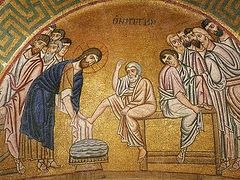
When Christ and the other disciples arrived at this house, the supper was ready. The custom of eating the Passover meal standing upright had already been forgotten. Reclining at the table was considered the most comfortable posture, so each guest would recline on a cushioned couch, leaning on his left elbow with the right hand free for eating. In the East, part of the floor of every house was covered with carpets, and on entering the room everyone took off his shoes—all the disciples did so as well. The Lord got up from the table, took off His outer clothing, took a vessel of water and a towel, and silently started washing the disciples’ feet. Their embarrassment plunged them into deep silence until it was St. Peter’s turn. His agitation was expressed in an astonished and protesting question: Lord, dost Thou wash my feet?... Thou shalt never wash my feet. Jesus answered him, If I wash thee not, thou hast no part with Me. Simon Peter saith unto Him, Lord, not my feet only, but also my hands and my head (Jn. 13:6–9). After washing, the disciples took their places at the supper, with St. John next to the Teacher and Judas Iscariot apparently reclining on the other side.
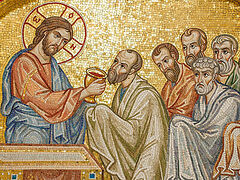
When the supper began, the Savior started explaining to the disciples the meaning of His action as a lesson on the humility with which they should treat each other. Then Christ openly announced: Verily I say unto you, that one of you shall betray Me. And they were exceeding sorrowful, and began every one of them to say unto Him, Lord, is it I?... Then Judas, which betrayed Him, answered and said, Master, is it I? He said unto him, Thou hast said (Mt. 26:21, 22, 25). but this answer remained unnoticed by the disciples. Peter asked the Teacher through John, His beloved disciple, who exactly would betray Him. Jesus answered, He it is, to whom I shall give a sop, when I have dipped it. And when He had dipped the sop, He gave it to Judas... Then said Jesus unto him, That thou doest, do quickly. Now no man at the table knew for what intent He spake this unto him. For some of them thought, because Judas had the bag, that Jesus had said unto him, Buy those things that we have need of against the feast; or, that he should give something to the poor. He then having received the sop went immediately out: and it was night (Jn. 13:26–30).
 The Betrayal of Judas. A fresco fragment of the Vatopedi Monastery on Mt. Athos
Then, with a lighter heart, Christ exclaimed, Now is the Son of Man glorified, and God is glorified in Him (Jn. 13:31). The hour of His glorification did come, but it had to be achieved through profound humiliation and torment. At the same time, Christ gave the new commandment to His disciples, and in fulfilling it they would form a community that was different from others—loving one another. Next, the Lord told the disciples about the upcoming horrors, explicitly predicting to them everything that would happen that night, and that they would temporarily desert Him. But He would meet them in Galilee after His Resurrection. I am the way, the truth, and the life: no man cometh unto the Father, but by Me. If ye had known Me, ye should have known My Father also (Jn. 14:6, 7).
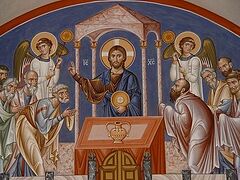
But the most important event during the Last Supper was the institution by Christ of the sacrament of the Eucharist as a grace-filling means of uniting the faithful with God. The Savior left the sacrament of Holy Communion to the disciples as a source of consolation. During the Last Supper, Jesus took bread, and blessed it, and brake it, and gave it to the disciples, and said, Take, eat; this is My Body. And He took the cup, and gave thanks, and gave it to them, saying, Drink ye all of it; For this is My Blood of the New Testament, which is shed for many for the remission of sins (Mt. 26:26-28). He commanded them always to perform this sacrament in His memory—which the Orthodox Church has been doing for 2,000 years.
After the supper and the farewell conversation, Christ said to the disciples, Arise, let us go hence (Jn. 14:31), and they arose, ad together with the Teacher, sang one of King David’s psalms. After singing, He once again addressed His disciples with words of edification and consolation. He spoke to them about the need for love and very close unity amongst them. And this love must have its source in Him, since He is the True Vine: As the branch cannot bear fruit of itself, except it abide in the vine; no more can ye, except ye abide in Me (Jn. 15:4).

Holy and Great Thursday is the key day of Holy Week and the last day before the Savior’s arrest. The events in the city and in the Temple shook the faith not only of the people surrounding Christ, but also of some of His disciples, who had expected the Savior to establish His Kingdom on earth, including through armed struggle. But the Savior insisted that His Kingdom was not of this world. It is only in communion with Him that we will attain salvation, and for this alone He came to earth—not to make us happy or rich. He came to open the door to salvation for us. And the primary means for this is the sacrament of His Body and Blood, the sacrament of the Holy Eucharist, which we solemnly celebrate on this day—Holy and Great Thursday. I greet you with all my heart on this feast! Amen.